What Lies Ahead for Network Tokenisation as Global Adoption Shows an Upward Trend?

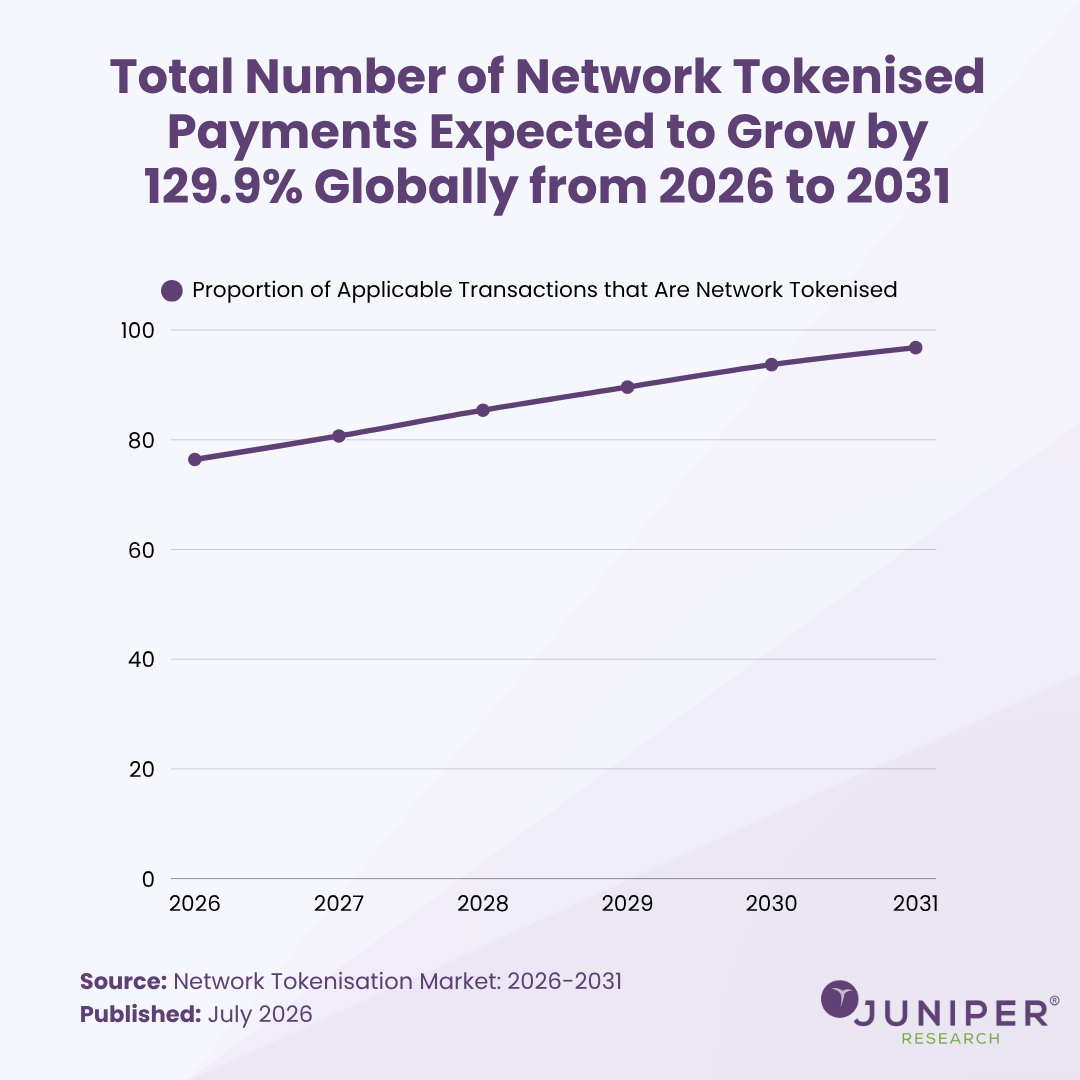
Network tokenisation continues to grow as the market moves from early adoption to broad operational necessity. Our latest research indicates global penetration rises from 76.4% in 2026 to 96.8% by 2031; suggesting that the technology is becoming close to standard infrastructure, rather than a niche enhancement. This trajectory is consistent with wider industry adoption drivers such as better authorisation rates, lower fraud, reduced churn in recurring payments and improved checkout conversion; all of which make network tokenisation commercially hard to ignore.
What’s Driving Adoption?
The Visa and Mastercard 2030 mandates create a strong gravitational pull towards network token adoption across the payments’ ecosystem. In practical terms, they encourage issuers, acquirers, PSPs and merchants to support tokenised credentials at scale, which pushes the market from optional adoption to expected capability. This will accelerate investment, product roadmaps, and integration work well beyond the card schemes themselves, because vendors that are not ready, risk being left behind as token-enabled acceptance becomes the norm.
The effect is global, not just scheme-specific, as the mandates influence markets that may not be directly governed by Visa or Mastercard rules, but still depend on their reach for cross-border commerce, digital wallets and recurring card payments. Even where domestic schemes dominate locally, international merchants and PSPs will increasingly require token support to preserve conversion and continuity across geographies. As a result, the 2030 mandates are likely to set a de facto standard that shapes the behaviour of payment providers in Europe, APAC, Latin America and other regions with strong card-not-present growth.
Broader Ramifications for Providers
For providers, network tokenisation has strategic implications that extend well beyond fraud reduction, as it is becoming a core enabler of higher authorisation rates, lower churn in recurring payments, and improved checkout performance across digital commerce. Providers that position tokenisation as a standalone security layer risk competing on a narrow feature set, whereas those that embed it into broader value-added services, such as lifecycle management, orchestration, retries, reporting and scheme optimisation, can create stronger merchant stickiness and more defensible revenue. It also raises the bar on partnerships, as providers need to align with global card schemes, domestic schemes, and wallet ecosystems to stay relevant across regions.
The Bigger Picture
The broader takeaway is that network tokenisation is no longer just following payments growth; it is increasingly helping shape it. The significant forecast rise suggests a market approaching saturation in the best sense - adoption becomes so widespread that tokenisation is simply part of how digital payments work. Vendors that want to capitalise should therefore move quickly on local scheme partnerships, recurring-payment optimisation, merchant performance dashboards, and market-specific propositions that turn compliance pressure into commercial advantage.
Source: Network Tokenisation Market: 2026-2031
Read the Press Release: Network Tokenisation to Secure 2.4 Trillion Global Transactions Between 2026 and 2030 – Representing 86% of Applicable Transactions
Download the Whitepaper: The Top Three Drivers of Network Tokenisation Adoption
Latest research, whitepapers & press releases
-
 ReportOctober 2026Fintech & Payments
 Jawad JahanCrypto-gaming Market: 2026-2035
Our Crypto-gaming Market research suite provides an insightful analysis of this rapidly growing market; enabling stakeholders - from crypto-gaming and sportsbooks operators, prediction market platforms, business-to-business (B2B) gambling platforms and software providers, to crypto payment processors and regulators - to understand future growth, key trends, and the competitive environment.
VIEW -
 ReportOctober 2026Telecoms & Connectivity
 Alex WebbRetail Roaming Market: 2026-2031
Our Retail Roaming research suite for mobile network operators (MNOs) and mobile virtual network operators (MVNOs) provides detailed analysis and strategic recommendations for the next era of retail roaming.
VIEW -
 ReportSeptember 2026Fintech & Payments
 Dr Manju ChhillarEmbedded Finance Market: 2026-2031
Embedded finance is one of the fastest-growing markets in financial services, and is about to accelerate even further. Our Embedded Finance Market research provides detailed analysis of the key drivers behind this growth, and what these mean for stakeholders in this market.
VIEW -
 ReportSeptember 2026IoT & Emerging Technology
 Thomas WilsonApplication Security Market: 2026-2031
Our Application Security research suite provides detailed analysis of this emerging market; allowing application security providers to gain an understanding of key security trends and challenges, potential growth opportunities, and the competitive environment.
VIEW -
 ReportSeptember 2026Fintech & Payments
 Shane O'SullivanBanking Fraud Prevention Market: 2026-2031
Our Banking Fraud Prevention research suite provides a comprehensive and in-depth analysis of the types of fraud currently impacting the banking sector, and the evolving methods that can be used to overcome them.
VIEW -
 ReportSeptember 2026Telecoms & Connectivity
 Nick MaynardPrivate LTE & 5G Networks Market: 2026-2031
Our Private LTE & 5G Networks research suite provides detailed and insightful analysis of this evolving market; enabling stakeholders - from private LTE & 5G network platform specialists, mobile network operators, and diversified technology companies - to understand future growth, key trends, and the competitive environment.
VIEW


-
 WhitepaperOctober 2026Telecoms & Connectivity
Alex Webb
WhitepaperOctober 2026Telecoms & Connectivity
Alex WebbReimagining the Future of Retail Roaming – How Mobile Network Operators Must Adapt
Our complimentary whitepaper, Reimagining the Future of Retail Roaming – How Mobile Network Operators Must Adapt, explores the emerging opportunities for MNOs within retail roaming.
VIEW -
 WhitepaperSeptember 2026Fintech & Payments
Dr Manju Chhillar
WhitepaperSeptember 2026Fintech & Payments
Dr Manju ChhillarEmerging Markets: The Next Opportunity for Embedded Finance
This free whitepaper examines how a combination of multiple factors is driving North America towards saturation for embedded finance.
VIEW -
 WhitepaperSeptember 2026IoT & Emerging Technology
Thomas Wilson
WhitepaperSeptember 2026IoT & Emerging Technology
Thomas WilsonVibe Coding: The Fastest-growing Threat to Application Security Today
Our complimentary whitepaper, Vibe Coding: The Fastest-growing Threat to Application Security Today, examines the state of the application security market; considering its impact on different verticals, and how it is being employed in these verticals to best combat malicious attackers and keep sensitive data safe.
VIEW -
 WhitepaperSeptember 2026Fintech & Payments
Shane O'Sullivan
WhitepaperSeptember 2026Fintech & Payments
Shane O'SullivanThe Fraud Frontier: Securing Banking in an AI-driven Era
Our complimentary whitepaper, The Fraud Frontier: Securing Banking in an AI-driven Era, examines the rapidly evolving state of the banking fraud prevention market.
VIEW -
 WhitepaperSeptember 2026Telecoms & Connectivity
Nick Maynard
WhitepaperSeptember 2026Telecoms & Connectivity
Nick MaynardHow Private Cellular Networks Are Unlocking Industry 4.0
Our complimentary whitepaper, How Private Cellular Networks Are Unlocking Industry 4.0, examines how private LTE & 5G networks are reshaping the way industry works.
VIEW -
 WhitepaperSeptember 2026Fintech & Payments
 Michael Greenwood
How Omnichannel Payment Platforms Are Streamlining Merchant Operations
Our complimentary whitepaper, How Omnichannel Payment Platforms Are Streamlining Merchant Operations, examines how merchants are utilising omnichannel payment platforms to capitalise on customer data and integration with other business management software in order to minimise inefficiency.
VIEW


-
Retail Roaming Revenue to Fall $4 Billion By 2031, as Regulatory Restrictions and Competition Bite
October 2026 -
Fintech & Payments
Soft POS to Surpass 100 Million Installations in 2030
September 2026 -
Fintech & Payments
The NextGen Payments & RegTech Forum Arrives in Dubai
September 2026 -
Fintech & Payments
The Global Trade Finance Expo Arrives in Dubai, UAE
September 2026 -
Fintech & Payments
The Vision Forex Forum Arrives in Dubai, UAE
September 2026 -
Fintech & Payments
Embedded Finance Revenue to Reach $617 Billion Globally by 2031, as B2B Revenue Surges 390%
September 2026