What It Takes to Lead in Modern Card Issuing: A Conversation with i2c

In our latest Modern Card Issuing Platforms research, we crowned i2c as an Established Leader in this space; on the strength of its unified, highly configurable global platform; its depth of issuing and processing capabilities across credit, debit, and prepaid; and its proven ability to support large-scale, complex deployments without compromising reliability or control.
To mark this recognition, we sat down with Amir Wain, Founder & CEO of i2c, to explore the thinking behind the platform, the challenges facing modern issuers, and how i2c is helping financial institutions and fintechs scale innovation without trade-offs.
 |
i2c is a leading global financial technology provider; enabling financial institutions and fintechs to deliver next-generation banking and payments solutions. Since founding i2c in 2000, Wain has guided the company’s vision to create a flexible, secure, all-in-one platform that empowers clients to launch innovative financial products - ranging from credit, debit, and prepaid to core banking and money movement services - at unprecedented speed and scale. |
What makes i2c an Established Leader among modern card issuing platforms?
For decades, financial institutions have had to compromise - forced to choose between mature, dependable processing platforms that resist change, or modern, flexible platforms that falter under pressure and scale.
i2c was created to end that compromise; giving institutions the power to innovate and evolve without sacrificing stability and trust. That conviction shaped the creation of a single, unified platform engineered to operate globally across products and markets. Instead of layering third-party components or stitching together acquired platforms, we developed a unified foundation of configurable building blocks designed to evolve over time. Financial institutions can launch and expand their business on one consistent platform that continues to perform and adapt to increasing market, regulatory, and customer complexities and demands.
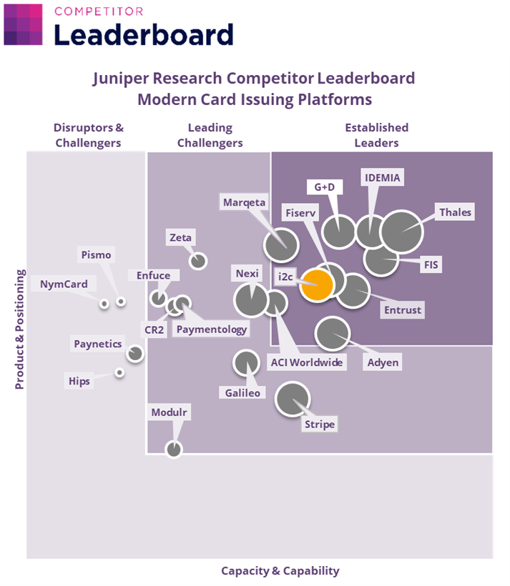
What matters most to financial institutions is trust in execution. They need confidence that issuing, risk, controls, and operations are designed to work together as one system. As a fully integrated platform, i2c empowers them to operate efficiently while maintaining reliability, security, and control at scale.
Equally important to them is control. From consumer and commercial credit to digital-first debit and flexible prepaid programmes, financial institutions can configure exactly what they need - when they need it - without overhauling their infrastructure. They can move at the pace of their customers, while maintaining the resilience required to operate and compete in an ever-evolving industry.
Striking that unique balance between innovation and trust has established i2c as a leader in the industry; enabling financial institutions and fintechs to grow their issuing strategies - without compromise.
What are some of the biggest challenges that your clients face, and how does i2c help solve them?
Financial institutions know how they want to serve their customers - but execution and scale stall when their infrastructure cannot keep up. Product-centric systems slow change, extend timelines, demand constant rework, and make even incremental updates painful. As a result, great ideas die before they reach customers.
The first hurdle is execution. i2c removes execution friction by putting financial institutions in control with self-service tools that let them configure, test, and iterate product development on their terms. The distance from idea to execution shrinks, and their teams move with greater speed and precision.
The next obstacle is scale. i2c’s all-in-one platform and customer-centric (not product-centric) architecture were designed to enable long-term growth across any product, programme, and market. That coordinated scale - where issuing, controls, and risk mitigation advance together - is what enables financial institutions to launch, refine, and grow card programmes without replatforming or creating operational strain as customer expectations, regulations, and market demands evolve in complexity.
With i2c, financial institutions can move at the speed of their ambitions; turning great ideas into scalable realities.
How is i2c aiding its clients in achieving sustainable card issuance strategies?
Sustainability starts with a platform that evolves seamlessly with our clients’ needs. Many institutions spread programmes across multiple systems, products, and regions - introducing complexity and constraining their ability to adapt quickly and cost-effectively to changing market conditions, customer expectations, and regulatory requirements.
Sustainability demands stability. i2c supports any product, segment, and market on a single global platform; creating a consistent and stable operating model across markets. This minimises the risk and technical debt that accumulates across multiple disparate environments by streamlining integration, development, maintenance, and reporting to a single point; reducing an institution’s total cost of ownership to innovate and grow their business without disruption.
Sustainability demands control. i2c’s building block technology enables financial institutions to configure and tailor card programmes and features to market and customer demands. Through self-service applications, they control creation and customisation of any financial use case without rebuilding their infrastructure or languishing in their processor’s development queue.
i2c uses sustainability as a strategic advantage; empowering financial institutions to build the issuing strategies that thrive today and remain resilient for whatever comes next.
What differentiates i2c’s next-generation platform from other processors in the market?
We built i2c to solve a problem that had gone unchallenged for decades: financial institutions were forced to compromise. They could choose reliability or flexibility, stability or speed, global reach or cohesive architecture - but never all at once, never in one platform.
Legacy processors reflected the era in which they were created. Their systems were stable but siloed - designed product by product, region by region. Over time, they expanded through acquisitions and bolt-on technologies; layering third-party systems to keep pace. The result was predictable: fragmentation that slowed innovation, made global expansion costly, and created operational drag just as customer expectations were accelerating.
Meanwhile, a new wave of modern processors offered agility and promise. Their composable, low-code frameworks made iteration faster, at least at the start. But they too relied on third parties for scale and coverage; creating the same patchwork of dependencies as the legacy providers they aimed to replace. Also, their lack of longevity made it difficult for institutions to place long-term trust in them - especially for mission-critical infrastructure where stability is not optional.
Twenty-five years ago, we refused to accept that these trade-offs were inevitable. We asked a simple but provocative question: why can’t financial institutions have both in a processing partner - uncompromising reliability and true flexibility - in one unified platform?
Then we built the answer.
From day one, i2c was architected as a global, integrated, issuer processing platform - customer-centric rather than product-centric; unified rather than stitched together. Instead of assembling a constellation of systems, we created configurable technology building blocks that could support any product, any market, any customer segment; all on a single platform.
That architectural choice changed everything. All products and geographies operate on the same underlying system. Financial institutions integrate once and gain access to a single API framework, a single interface, and a single data model – whether launching in one country or across continents, or offering one product or building an entire portfolio. This consistency gives institutions the ability to scale without reinventing their operating model each time they grow.
The impact is real. We’ve powered fully digital credit launches in Latin America where customers can apply, receive, and begin using a card within minutes. We’ve executed large-scale US migrations under extraordinary time pressure - moving hundreds of thousands of cards in days without service disruption - because issuing, risk, and servicing all operate as one system. Across Asia-Pacific and North America, institutions have launched digital-first prepaid, travel, and small business credit programmes in days rather than months using the same self-service tools, workflows, and global infrastructure. These aren’t isolated successes - they’re the natural outcome of a platform designed to scale seamlessly, consistently, and intelligently.
Ultimately, i2c occupies a truly unique position in the industry as the only nextgeneration processor; proving that legacy reliability and modern flexibility can coexist in one platform to deliver the repeatable model for growth and innovation that financial institutions need - without compromise.
How do you see the card issuing space evolving?
The most important shift is generational. Younger consumers expect digital-first, highly personalised experiences - immediacy, transparency, and control as a baseline.
That expectation is accelerating the move from branch-led scale to infrastructure-led scale. Yesterday, size and physical presence defined success. Today, the platform behind the product is the differentiator - how fast it adapts, how reliably it operates under greater complexity, and how intelligently it manages risk in real time.
As expectations rise, financial products will become more responsive and dynamically configurable. This opens the door for agentic capabilities: systems acting within defined controls to adjust parameters, manage risk, and support customer experiences without waiting for manual intervention.
The institutions that win will invest in flexible, scalable infrastructure - and pair it with intelligent, thoughtful operations. Platforms built for adaptability at their core, like i2c, will be best positioned to enable the next phase of growth and innovation in banking and payments.
Learn more about why i2c was named an Established Leader in modern card issuing, download the report today. You can also connect with Amir on LinkedIn.
Related Research
-
 ReportNovember 2025Modern Card Issuing
 Jawad JahanModern Card Issuing Platforms Market, 2025-2030
Our Modern Card Issuing Platforms Market research suite provides a detailed and insightful analysis of this evolving market; enabling stakeholders from banks, financial institutions, fintech companies, and technology vendors to understand future growth, key trends, and the competitive environment.
VIEW
Latest research, whitepapers & press releases
-
 ReportOctober 2026Fintech & Payments
 Jawad JahanCrypto-gaming Market: 2026-2035
Our Crypto-gaming Market research suite provides an insightful analysis of this rapidly growing market; enabling stakeholders - from crypto-gaming and sportsbooks operators, prediction market platforms, business-to-business (B2B) gambling platforms and software providers, to crypto payment processors and regulators - to understand future growth, key trends, and the competitive environment.
VIEW -
 ReportOctober 2026Telecoms & Connectivity
 Alex WebbRetail Roaming Market: 2026-2031
Our Retail Roaming research suite for mobile network operators (MNOs) and mobile virtual network operators (MVNOs) provides detailed analysis and strategic recommendations for the next era of retail roaming.
VIEW -
 ReportSeptember 2026Fintech & Payments
 Dr Manju ChhillarEmbedded Finance Market: 2026-2031
Embedded finance is one of the fastest-growing markets in financial services, and is about to accelerate even further. Our Embedded Finance Market research provides detailed analysis of the key drivers behind this growth, and what these mean for stakeholders in this market.
VIEW -
 ReportSeptember 2026IoT & Emerging Technology
 Thomas WilsonApplication Security Market: 2026-2031
Our Application Security research suite provides detailed analysis of this emerging market; allowing application security providers to gain an understanding of key security trends and challenges, potential growth opportunities, and the competitive environment.
VIEW -
 ReportSeptember 2026Fintech & Payments
 Shane O'SullivanBanking Fraud Prevention Market: 2026-2031
Our Banking Fraud Prevention research suite provides a comprehensive and in-depth analysis of the types of fraud currently impacting the banking sector, and the evolving methods that can be used to overcome them.
VIEW -
 ReportSeptember 2026Telecoms & Connectivity
 Nick MaynardPrivate LTE & 5G Networks Market: 2026-2031
Our Private LTE & 5G Networks research suite provides detailed and insightful analysis of this evolving market; enabling stakeholders - from private LTE & 5G network platform specialists, mobile network operators, and diversified technology companies - to understand future growth, key trends, and the competitive environment.
VIEW


-
 WhitepaperOctober 2026Telecoms & Connectivity
Alex Webb
WhitepaperOctober 2026Telecoms & Connectivity
Alex WebbReimagining the Future of Retail Roaming – How Mobile Network Operators Must Adapt
Our complimentary whitepaper, Reimagining the Future of Retail Roaming – How Mobile Network Operators Must Adapt, explores the emerging opportunities for MNOs within retail roaming.
VIEW -
 WhitepaperSeptember 2026Fintech & Payments
Dr Manju Chhillar
WhitepaperSeptember 2026Fintech & Payments
Dr Manju ChhillarEmerging Markets: The Next Opportunity for Embedded Finance
This free whitepaper examines how a combination of multiple factors is driving North America towards saturation for embedded finance.
VIEW -
 WhitepaperSeptember 2026IoT & Emerging Technology
Thomas Wilson
WhitepaperSeptember 2026IoT & Emerging Technology
Thomas WilsonVibe Coding: The Fastest-growing Threat to Application Security Today
Our complimentary whitepaper, Vibe Coding: The Fastest-growing Threat to Application Security Today, examines the state of the application security market; considering its impact on different verticals, and how it is being employed in these verticals to best combat malicious attackers and keep sensitive data safe.
VIEW -
 WhitepaperSeptember 2026Fintech & Payments
Shane O'Sullivan
WhitepaperSeptember 2026Fintech & Payments
Shane O'SullivanThe Fraud Frontier: Securing Banking in an AI-driven Era
Our complimentary whitepaper, The Fraud Frontier: Securing Banking in an AI-driven Era, examines the rapidly evolving state of the banking fraud prevention market.
VIEW -
 WhitepaperSeptember 2026Telecoms & Connectivity
Nick Maynard
WhitepaperSeptember 2026Telecoms & Connectivity
Nick MaynardHow Private Cellular Networks Are Unlocking Industry 4.0
Our complimentary whitepaper, How Private Cellular Networks Are Unlocking Industry 4.0, examines how private LTE & 5G networks are reshaping the way industry works.
VIEW -
 WhitepaperSeptember 2026Fintech & Payments
 Michael Greenwood
How Omnichannel Payment Platforms Are Streamlining Merchant Operations
Our complimentary whitepaper, How Omnichannel Payment Platforms Are Streamlining Merchant Operations, examines how merchants are utilising omnichannel payment platforms to capitalise on customer data and integration with other business management software in order to minimise inefficiency.
VIEW


-
Retail Roaming Revenue to Fall $4 Billion By 2031, as Regulatory Restrictions and Competition Bite
October 2026 -
Fintech & Payments
Soft POS to Surpass 100 Million Installations in 2030
September 2026 -
Fintech & Payments
The NextGen Payments & RegTech Forum Arrives in Dubai
September 2026 -
Fintech & Payments
The Global Trade Finance Expo Arrives in Dubai, UAE
September 2026 -
Fintech & Payments
The Vision Forex Forum Arrives in Dubai, UAE
September 2026 -
Fintech & Payments
Embedded Finance Revenue to Reach $617 Billion Globally by 2031, as B2B Revenue Surges 390%
September 2026