What Factors Are Driving Mobile Financial Services in 2024?

The current situation for telcos is a tricky one – they face a market where traditional revenue is declining, and the market is uncertain. As such, any market that can generate additional revenue streams for operators is vital. Therefore, the MFS (Mobile Financial Services) market is one of central importance, which can drive new growth for operators.
However, mobile money is a complex market, with many different trends, and it can be difficult to unpack the key factors to watch and for operators to prioritise for growth. To assist in this task, Ericsson and Juniper Research conducted a study, called "What Will Drive Mobile Financial Services Growth?", which surveyed decision makers responsible for MFS at MNOs across 4 key regions. The survey included 46 respondents from 46 MNOs in 35 countries, all from MNOs that offer MFS presently.
The results from this survey highlight the top 10 findings from the market as to what will drive growth in future. These are:
- 40% of Mobile Network Operator User Bases Will Be Actively Using Mobile Financial Services in the Next 5 Years
- 80% Growth in Mobile Financial Services Transaction Value Anticipated Over the Next 5 Years
- Customer Incentives, Extensive Last-mile Networks and COVID-19 Digital Payments Surge Lead Top
- 10 Factors That Have Accelerated Mobile Financial Services Success
- Advanced Services to Drive Mobile Financial Services Growth Over the Next 5 Years
- QR Code, AI/ML and NFC Lead List of Technologies That Will Have Most Impact on Mobile Financial Services Over the Next 5 Years
- Mobile Network Operators Are Focused on Extending Payments and International Remittances via Partnerships with Merchants and Money Transfer Operators
- Regulations and Taxation, Enduring Preferences for Cash and Security Concerns Are Key Challenges Inhibiting MFS Growth
- Service Portfolios Are Evolving Rapidly, with Banking Tech and Value-added Services Taking the Lead
- Mobile Financial Services Critical for Enabling Revenue Growth and Diversification for Mobile Network Operators
- Enabling SDGs, Access to Formal Financial Services and Financial Inclusion Are the Biggest Social Benefits of Mobile Financial Services
For this blog, we will examine two of these findings - and for analysis of the others, download the full report today!
Advanced Services to Drive Mobile Financial Services Growth Over the Next 5 Years
Ultimately, in order to maximise their future chances, MNOs must understand what factors will drive MFS growth, and where to focus their limited resources. Operators stand at a crossroads in many markets, with competition from fintechs and banks, as well as social media financial services becoming paramount.
We asked operators which top factors will drive their growth over the next five years, and the answer we got could not have been clearer – MNOs expect advanced services to drive their growth over the next 5 years.
MFS providers currently earn the majority of their revenue from fees on conventional services such as P2P transfers, cash withdrawals and utility payments, as well as earning interest on the float balances they hold.
However, this established situation is changing over time, with this traditional revenue being challenged by the market entry of new start-ups with competitive pricing. Therefore, in order to differentiate themselves, MFS providers must increasingly focus on advanced services like sophisticated micro-finance services, loans, overdrafts, BNPL, investments, merchant payments, bulk payments, etc. By doing this, MFS providers can begin to transition their own large user bases to these more advanced services; driving additional revenue streams, offsetting the potential loss of business to new competitors, and reducing user churn.
Ultimately, MFS providers are anticipating a great deal of change. How they cope with these changes, and prepare for the future market will determine their success going forward.
The priorities for vendors are clear – enhanced user experience, greater personalisation, offering a comprehensive service portfolio, convenience and ease of use, security & trust and driving growth. As such, these priorities will reshape the way MFS providers operate; shaking up their revenue models, product portfolios and user experiences. MFS providers must prepare for this disruption now, or they will be left behind by new fintech and technology company competitors.
Service Portfolios Are Evolving Rapidly, with Banking Tech and Value-added Services Taking the Lead
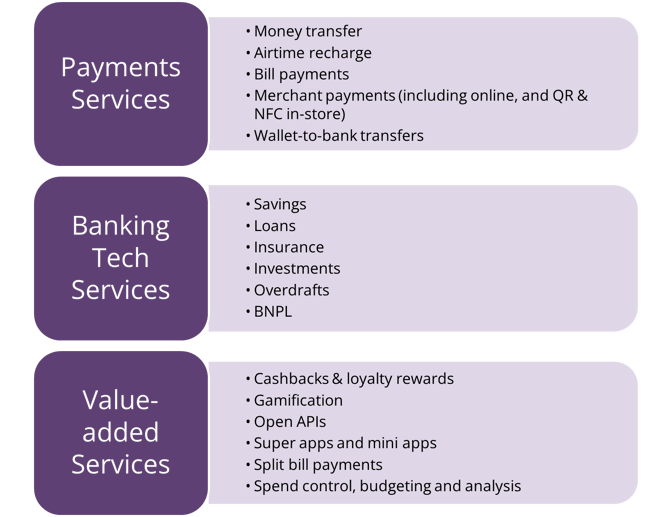
The MFS market is highly varied, with MNOs taking different approaches based on which markets they individually operate within. When looking at which services MFS providers offer, there are a multitude of ways in which services are provided. As such, we asked our respondents which services they presently offer, which ones they expect to expand in future, and which ones they do not intend to pursue. Their answers are revealing about the overall nature of the market, and reflect the different priorities MNOs have for MFS growth.
i. Payments Services
All our surveyed operators offer basic payments services, which include money transfer, airtime recharge, bill payments, merchant payments and wallet-to-bank transfers.
Within the merchant payment category, the overwhelming majority of operators (90%) are offering in-store, online and QR code-based merchant payments.
NFC-based payments or companion payments cards are still relatively niche offerings according to respondents, but there is an appetite to offer these services in the future, matching previous answers.
International remittances and bulk payments are offered by over 75% of respondents, with these services being restricted by regulations in some countries. However, most operators want to offer and expand these services as they have high revenue potential, compared to more basic services.
Within bulk payments, MFS providers want to partner with enterprises for salary disbursement or governments and NGOs for financial-aid disbursement, and earn revenue, thereby reducing dependence on P2P transfers as a revenue source.
ii. Banking Tech Services
The survey found that 60% or less of surveyed operators offer advanced or banking tech services including savings, loans, insurance, investments, overdrafts and BNPL, showing that there is progress to be made here.
However, the majority of respondents who do not offer these more advanced services were highly interested in offering these services in the near future or are already working on expanding their services to feature a number of advanced services, such as loans, overdrafts, BNPL, savings, insurance, pension schemes, share trading, crypto-payments and investments.
In the Americas, all surveyed operators indicated they either offered or wanted to offer access to cryptocurrency; reflecting strong interest in these services in that market. Within Africa, there was strong enthusiasm for offering insurance services, reflecting the well-established market for micro-insurance in the region.
iii. Value-added Services
Beyond payments, operators are also strengthening the value-added services they offer to enable them to deliver an engaging and holistic experience to users.
Cashbacks and loyalty were both offered by over 60% of respondents presently, with the remainder largely interested in rolling out these services in the future.
Services like gamification, Open APIs, super apps and mini apps, split bill payments, spend control, budgeting and analysis in comparison are not presently offered by many respondents, but these respondents were keen to offer them in the future; showing the appetite for value-added services.
In Africa, over 90% of respondents wanted to offer super apps in future, showing the importance of this to MFS strategies over the next five years, as the African market becomes more advanced. In the Middle East, 100% of respondents wanted to offer a super app within the next five years, while in Asia Pacific, over 90% of respondents either wanted to offer a super app, or already did, showing the importance of this.
iv. Emerging Services
Within the more future-looking area of services, CBDCs or blockchain-based payments, IoT payments and augmented reality-based payments typically are not offered by the surveyed respondents, but many of the respondents do want to explore the potential of offering these services over a longer time frame. This reflects the early stage of development of these technologies, but again means that MFS providers must leverage platforms that boast ambitious roadmaps that have the potential to lead future innovation.
In analysing these services, clear patterns emerge within the future of the market. Fundamentally, a large number of MFS providers offer the same basic services, but are looking to diversify into a variety of advanced and value-added services to differentiate themselves.
MFS providers want to explore new services, and will require support from their ecosystem in achieving business model innovations, and from platform providers in enabling new use cases.
Conclusion
From only examining these two key trends, it is clear that a large amount of change is coming to the MFS market. MNOs understand their priorities, and as such, they need to choose technology platforms and vendors that enable them to reach their next phases of growth. If they get this choice right, they will be well set to capitalise on future market opportunities.
For further details on the study, download your copy of "What Will Drive Mobile Financial Services Growth?" today!
Want even more insight? Join Juniper Research and Ericsson on 3rd April for an exciting webinar that'll shine a light on the key report findings - and how your business can benefit. Register your spot today!
Latest research, whitepapers & press releases
-
 ReportSeptember 2026IoT & Emerging Technology
 Thomas WilsonApplication Security Market: 2026-2031
Our Application Security research suite provides detailed analysis of this emerging market; allowing application security providers to gain an understanding of key security trends and challenges, potential growth opportunities, and the competitive environment.
VIEW -
 ReportSeptember 2026Fintech & Payments
 Shane O'SullivanBanking Fraud Prevention Market: 2026-2031
Our Banking Fraud Prevention research suite provides a comprehensive and in-depth analysis of the types of fraud currently impacting the banking sector, and the evolving methods that can be used to overcome them.
VIEW -
 ReportSeptember 2026Telecoms & Connectivity
 Nick MaynardPrivate LTE & 5G Networks Market: 2026-2031
Our Private LTE & 5G Networks research suite provides detailed and insightful analysis of this evolving market; enabling stakeholders - from private LTE & 5G network platform specialists, mobile network operators, and diversified technology companies - to understand future growth, key trends, and the competitive environment.
VIEW -
 ReportSeptember 2026Fintech & Payments
 Michael GreenwoodOmnichannel Payment Platform Market: 2026-2031
Our Omnichannel Payment Platform research provides detailed analysis of this rapidly emerging market; allowing omnichannel payment platform providers to gain an understanding of key payment trends and challenges, potential growth opportunities, and the competitive environment.
VIEW -
 ReportSeptember 2026IoT & Emerging Technology
Nick MaynardIdentity & Access Management Market: 2026-2031
ReportSeptember 2026IoT & Emerging Technology
Nick MaynardIdentity & Access Management Market: 2026-2031Our Identity & Access Management research suite provides detailed and insightful analysis of this evolving market; enabling stakeholders - from Identity & Access Management platform specialists, cybersecurity vendors, and diversified technology companies - to understand future growth, key trends, and the competitive environment.
VIEW -
 ReportAugust 2026Fintech & Payments
Nick MaynardContactless Payments Market Data: 2026-2031
ReportAugust 2026Fintech & Payments
Nick MaynardContactless Payments Market Data: 2026-2031Our Contactless Payments market analysis provides exhaustive data coverage of the market in its entirety, including the adoption of mobile wallets featuring contactless payment technology, the growth of contactless transactions, and the market’s associated values.
VIEW


-
 WhitepaperSeptember 2026IoT & Emerging Technology
Thomas Wilson
WhitepaperSeptember 2026IoT & Emerging Technology
Thomas WilsonVibe Coding: The Fastest-growing Threat to Application Security Today
Our complimentary whitepaper, Vibe Coding: The Fastest-growing Threat to Application Security Today, examines the state of the application security market; considering its impact on different verticals, and how it is being employed in these verticals to best combat malicious attackers and keep sensitive data safe.
VIEW -
 WhitepaperSeptember 2026Fintech & Payments
Shane O'Sullivan
WhitepaperSeptember 2026Fintech & Payments
Shane O'SullivanThe Fraud Frontier: Securing Banking in an AI-driven Era
Our complimentary whitepaper, The Fraud Frontier: Securing Banking in an AI-driven Era, examines the rapidly evolving state of the banking fraud prevention market.
VIEW -
 WhitepaperSeptember 2026Telecoms & Connectivity
Nick Maynard
WhitepaperSeptember 2026Telecoms & Connectivity
Nick MaynardHow Private Cellular Networks Are Unlocking Industry 4.0
Our complimentary whitepaper, How Private Cellular Networks Are Unlocking Industry 4.0, examines how private LTE & 5G networks are reshaping the way industry works.
VIEW -
 WhitepaperSeptember 2026Fintech & Payments
Michael Greenwood
WhitepaperSeptember 2026Fintech & Payments
Michael GreenwoodHow Omnichannel Payment Platforms Are Streamlining Merchant Operations
Our complimentary whitepaper, How Omnichannel Payment Platforms Are Streamlining Merchant Operations, examines how merchants are utilising omnichannel payment platforms to capitalise on customer data and integration with other business management software in order to minimise inefficiency.
VIEW -
 WhitepaperSeptember 2026Telecoms & Connectivity
 Jawad Jahan
Beyond the Headlines: What the 'AI Bubble' Really Means
Our complimentary whitepaper, Beyond the Headlines – What the 'AI Bubble' Really Means, analyses the scale and structure of AI infrastructure investment in the West, and the channels through which it could transmit stress to the wider financial system.
VIEW -
 WhitepaperSeptember 2026IoT & Emerging Technology
Nick Maynard
WhitepaperSeptember 2026IoT & Emerging Technology
Nick MaynardNon-human Identities ~ Transforming Identity & Access Management
Our complimentary whitepaper, Non-human Identities ~ Transforming Identity & Access Management, examines how non-human identities are revolutionising the Identity & Access Management market.
VIEW


-
IoT & Emerging Technology
AppSec Enterprise Spend to Approach $13 Billion Globally by 2031, as Market Leaders Revealed in New Competitor Leaderboard
September 2026 -
Banking Fraud to Reach 2.2 billion Transactions by 2031, Fuelled by Growing AI-enabled Attacks
September 2026 -
Telecoms & Connectivity
Private Network Spend to Exceed $84 Billion Globally by 2031, as Market Leaders Set to Capitalise
September 2026 -
Fintech & Payments
The 6th Financial Innovation Forum – Payments & RegTech Arrives in London
September 2026 -
Fintech & Payments
Omnichannel Payment Platform Revenue to Exceed $100 Billion Globally by 2031, as Leading Platforms Set to Capitalise Are Revealed
September 2026 -
Telecoms & Connectivity
Calling the Game-changers in Telco: 2027 Future Digital Awards are Now Open for Entries
September 2026