Play to Pay ~ How Gamification is Revolutionising Digital Banking

Gamification has become a powerful tool for banks and fintechs, transforming customer engagement, boosting loyalty, and enhancing the overall banking experience.
With AI-driven insights, gamification goes beyond just rewards; it empowers customers to better understand and manage their finances, improving financial literacy. In an increasingly crowded digital banking landscape, where neobanks, traditional banks, and fintechs compete for customer attention, gamification offers a strategic edge. By integrating game mechanics into banking apps, financial institutions can create more engaging, rewarding, and interactive experiences that set them apart.
What Makes Gamification?
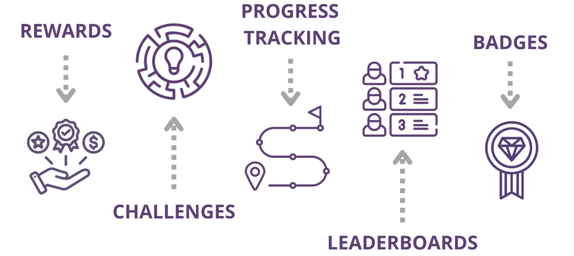
The game mechanics that are commonplace across examples of gamification include:
-
Rewards: Incentives such as cashback, discounts, or exclusive perks can encourage users to engage with financial services more regularly.
-
Challenges: Time-sensitive or goal-based tasks, such as spending a certain amount within a period or hitting a savings target, can keep users motivated and engaged.
-
Progress Tracking: Visual indicators like progress bars, spending milestones, or savings goals can provide users with a sense of accomplishment, reinforce positive financial habits, and encourage continued engagement.
-
Leaderboards: Ranking systems that display top-performing users based on specific criteria, such as savings streaks or transaction volume, foster friendly competition, and enhance user participation and engagement.
-
Badges: Digital achievements earned by completing specific financial actions, like setting up direct debits, using digital wallets, or reaching savings goals can serve as milestones, reinforcing continued usage.
Source: Juniper Research
Monobank, a neobank that was recently ranked #1 in our Fintech Future Leaders 100, presents one of the most elaborate examples of gamification in the market.
Monobank’s in-app experience is led by a playful cat mascot to create a fun and engaging experience. Its high-level of customisation allows users to personalise their achievement and rewards, further incentivising users to unlock more badges and features. Monobank offers up to 51 achievement badges for completing tasks like filling out their profile or using Apple Pay.
Revolut is another great example of gamification in practice. Revolut is one of the most disruptive challenger banks, which is set to further disrupt the digital banking landscape following its recent acquisition of a UK banking licence alongside its fast growth.
Revolut’s gamification strategy centres around its RevPoints system. Revolut uses a leaderboard to display users’ points and foster competition among users. Users can earn points by making transactions, inviting friends, or participating in challenges; points can be redeemed for rewards or used to enter raffles for cash prizes.
A different example is Aspiration. Aspiration is a ‘climate friendly’ consumer fintech platform founded in 2013. Aspiration offers consumers financial solutions that strive to help combat climate change, and enables users to join in collective action.
Aspiration offers consumers cashback and rewards when purchasing from eco-friendly merchants. Through its Green Marketplace, customers can gain up to 6% cash back on climate-friendly brands, including Patagonia, Thrive Market, Who Gives A Crap, Tesla Supercharger, Misfits Market, and Pact. Aspiration’s marketplace motivates users to make more environmentally conscious decisions.
Implementing Gamification
Simply rolling out a one-size-fits-all scheme is insufficient on its own; banks must deliberately develop and execute a well-crafted gamification strategy. This strategy should effectively incorporate game mechanics which thoughtfully address customers' psychological needs and preferences.
The most successful gamification strategies found across banking apps focus on increasing customer engagement, to motivate users to use the app. However, these tasks need to be proven to be stimulating and effectively release dopamine. This can be achieved by making sure rewards and prizes create satisfaction and monitoring whether this drives users’ continued engagement.
Points and progress bars can be used, to play on customers’ reluctance to lose progress and encourage continued effort towards the goal. Furthermore, banks should aim to make their gamification deeply immersive, with the aim of inducing a ‘flow state’ which can make financial management tasks more enjoyable and engaging.
Gamification can be utilised to enhance financial literacy, by making educational content more interactive. This includes quizzes and simulations - which can teach users how to budget, save, and invest in an engaging manner. Digital banks can leverage AI and data analytics to personalise gamification based on user behaviour and preferences. This tailored approach increases use, satisfaction, and encourages more active participation in financial management.
Future Trends in Banking Gamification
As seen with Aspiration, there is a growing trend towards incorporating sustainability into gamification strategies, which appeals to eco-conscious consumers and promotes an environmentally friendly lifestyle.
To build on this, AI is becoming increasingly common across gamification – being utilised to create personalised solutions tailored to customer-specific needs. The future of gamification is anticipated to scale up into mega financial platforms, integrating a wide range of financial services with gamified elements. This is driven by the need to create a comprehensive and engaging financial system, where banks will need to address key challenges such as sustaining engagement overtime. Successful gamification will balance fun and seriousness, whilst ensuring transparency and fairness across rewards and challenges.
In conclusion, for digital banks to successfully unlock the full power of gamification they require an elaborate strategy that not only leverages game mechanics but also deeply understands consumer psychology and needs.
By focusing on creating satisfying and immersive experiences, banks can effectively motivate users to manage finances more actively. The integration of gamification with educational content can be used as an effective tool to boost financial literacy, while AI-driven personalisation ensures a tailored experience, promoting user satisfaction.
Ultimately, the most successful gamification will be those that successfully deliver fun, learning, transparency and fairness, creating a holistic financial ecosystem that sustains engagement over time.
As a member of Juniper Research’s Fintech & Payments team, Dan analyses developments in financial and payments markets, and how these interplay with emerging technologies, such as blockchain and AI. His recent reports include QR Code Payments, Fintech Future Leaders 100, and KYC/KYB Systems.
Related Research
-
 ReportNovember 2024Fintech & Payments
 Daniel BedfordFuture Leaders 100, Fintech 2025
Our Future Leaders 100: Fintech 2025 research suite is dedicated to identifying the most innovative start-ups within fintech which have the disruptive potential to reshape the fintech landscape.
VIEW -
 ReportNovember 2025Digital Wallets
 Thomas WilsonDigital Wallets Market, 2025-2030
Our digital wallets research suite provides detailed analysis of this rapidly changing market; allowing digital wallet providers to gain an understanding of key payment trends and challenges, potential growth opportunities, and the competitive environment.
VIEW
Latest research, whitepapers & press releases
-
 ReportOctober 2026Fintech & Payments
 Jawad JahanCrypto-gaming Market: 2026-2035
Our Crypto-gaming Market research suite provides an insightful analysis of this rapidly growing market; enabling stakeholders - from crypto-gaming and sportsbooks operators, prediction market platforms, business-to-business (B2B) gambling platforms and software providers, to crypto payment processors and regulators - to understand future growth, key trends, and the competitive environment.
VIEW -
 ReportOctober 2026Telecoms & Connectivity
 Alex WebbRetail Roaming Market: 2026-2031
Our Retail Roaming research suite for mobile network operators (MNOs) and mobile virtual network operators (MVNOs) provides detailed analysis and strategic recommendations for the next era of retail roaming.
VIEW -
 ReportSeptember 2026Fintech & Payments
 Dr Manju ChhillarEmbedded Finance Market: 2026-2031
Embedded finance is one of the fastest-growing markets in financial services, and is about to accelerate even further. Our Embedded Finance Market research provides detailed analysis of the key drivers behind this growth, and what these mean for stakeholders in this market.
VIEW -
 ReportSeptember 2026Identity & Security
 Thomas WilsonApplication Security Market: 2026-2031
Our Application Security research suite provides detailed analysis of this emerging market; allowing application security providers to gain an understanding of key security trends and challenges, potential growth opportunities, and the competitive environment.
VIEW -
 ReportSeptember 2026Fintech & Payments
 Shane O'SullivanBanking Fraud Prevention Market: 2026-2031
Our Banking Fraud Prevention research suite provides a comprehensive and in-depth analysis of the types of fraud currently impacting the banking sector, and the evolving methods that can be used to overcome them.
VIEW -
 ReportSeptember 2026Telecoms & Connectivity
 Nick MaynardPrivate LTE & 5G Networks Market: 2026-2031
Our Private LTE & 5G Networks research suite provides detailed and insightful analysis of this evolving market; enabling stakeholders - from private LTE & 5G network platform specialists, mobile network operators, and diversified technology companies - to understand future growth, key trends, and the competitive environment.
VIEW


-
 WhitepaperOctober 2026Fintech & Payments
Jawad Jahan
WhitepaperOctober 2026Fintech & Payments
Jawad JahanCompliance or Anonymity - The Crypto-gaming Operator’s Dilemma
Our complimentary whitepaper, Compliance or Anonymity - The Crypto-gaming Operator’s Dilemma, analyses the current regulatory landscape of the crypto-gaming market.
VIEW -
 WhitepaperOctober 2026Telecoms & Connectivity
Alex Webb
WhitepaperOctober 2026Telecoms & Connectivity
Alex WebbReimagining the Future of Retail Roaming – How Mobile Network Operators Must Adapt
Our complimentary whitepaper, Reimagining the Future of Retail Roaming – How Mobile Network Operators Must Adapt, explores the emerging opportunities for MNOs within retail roaming.
VIEW -
 WhitepaperSeptember 2026Fintech & Payments
Dr Manju Chhillar
WhitepaperSeptember 2026Fintech & Payments
Dr Manju ChhillarEmerging Markets: The Next Opportunity for Embedded Finance
This free whitepaper examines how a combination of multiple factors is driving North America towards saturation for embedded finance.
VIEW -
 WhitepaperSeptember 2026Emerging Technology
Thomas Wilson
WhitepaperSeptember 2026Emerging Technology
Thomas WilsonVibe Coding: The Fastest-growing Threat to Application Security Today
Our complimentary whitepaper, Vibe Coding: The Fastest-growing Threat to Application Security Today, examines the state of the application security market; considering its impact on different verticals, and how it is being employed in these verticals to best combat malicious attackers and keep sensitive data safe.
VIEW -
 WhitepaperSeptember 2026Fintech & Payments
Shane O'Sullivan
WhitepaperSeptember 2026Fintech & Payments
Shane O'SullivanThe Fraud Frontier: Securing Banking in an AI-driven Era
Our complimentary whitepaper, The Fraud Frontier: Securing Banking in an AI-driven Era, examines the rapidly evolving state of the banking fraud prevention market.
VIEW -
 WhitepaperSeptember 2026Telecoms & Connectivity
Nick Maynard
WhitepaperSeptember 2026Telecoms & Connectivity
Nick MaynardHow Private Cellular Networks Are Unlocking Industry 4.0
Our complimentary whitepaper, How Private Cellular Networks Are Unlocking Industry 4.0, examines how private LTE & 5G networks are reshaping the way industry works.
VIEW


-
Fintech & Payments
Crypto Gaming: Wagers to Reach $1.3 Trillion by 2035, as Crypto Rails Widen Global Access Despite Regulatory Challenges
October 2026 -
Fintech & Payments
Juniper Research Unveils Identity & Security Award Winners for 2026
October 2026 -
Retail Roaming Revenue to Fall $4 Billion By 2031, as Regulatory Restrictions and Competition Bite
October 2026 -
Fintech & Payments
Soft POS to Surpass 100 Million Installations in 2030
September 2026 -
Fintech & Payments
The NextGen Payments & RegTech Forum Arrives in Dubai
September 2026 -
Fintech & Payments
The Global Trade Finance Expo Arrives in Dubai, UAE
September 2026