Why 6G Needs to Be Built for Enterprise, Not Consumers

The telecommunications industry is at a turning point. Operators are rolling out new strategies to unlock fresh revenue streams, but one thing is clear: boosting average revenue per user (ARPU) in the consumer market will be a challenge. Most mobile subscribers simply aren’t willing to pay more unless operators significantly invest in new, value-added services.
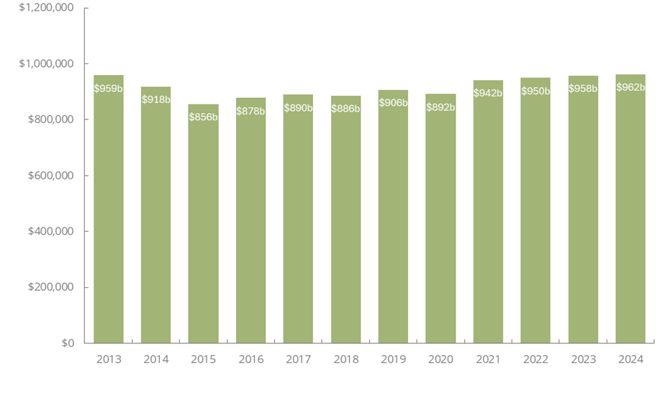
Tech giants like Amazon, Alphabet and Apple have capitalised on their agility to launch innovative services, often built on the backbone of Tier 1 operators’ infrastructure. Meanwhile, as the chart below shows, operator revenue growth has largely stagnated over the past decade. Even with heavy investment in technologies like 4G and 5G, ARPU hasn’t kept pace.
Global Operator-billed Revenue ($m), 2013–2024
Source: Juniper Research
Operators’ attempts to generate ROI from 5G have mostly fallen short - a situation they can’t afford to repeat with 6G. While consumer revenue is set to decline, Juniper Research sees far greater opportunity in the enterprise sector. We expect this to become a core focus in discussions around 6G and what it truly needs to deliver.
Shifting from Use Cases to Real Revenue
Operators, industry groups and standard-setters working on 6G must think beyond ‘marketable’ use cases and instead prioritise the industries that will actually generate revenue. During 5G’s development, much attention was given to headline-grabbing use cases like remote healthcare, augmented reality, and autonomous vehicles. But while they sounded good, they didn’t deliver on ROI.
Take AR, for example. While 5G could support mobile AR, uptake was limited by both hardware availability and a lack of willingness from users to pay extra for connectivity. The core issue? Consumers don’t want to pay more for mobile services. Even remote surgeries - a highly publicised 5G use case - generated little return for operators, despite the technology being in place.
Lessons for 6G Development
The big lesson from 5G is this: as networks become more advanced, operators must move beyond connectivity and offer consulting and managed services to boost the value of cellular adoption. There’s a large addressable market for 6G, but only if solutions are modular and not confined to a handful of niche use cases.
Future development shouldn’t revolve around faster speeds or lower latency. Many of the use cases pitched in the 5G era were theoretically improved by better performance, but in practice, 4G was often good enough and enterprises didn’t see the need to upgrade.
Instead, 6G needs to enable enterprise autonomy; letting businesses manage their own operations over 6G, whether through private networks or simple API integrations. To tap into future growth, operators must also focus on SMEs, who often lack the internal expertise to deploy cellular services. While individual spending may be lower, the volume opportunity is significant.
What Needs to Happen Next?
As 6G networks take shape, Juniper Research believes the following are essential:
- 6G must be modular - Rather than searching for the next ‘killer app’, the telecoms industry must support a wide range of enterprise needs. 6G should be AI-native and cloud-native, allowing businesses to quickly adapt their network capabilities while reducing costs for Tier 1 operators. Our latest report on 6G development explores this in more detail.
- Service-based architecture must be a priority - This approach, already part of 5G standards, emphasises supporting services over general connectivity. For 6G, it must be front and centre, enabling a modular, API-driven framework that supports broader enterprise adoption.
- Pay-per-usage monetisation is essential - Operators need to enable flexible, ad hoc access to network services rather than tying enterprises into traditional monthly subscriptions. While APIs are already a step in this direction, wider adoption strategies are needed. Our research into network APIs provides further insights.
- ARPU is becoming outdated - With enterprise revenue set to take centre stage, the ARPU metric is losing relevance. Juniper Research recommends operators report average revenue separately for consumer and enterprise segments going forward.
6G standardisation officially began in 2024, with the ITU designating it as IMT-2030, signalling that commercial availability is expected in the early 2030s. Juniper Research forecasts initial deployments within the next five years, with wider commercial rollouts expected after 2030.
As VP of Telecoms Market Research at Juniper Research, Sam produces high-quality research on telecommunications technologies and the future of digital content. His recent reports include CPaaS, Direct-to-Cell, and Operator Revenue Strategies.
Related Research
-
 ReportMay 2026Telecoms & Connectivity
 Alex Webb6G Market, 2026-2035
Our 6G Market research suite provides detailed analysis and strategic recommendations for mobile network operators developing their 6G roadmaps in the build up to its standardisation and launch.
VIEW -
 ReportAugust 2025Telecoms & Connectivity
Alex WebbNetwork APIs Market, 2025-2030
ReportAugust 2025Telecoms & Connectivity
Alex WebbNetwork APIs Market, 2025-2030Our Network API research suite provides operators, CPaaS providers, and other GSMA channel partners with extensive analysis and actionable insights into the rapidly growing network API market. It contains data that allows stakeholders in the market to make informed decisions on their product development and business strategies in the network API market.
VIEW -
 ReportMay 2025Telecoms & Connectivity
 Fred SavageOperator Revenue Strategies Market, 2025-2029
Discover invaluable insights into trends and strategies for network operator revenue in our latest report, Network Operator Revenue Strategies. With data split across 60 countries, this extensive forecast analyses the dynamic and competitive network operator market and the current market challenges posed by slowing revenue, high market saturation in the consumer market, rising network ownership costs, and challenges in 5G monetisation.
VIEW
Latest research, whitepapers & press releases
-
 ReportOctober 2026Fintech & Payments
 Michael GreenwoodAccounts Payable Automation Market: 2026-2031
Our Accounts Payable (AP) Automation research suite provides an insightful analysis of this rapidly growing market; enabling stakeholders to understand future growth, key trends and the competitive environment.
VIEW -
 ReportOctober 2026Fintech & Payments
 Jawad JahanCrypto-gaming Market: 2026-2035
Our Crypto-gaming Market research suite provides an insightful analysis of this rapidly growing market; enabling stakeholders - from crypto-gaming and sportsbooks operators, prediction market platforms, business-to-business (B2B) gambling platforms and software providers, to crypto payment processors and regulators - to understand future growth, key trends, and the competitive environment.
VIEW -
 ReportOctober 2026Telecoms & Connectivity
 Alex WebbRetail Roaming Market: 2026-2031
Our Retail Roaming research suite for mobile network operators (MNOs) and mobile virtual network operators (MVNOs) provides detailed analysis and strategic recommendations for the next era of retail roaming.
VIEW -
 ReportSeptember 2026Fintech & Payments
 Dr Manju ChhillarEmbedded Finance Market: 2026-2031
Embedded finance is one of the fastest-growing markets in financial services, and is about to accelerate even further. Our Embedded Finance Market research provides detailed analysis of the key drivers behind this growth, and what these mean for stakeholders in this market.
VIEW -
 ReportSeptember 2026Identity & Security
 Thomas WilsonApplication Security Market: 2026-2031
Our Application Security research suite provides detailed analysis of this emerging market; allowing application security providers to gain an understanding of key security trends and challenges, potential growth opportunities, and the competitive environment.
VIEW -
 ReportSeptember 2026Fintech & Payments
 Shane O'SullivanBanking Fraud Prevention Market: 2026-2031
Our Banking Fraud Prevention research suite provides a comprehensive and in-depth analysis of the types of fraud currently impacting the banking sector, and the evolving methods that can be used to overcome them.
VIEW


-
 WhitepaperOctober 2026Fintech & Payments
Michael Greenwood
WhitepaperOctober 2026Fintech & Payments
Michael GreenwoodAccounts Payable Automation ~ How Businesses Are Reducing Operational Costs
Our complimentary whitepaper, Accounts Payable Automation ~ How Businesses Are Reducing Operational Costs, analyses how AP automation is combatting costs by decreasing the need for manual processes, and provides strategic insight into a number of key trends in the AP automation space.
VIEW -
 WhitepaperOctober 2026Fintech & Payments
Jawad Jahan
WhitepaperOctober 2026Fintech & Payments
Jawad JahanCompliance or Anonymity - The Crypto-gaming Operator’s Dilemma
Our complimentary whitepaper, Compliance or Anonymity - The Crypto-gaming Operator’s Dilemma, analyses the current regulatory landscape of the crypto-gaming market.
VIEW -
 WhitepaperOctober 2026Telecoms & Connectivity
Alex Webb
WhitepaperOctober 2026Telecoms & Connectivity
Alex WebbReimagining the Future of Retail Roaming – How Mobile Network Operators Must Adapt
Our complimentary whitepaper, Reimagining the Future of Retail Roaming – How Mobile Network Operators Must Adapt, explores the emerging opportunities for MNOs within retail roaming.
VIEW -
 WhitepaperSeptember 2026Fintech & Payments
Dr Manju Chhillar
WhitepaperSeptember 2026Fintech & Payments
Dr Manju ChhillarEmerging Markets: The Next Opportunity for Embedded Finance
This free whitepaper examines how a combination of multiple factors is driving North America towards saturation for embedded finance.
VIEW -
 WhitepaperSeptember 2026Emerging Technology
Thomas Wilson
WhitepaperSeptember 2026Emerging Technology
Thomas WilsonVibe Coding: The Fastest-growing Threat to Application Security Today
Our complimentary whitepaper, Vibe Coding: The Fastest-growing Threat to Application Security Today, examines the state of the application security market; considering its impact on different verticals, and how it is being employed in these verticals to best combat malicious attackers and keep sensitive data safe.
VIEW -
 WhitepaperSeptember 2026Fintech & Payments
Shane O'Sullivan
WhitepaperSeptember 2026Fintech & Payments
Shane O'SullivanThe Fraud Frontier: Securing Banking in an AI-driven Era
Our complimentary whitepaper, The Fraud Frontier: Securing Banking in an AI-driven Era, examines the rapidly evolving state of the banking fraud prevention market.
VIEW


-
Fintech & Payments
26th NextGen Payments & RegTech Forum Arrives in Austin, Texas
October 2026 -
Fintech & Payments
Financial Institutions to Spend Over $66.2 Billion Globally on Fraud Prevention by 2031, Driven by Growing Demand for Cross-industry Fraud Intelligence
October 2026 -
Fintech & Payments
Omnichannel Payment Platforms to See a Dramatic 172% Growth in the Value of Transactions Processed Globally by 2031, as Merchants Capitalise on Payment Data
October 2026 -
Fintech & Payments
Accounts Payable Automation to Save Global Businesses 6.2 Billion Hours by 2031, Accelerated by Business System Integration
October 2026 -
Fintech & Payments
The 25th NextGen Payments & RegTech Forum Arrives in Athens, Greece
October 2026 -
Fintech & Payments
Crypto Gaming: Wagers to Reach $1.3 Trillion by 2035, as Crypto Rails Widen Global Access Despite Regulatory Challenges
October 2026