The Distillery: China's Superapp Platform, Open Standard Launches OUSD, and Rolls-Royce's SMR plans


In this edition:
- China’s superapp platform to make an app for international travellers - China’s Tencent is developing an app called TenPayGo.
- Open standard launches Open USD - OUSD is backed by over 140 companies including Visa, Mastercard, Stripe and others.
- Our latest customer payments Tech Horizon provides an insight into the crucial players in the payments space.
- Rolls-Royce SMR plans to open its ‘Pioneer Works’ manufacturing development centre in Derby.
- Our conversation with Visa, the leading vendor in our eCommerce Fraud Prevention Market 2025-2030 report.
- Our Fintech and Payments FDA award winners have been announced. Find out who they are.
FINTECH & PAYMENTS
China’s Superapp Platform Tencent Is Developing an App for International Travellers

In a bid to make China’s digital payments ecosystem more accessible to international travellers, Tencent is piloting an app called TenPayGo. The app will connect WeChatPay - a popular Chinese payment app - to foreign payment methods, which will allow tourists to use their local, familiar digital payment methods when visiting China.
Tencent originally launched WeChatPay as a messaging platform, which evolved into the ability to make payments in chat, then towards integrating shopping, messaging, and payments into the same ecosystem. It is one of the most popular mobile payment systems in China, along with Alipay.
Distilled…
🟣 A Blueprint for Helping Tourists Navigate a Cashless Society - Currently, China’s payments ecosystem is largely cashless, with some merchants in major metropolitan areas not accepting cash or international cards at all. Instead, customers scan QR codes at checkout, and use popular superapps such as WeChat and Alipay to pay. While tourists can download these apps, make accounts, and upload their cards, there are foreign card restrictions at some merchants. Being able to pay through local methods will simplify the payments’ process for users who do not hold a domestic Chinese bank account. As more and more countries’ payment ecosystems begin to revolve around local payments methods, and cash becomes less prevalent, more countries may choose to take this route to encourage international tourism.
🟣 China Could Overtake the US as World’s Leading Tourism Destination - The National Immigration Administration recorded 82 million entries and exits in China in 2025; up 26% from the year before. This reflects an expansion in visa-free arrangements and long-term infrastructure investment in developing tourism zones; making it easier for overseas visitors to enter China. As the US sees a corresponding decline in visitors - a 5.5% decline from the previous year - China could overtake it to become the world’s biggest tourist destination.
🟣 China is Making Cross-border Payments a Priority: This measure by TenPay builds on previous initiatives that create bilateral links between payment systems. For example, the central banks of Indonesia and China have linked their retail QR code systems together; allowing Chinese tourists to pay Indonesian merchants using the UnionPay app and Alipay. Conversely, Indonesian visitors can pay Chinese merchants using major local digital wallets such as OVO and GoPay. This makes the UnionPay payment network interoperable across seven of the 11 ASEAN nations; reflecting the importance that China places on payments as a facilitator of international travel and tourism revenue.
MORE FINTECH INSIGHTS
💸 Chargeback Management: The Fightback Against Friendly Fraud [Whitepaper]
📱 Monzo Takes Another Step Towards Super-app Status with the Launch of Its Mobile Plan [Blog]
🏦 Pay by Bank Pursues the American Dream [Blog]
FINTECH & PAYMENTS
Open Standard Launches Open USD, a Consortium Stablecoin Backed By 140+ Companies

On the 30th June 2026, a coalition of more than 140 companies unveiled Open Standard, a newly formed independent entity, and its dollar-backed stablecoin, Open USD (OUSD). The company and stablecoin will be collectively governed by a consortium spanning payment networks, banks, fintechs, and crypto-native firms, including Visa, Mastercard, American Express, Stripe, BlackRock, Coinbase, and others; with a live launch set for later in 2026. Open Standard has not yet disclosed on which blockchain networks the stablecoin will be rolled out on, however Solana, a Layer 1 network, announced it will support OUSD launches natively from day one.
Notably, two dominant stablecoin incumbents, Tether (USDT) and Circle (USDC), are not part of the consortium, and as a result, Circle’s shares fell within hours of the announcement. This is because, unlike incumbent issuers, OUSD charges nothing to mint or redeem at any volume, whilst returning all reserve earnings to partner companies less a small management fee. Open Standard marks a turning point in the stablecoin industry and the business models supporting it.
Distilled…
🟣 OUSD inverts the economic model that has underpinned the stablecoin market to date. Traditionally, issuers profit by holding reserves in short-term US Treasuries and retaining the yield. For Circle, this reserve interest accounted for approximately 99% of its revenue in 2024. By redistributing the majority of this income to distribution partners, Open Standard is directly competing with incumbent issuer economics – pushing the playing field from who controls the largest, most liquid token, towards who can assemble the broadest network of distributors with a financial incentive in pushing it.
🟣 Whilst the Open Standard consortium consists of heavy hitters in the space, it is absent from some of the largest US banks such as JPMorgan Chase, Bank of America, and Citigroup, who are pursuing tokenised bank deposits instead. This is not coincidental, as banks with large, defensible deposit franchises have every incentive to tokenise their own deposits and keep balances on their own books. Institutions without that moat gain far more from backing shared external infrastructure. Therefore, OUSD should be read as a coalition, in opposition to a tokenised-deposit bloc, rather than the unified front its scale suggests.
🟣 Consortium stablecoins have struggled to scale in the past, and governance may prove to be a harder constraint than distribution reach. Paxos’ Global Dollar Network (USDG), built on the same shared-reserve premise, has reached only around $3 billion in supply since its late-2024 launch. Similarly, the payment networks backing OUSD previously backed Facebook’s Libra in 2019, only to abandon it within months under regulatory pressure – though the GENIUS Act and MiCA now offer the regulatory clarity Libra lacked. Even so, aligning a coalition of more than 140 members, several of them direct competitors, on fee-splits, blockchain strategy, and governance will likely prove harder than the technology itself.
MORE FINTECH INSIGHTS
🪙 The Scramble for Stablecoins Is Underway [Blog]
FINTECH & PAYMENTS
The Consumer Payments Tech Horizon
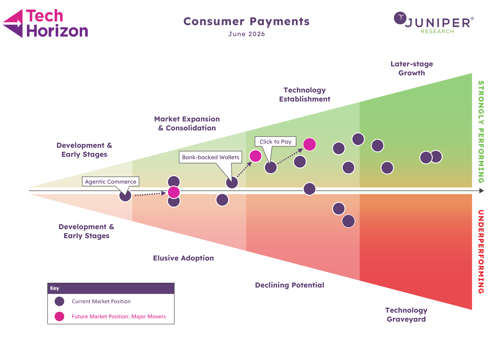
Our latest Consumer Payments Tech Horizon provides a visual representation of crucial players in the payments space and points out the top three major movers in the market. Our unique 'above-the line/below-the-line' metric tracks the stage of development and market performance of significant payment technologies. These are the key technologies that Juniper Research anticipates will experience the greatest development and increase in performance over the next year.
The Consumer Payments Tech Horizon aims to help stakeholders understand how different payment technologies are evolving, enables better strategic decision-making, and anticipation of future market developments. The Tech Horizon also helps stakeholders understand which opportunities they must invest in now to be early movers and capitalise on the growth in revenue from each technology over the next 12 months.

SMART CITIES & SUSTAINABILITY
Rolls Royce Announces Plans to Open Small Modular Reactor Manufacturing in Derby, UK, as SMR Industry Scales Up

Rolls Royce SMR, a Small Modular Reactor (SMR) specialist in the UK, announced this week that it plans to open what it is calling ‘Pioneer Works’ in Derby in the UK. This is a manufacturing development centre where it will establish the build processes, precision assembly and advanced testing needed to de-risk the delivery of its SMR fleet in the UK, Czechia and now Sweden.
The new facility, set to open in Q4 2026, will develop and validate the techniques, technologies and processes required to assemble the primary circuit and highest integrity components that sit at the heart of the nuclear power plant. This is the latest sign that SMR technology is scaling up to meet the hype, and it will have a significant impact on how energy is generated.
Distilled…
🟣 SMRs Holds the Promise of Reducing Nuclear Costs & Delays: This development reflects the promise SMRs hold for powering future energy needs. SMRs are billed as being most cost effective and easier to manufacture on standardised designs; making roll-outs easier. This is critical, as traditional nuclear energy sources are very expensive to roll out, and the process can take decades. Recent weeks have seen multiple commitments to roll out SMRs in Europe; intensifying the potential.
🟣 Datacentres Intensifying Need for SMR Roll Out: The rapid rise in the need for datacentres has put pressure on energy grids – sudden increases in demand are difficult for current infrastructure to deal with. As such, SMRs represent an important way to bring extra capacity into the grid, without the delays that go along with traditional energy sources.
🟣 SMRs Still Face Challenges: Potential, commitments, and hype continue to build, but we have still yet to see large numbers of SMRs actually be deployed in practice. Over time, this will likely emerge, as the investment into SMR technologies has been significant. However, the concept that SMRs will be significantly easier to roll out than traditional plants is yet to be tested in practice – regulatory standards will have to evolve in order to unlock rapid enough roll-outs to solve the challenges energy grids face.
FINTECH & PAYMENTS
eCommerce Fraud Prevention - An Interview with Visa

Our recently published report titled eCommerce Fraud Prevention Market 2025-2030 found Visa to be the leading vendor. Visa’s strong global network, the quality of its AI-driven fraud decisioning, and the powerful impact of its investments, such as the acquisition of Featurespace in 2024, found Visa to be the pioneer in the market.
Our VP of Research, Nick Maynard conversed with Eric Goodman, VP of Acceptance Risk and Authentication Solutions at Visa, to discuss how eCommerce fraud is evolving, the solutions being developed to fight back, and why Visa is leading the market.
FUTURE DIGITAL AWARDS
The Winners for Future Digital Awards for Fintech & Payments Are Announced! 🏆

The award honours exceptional trailblazers in the fintech and payments industry; celebrating both the companies breaking new ground and the individuals steering innovation and growth.
Congratulations to all the winners!
FREE WEBINAR
The Untapped Asset: Unlocking Operators' Revenue with Utility IoT Partnerships

Utilities aren't just another IoT customer - they could be a mobile operator's most valuable long-term partner.
Electricity, gas and water providers operate millions of connected assets across wide geographic areas, with infrastructure expected to last for decades. The data is there. The challenge is turning it into operational insight.
Join Juniper Research and Motive as they explore this next wave of moving from connectivity to intelligence, and how it will impact the IoT market.
THE LAST DROP
🪙 Fan Tokens & Digital Payments: How the 2026 World Cup Could Accelerate Financial Inclusion [Blog]
🏦 Nubank’s MVNO Now Has 1 Million Customers, How Much More Can it Grow? [Blog]
💱 The Top Three Drivers of Network Tokenisation Adoption [Whitepaper]
Related Research
-
 ReportApril 2026Fintech & Payments
 Nick MaynardAgentic Commerce Market, 2026-2031
Juniper Research’s Agentic Commerce research suite provides an insightful analysis of this rapidly emerging market; enabling stakeholders, including AI developers, payment infrastructure providers, eCommerce marketplaces, merchants and many others, to understand future growth, key trends, and the competitive environment.
VIEW -
 ReportJuly 2026Fintech & Payments
 Thomas WilsonNetwork Tokenisation Market, 2026-2031
Our Network Tokenisation research suite provides a comprehensive and in-depth analysis of the ecosystem surrounding network tokenisation, enabling stakeholders such as merchants, payment gateways, token service providers and token requestors to understand future growth, key trends and the competitive environment.
VIEW -
 ReportApril 2026Fintech & Payments
 Jawad JahanStablecoins Market, 2026-2035
Our Stablecoins market research suite provides detailed and insightful analysis of this evolving market; enabling stakeholders such as central banks, commercial banks, stablecoin issuers, and payment service providers to understand future growth, key trends, and the competitive environment.
VIEW
Latest research, whitepapers & press releases
-
 ReportOctober 2026Fintech & Payments
 Jawad JahanCrypto-gaming Market: 2026-2035
Our Crypto-gaming Market research suite provides an insightful analysis of this rapidly growing market; enabling stakeholders - from crypto-gaming and sportsbooks operators, prediction market platforms, business-to-business (B2B) gambling platforms and software providers, to crypto payment processors and regulators - to understand future growth, key trends, and the competitive environment.
VIEW -
 ReportOctober 2026Telecoms & Connectivity
 Alex WebbRetail Roaming Market: 2026-2031
Our Retail Roaming research suite for mobile network operators (MNOs) and mobile virtual network operators (MVNOs) provides detailed analysis and strategic recommendations for the next era of retail roaming.
VIEW -
 ReportSeptember 2026Fintech & Payments
 Dr Manju ChhillarEmbedded Finance Market: 2026-2031
Embedded finance is one of the fastest-growing markets in financial services, and is about to accelerate even further. Our Embedded Finance Market research provides detailed analysis of the key drivers behind this growth, and what these mean for stakeholders in this market.
VIEW -
 ReportSeptember 2026IoT & Emerging Technology
 Thomas WilsonApplication Security Market: 2026-2031
Our Application Security research suite provides detailed analysis of this emerging market; allowing application security providers to gain an understanding of key security trends and challenges, potential growth opportunities, and the competitive environment.
VIEW -
 ReportSeptember 2026Fintech & Payments
 Shane O'SullivanBanking Fraud Prevention Market: 2026-2031
Our Banking Fraud Prevention research suite provides a comprehensive and in-depth analysis of the types of fraud currently impacting the banking sector, and the evolving methods that can be used to overcome them.
VIEW -
 ReportSeptember 2026Telecoms & Connectivity
 Nick MaynardPrivate LTE & 5G Networks Market: 2026-2031
Our Private LTE & 5G Networks research suite provides detailed and insightful analysis of this evolving market; enabling stakeholders - from private LTE & 5G network platform specialists, mobile network operators, and diversified technology companies - to understand future growth, key trends, and the competitive environment.
VIEW


-
 WhitepaperOctober 2026Telecoms & Connectivity
Alex Webb
WhitepaperOctober 2026Telecoms & Connectivity
Alex WebbReimagining the Future of Retail Roaming – How Mobile Network Operators Must Adapt
Our complimentary whitepaper, Reimagining the Future of Retail Roaming – How Mobile Network Operators Must Adapt, explores the emerging opportunities for MNOs within retail roaming.
VIEW -
 WhitepaperSeptember 2026Fintech & Payments
Dr Manju Chhillar
WhitepaperSeptember 2026Fintech & Payments
Dr Manju ChhillarEmerging Markets: The Next Opportunity for Embedded Finance
This free whitepaper examines how a combination of multiple factors is driving North America towards saturation for embedded finance.
VIEW -
 WhitepaperSeptember 2026IoT & Emerging Technology
Thomas Wilson
WhitepaperSeptember 2026IoT & Emerging Technology
Thomas WilsonVibe Coding: The Fastest-growing Threat to Application Security Today
Our complimentary whitepaper, Vibe Coding: The Fastest-growing Threat to Application Security Today, examines the state of the application security market; considering its impact on different verticals, and how it is being employed in these verticals to best combat malicious attackers and keep sensitive data safe.
VIEW -
 WhitepaperSeptember 2026Fintech & Payments
Shane O'Sullivan
WhitepaperSeptember 2026Fintech & Payments
Shane O'SullivanThe Fraud Frontier: Securing Banking in an AI-driven Era
Our complimentary whitepaper, The Fraud Frontier: Securing Banking in an AI-driven Era, examines the rapidly evolving state of the banking fraud prevention market.
VIEW -
 WhitepaperSeptember 2026Telecoms & Connectivity
Nick Maynard
WhitepaperSeptember 2026Telecoms & Connectivity
Nick MaynardHow Private Cellular Networks Are Unlocking Industry 4.0
Our complimentary whitepaper, How Private Cellular Networks Are Unlocking Industry 4.0, examines how private LTE & 5G networks are reshaping the way industry works.
VIEW -
 WhitepaperSeptember 2026Fintech & Payments
 Michael Greenwood
How Omnichannel Payment Platforms Are Streamlining Merchant Operations
Our complimentary whitepaper, How Omnichannel Payment Platforms Are Streamlining Merchant Operations, examines how merchants are utilising omnichannel payment platforms to capitalise on customer data and integration with other business management software in order to minimise inefficiency.
VIEW


-
Retail Roaming Revenue to Fall $4 Billion By 2031, as Regulatory Restrictions and Competition Bite
October 2026 -
Fintech & Payments
Soft POS to Surpass 100 Million Installations in 2030
September 2026 -
Fintech & Payments
The NextGen Payments & RegTech Forum Arrives in Dubai
September 2026 -
Fintech & Payments
The Global Trade Finance Expo Arrives in Dubai, UAE
September 2026 -
Fintech & Payments
The Vision Forex Forum Arrives in Dubai, UAE
September 2026 -
Fintech & Payments
Embedded Finance Revenue to Reach $617 Billion Globally by 2031, as B2B Revenue Surges 390%
September 2026