Fan Tokens & Digital Payments: How the 2026 World Cup Could Accelerate Financial Inclusion

The 2026 FIFA World Cup is shaping up to be more than the biggest tournament in football history. It is also becoming a powerful showcase for how fan tokens, fintech and digital payments can bring millions of supporters closer to the financial system.
As the tournament expands to 48 teams, and reaches audiences across the world, it arrives at a time when digital wallets, instant payments and tokenised financial services are far more embedded in everyday life than they were at the last iteration of the World Cup four years ago. That matters because the fan experience is no longer limited to ticket purchases and merchandise; it increasingly includes loyalty schemes, mobile apps, digital assets and new forms of digital engagement.
A New Kind of Fan Economy
One of the clearest shifts is the rise of fan tokens. They are blockchain-based digital assets that fans usually buy through a crypto app or exchange; often by first purchasing a base token, or supported currency and then swapping into the fan token itself. Once bought, they can be held or traded, but their main purpose is to unlock fan-related perks such as voting in polls, accessing exclusive rewards, and getting closer to a team or event.
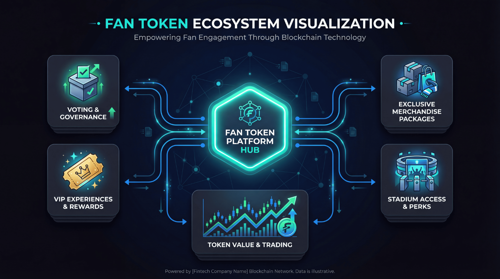
Visualisation of Fan Token Ecosystem
Source: Zipmex
This evolution is helping create a new sports economy in which fans become active participants rather than passive consumers. This is important for financial inclusion, as it opens the door for people who may have had limited engagement with formal financial services to interact through wallets, apps and digital payment tools instead.
Why the World Cup Matters for Inclusion
The World Cup’s financial impact is especially relevant in regions where gaps in access to traditional banking remain significant. There exists an opportunity for fintechs, payment processors, investment platforms, and wealth managers to bring various financial services to masses of people who, historically, have had limited engagement with formal financial systems. This is true in Latin America in particular, where smartphone use and digital payments are growing quickly, even as financial inclusion gaps persist.
That makes the tournament a useful gateway for fintech firms and payment providers. By meeting fans on mobile devices, in digital communities, and through simple payment experiences, essentially where they already are, these companies can help widen access to financial tools without requiring people to start with a traditional bank relationship.
Uncertainties around consumer demand may be why Mastercard’s expansion is targeting a slightly different segment: machine-to-machine payments. Agent Pay for Machines (AP4M), introduced last week, will power automated microtransactions that happen in the background of digital commerce. For example, a logistics AI agent could pay for loading-bay access and settle warehouse handling fees automatically throughout the lifespan of a shipment. Mastercard will settle payments across multiple rails, including cards, bank accounts, and stablecoins.
Digital Payments at Scale
The 2026 World Cup is also proving to be a major stress test for digital payment infrastructure. Millions of visitors are making cross-border transactions, booking travel, buying merchandise and using mobile payments, which puts digital wallets, remittance services and foreign exchange providers firmly in the spotlight.
This is where the broader UK policy context becomes relevant. The UK government has recently set out plans to modernise payments regulation, support tokenised payments and prepare for new forms of digital financial activity, including AI-driven payments. That direction of travel reinforces the idea that tokenisation, wallets and digital payment rails are no longer niche innovations; they are becoming part of the mainstream financial landscape.
What Fintech Firms Can Learn
For fintechs, the opportunity is not just to process payments more efficiently, but to create better access points into the financial system. Fan tokens package digital ownership, engagement, and payments into a simple mobile-first experience that feels more accessible than traditional finance, especially for people who are already active in sports communities. They can introduce users to wallets, digital assets and online transactions through a familiar interest (their favourite team), rather than through a bank-led product journey.
The real lesson from the 2026 World Cup is that financial inclusion is increasingly being driven by everyday digital experiences, not only by formal banking policy. When sport, payments, and digital ownership converge, they can create a more accessible financial ecosystem for fans, especially in markets where mobile-first behaviour is already deeply established.
Looking at the bigger picture, the 2026 World Cup may ultimately be remembered not only for its scale, but for how it accelerated the blending of entertainment and finance. Fan tokens and digital payments are helping turn supporters into active digital participants, while also expanding access to financial services in ways that feel natural and relevant.
For the payments industry, that makes the tournament more than a sporting event. It is a live demonstration of how financial inclusion can be advanced through digital engagement, tokenisation and simple, mobile-first payment experiences.
Related Research
-
 ReportApril 2026Fintech & Payments
 Jawad JahanStablecoins Market, 2026-2035
Our Stablecoins market research suite provides detailed and insightful analysis of this evolving market; enabling stakeholders such as central banks, commercial banks, stablecoin issuers, and payment service providers to understand future growth, key trends, and the competitive environment.
VIEW -
 ReportSeptember 2025Fintech & Payments
 Thomas WilsonA2A Payments Market, 2025-2030
Our A2A Payments research suite provides detailed analysis of this rapidly changing market; enabling A2A payments service providers to gain an understanding of key payment trends and challenges, potential growth opportunities, and the competitive environment.
VIEW -
 ReportJuly 2025Fintech & Payments
 Michael GreenwoodB2B Payments Market, 2025-2030
Juniper Research’s B2B Payments research suite provides a comprehensive and insightful analysis of this market; enabling stakeholders from B2B payment platform providers to regulators and banks, to understand future growth, key trends and the competitive environment.
VIEW
Latest research, whitepapers & press releases
-
 ReportSeptember 2026Fintech & Payments
 Dr Manju ChhillarEmbedded Finance Market: 2026-2031
Embedded finance is one of the fastest-growing markets in financial services, and is about to accelerate even further. Our Embedded Finance Market research provides detailed analysis of the key drivers behind this growth, and what these mean for stakeholders in this market.
VIEW -
 ReportSeptember 2026IoT & Emerging Technology
 Thomas WilsonApplication Security Market: 2026-2031
Our Application Security research suite provides detailed analysis of this emerging market; allowing application security providers to gain an understanding of key security trends and challenges, potential growth opportunities, and the competitive environment.
VIEW -
 ReportSeptember 2026Fintech & Payments
 Shane O'SullivanBanking Fraud Prevention Market: 2026-2031
Our Banking Fraud Prevention research suite provides a comprehensive and in-depth analysis of the types of fraud currently impacting the banking sector, and the evolving methods that can be used to overcome them.
VIEW -
 ReportSeptember 2026Telecoms & Connectivity
 Nick MaynardPrivate LTE & 5G Networks Market: 2026-2031
Our Private LTE & 5G Networks research suite provides detailed and insightful analysis of this evolving market; enabling stakeholders - from private LTE & 5G network platform specialists, mobile network operators, and diversified technology companies - to understand future growth, key trends, and the competitive environment.
VIEW -
 ReportSeptember 2026Fintech & Payments
 Michael GreenwoodOmnichannel Payment Platform Market: 2026-2031
Our Omnichannel Payment Platform research provides detailed analysis of this rapidly emerging market; allowing omnichannel payment platform providers to gain an understanding of key payment trends and challenges, potential growth opportunities, and the competitive environment.
VIEW -
 ReportSeptember 2026IoT & Emerging Technology
Nick MaynardIdentity & Access Management Market: 2026-2031
ReportSeptember 2026IoT & Emerging Technology
Nick MaynardIdentity & Access Management Market: 2026-2031Our Identity & Access Management research suite provides detailed and insightful analysis of this evolving market; enabling stakeholders - from Identity & Access Management platform specialists, cybersecurity vendors, and diversified technology companies - to understand future growth, key trends, and the competitive environment.
VIEW


-
 WhitepaperSeptember 2026Fintech & Payments
Dr Manju Chhillar
WhitepaperSeptember 2026Fintech & Payments
Dr Manju ChhillarEmerging Markets: The Next Opportunity for Embedded Finance
This free whitepaper examines how a combination of multiple factors is driving North America towards saturation for embedded finance.
VIEW -
 WhitepaperSeptember 2026IoT & Emerging Technology
Thomas Wilson
WhitepaperSeptember 2026IoT & Emerging Technology
Thomas WilsonVibe Coding: The Fastest-growing Threat to Application Security Today
Our complimentary whitepaper, Vibe Coding: The Fastest-growing Threat to Application Security Today, examines the state of the application security market; considering its impact on different verticals, and how it is being employed in these verticals to best combat malicious attackers and keep sensitive data safe.
VIEW -
 WhitepaperSeptember 2026Fintech & Payments
Shane O'Sullivan
WhitepaperSeptember 2026Fintech & Payments
Shane O'SullivanThe Fraud Frontier: Securing Banking in an AI-driven Era
Our complimentary whitepaper, The Fraud Frontier: Securing Banking in an AI-driven Era, examines the rapidly evolving state of the banking fraud prevention market.
VIEW -
 WhitepaperSeptember 2026Telecoms & Connectivity
Nick Maynard
WhitepaperSeptember 2026Telecoms & Connectivity
Nick MaynardHow Private Cellular Networks Are Unlocking Industry 4.0
Our complimentary whitepaper, How Private Cellular Networks Are Unlocking Industry 4.0, examines how private LTE & 5G networks are reshaping the way industry works.
VIEW -
 WhitepaperSeptember 2026Fintech & Payments
Michael Greenwood
WhitepaperSeptember 2026Fintech & Payments
Michael GreenwoodHow Omnichannel Payment Platforms Are Streamlining Merchant Operations
Our complimentary whitepaper, How Omnichannel Payment Platforms Are Streamlining Merchant Operations, examines how merchants are utilising omnichannel payment platforms to capitalise on customer data and integration with other business management software in order to minimise inefficiency.
VIEW -
 WhitepaperSeptember 2026Telecoms & Connectivity
 Jawad Jahan
Beyond the Headlines: What the 'AI Bubble' Really Means
Our complimentary whitepaper, Beyond the Headlines – What the 'AI Bubble' Really Means, analyses the scale and structure of AI infrastructure investment in the West, and the channels through which it could transmit stress to the wider financial system.
VIEW


-
Fintech & Payments
Soft POS to Surpass 100 Million Installations in 2030
September 2026 -
Fintech & Payments
The NextGen Payments & RegTech Forum Arrives in Dubai
September 2026 -
Fintech & Payments
The Global Trade Finance Expo Arrives in Dubai, UAE
September 2026 -
Fintech & Payments
The Vision Forex Forum Arrives in Dubai, UAE
September 2026 -
Fintech & Payments
Embedded Finance Revenue to Reach $617 Billion Globally by 2031, as B2B Revenue Surges 390%
September 2026 -
IoT & Emerging Technology
AppSec Enterprise Spend to Approach $13 Billion Globally by 2031, as Market Leaders Revealed in New Competitor Leaderboard
September 2026