Nubank’s MVNO Now Has 1 Million Customers, How Much More Can it Grow?

On the 19th of June 2026, Nubank announced that its mobile virtual network operator (MVNO) NuCel had surpassed more than 1 million customers; just a year and a half since its commercial launch in January 2025. Last year, Brazil’s National Telecommunications Agency (Anatel) reported NuCel as having 29,400 accesses in May 2025, and 44,000 in June 2025; meaning that Nubank has added close to a million mobile subscribers since the latter date.
The fintech offers loyalty-free mobile tariffs - available in the Nubank application - including unlimited mobile access to WhatsApp. It relies on Claro’s mobile network, and offers plans at R$45 (25GB), R$60 (30GB), and R$70 (40GB). Assuming a rough average revenue per user (ARPU) of +R$45 a month, Nubank’s income from mobile services could already be worth more than $100 million USD a year.
NuCel’s plans are set at competitive prices. These price points are often clearer for consumers than alternatives, which may combine similar costs for using limited time with special data allowance boosts; provided they commit to a long-term contract. For example, TIM’s TIM Control plan is priced at R$58.99 for 15GB flat, with a temporary 20GB Internet bonus and 6GB special bonus; providing the customer remains for 12 months. It does, however, also include streaming services such as Paramount, and free WhatsApp messaging (voice and video are not included); meaning there can be greater value for consumers staying for the year, or more.
Livia Chanes, CEO of Nubank Brazil, said: “Reaching 1 million customers confirms that Brazilians value a simple and transparent proposal that returns autonomy to people. NuCel also shows how Nubank is becoming increasingly present in the lives of those who already trust us to look after their money, expanding our impact on the lives of millions of Brazilians.”
Notably, the service combines financial and mobile services with an exclusive Turbo Box that offers a yield of 120% of the Certificado de Depósito Interbancário (CDI). Essentially, mobile subscribers with NuCel have access to higher interest rates; incentivising adoption, and creating a unique value proposition for mobile subscribers. Juniper Research believes that this type of combination of financial and mobile services is highly effective at winning over customers; with consumers increasingly expecting value from their mobile services beyond data allowances, voice, and SMS.
However, NuCel is not only disrupting mobile services with exclusive financial offerings. It is also providing features such as its GB Reserve, and real-time adjustment suggestions based on a customer’s usage profile. The GB Reserve automatically guarantees additional data when a customer’s monthly allowance is about to run out, at no additional cost. The additional GBs are stored once the plan is contracted, with customers able to earn additional GBs at additional points in their journey. Each extra GB remains valid for 365 days while in the Reserve. Once an extra GB is activated on the plan, it can be used within 30 days.
Fintechs have long been at the forefront of innovating new banking features (for example, spending analytics, round-up saving, and disposable virtual cards), and we expect that they will apply a similar approach to mobile services. Juniper Research believes that features such as GB Reserve will be key to MVNOs such as NuCel disrupting the mobile service market, with fintech MVNOs moving quickly to create new, valuable features for consumers.
NuCel Still Has Significant Growth Potential
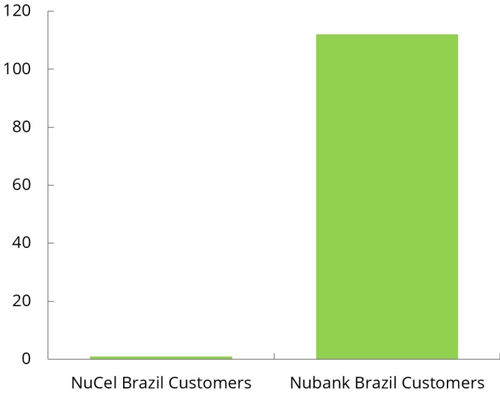
Whilst Nubank has already built its MVNO to more than 1 million customers, the fintech still has significant growth potential. With 1 million NuCel customers, Nubank has converted less than 1% of its 112 million+ customers in Brazil alone. As a result, it is in a strong position to further grow its mobile service business. By leveraging its existing relationships, services, and customer base, Nubank can achieve low customer acquisition costs, while integrating its mobile service with its wider ecosystem.
Fintech MVNOs have often focused on eSIM-only offerings. However, Nubank has built a platform for growth by adding physical SIMs, in July 2025, whilst retaining a 100% digital contracting process via the Nubank app (physical SIMs are ordered to an address in the Nubank application). Whilst eSIMs are increasingly available and adopted by consumers, a notable proportion of mobile subscribers in Brazil continue to rely on physical SIMs - either out of habit, preference, or a lack of eSIM support in their smartphone.
Figure 1: Nubank and NuCel Customers in Brazil, in 2026, as Reported by Nubank
Source: Nubank
Furthermore, with more than 20 million additional customers outside of Brazil - in Mexico and Colombia - the company has further opportunities for international growth. Notably, the Red Compartida in Mexico, a national wholesale shared network for MVNOs, is already being relied on by highly successful MVNOs; for example, Walmart’s Bait, which has 26 million mobile subscribers. This sets a precedent for Nubank to enter the Mexican market, as it indicates that the Red Compartida provides a strong foundation for growth. Additionally, in April 2026, a consortium led by the Telecom-as-a-Service provider OXIO (which was already active in Mexico) acquired Movistar Mexico from Telefónica; offering Nubank another potential partner for expanding mobile services.
Overall, Juniper Research expects that Nubank’s MVNO will continue to grow at pace over the next year, with the company well-positioned to grow to one of the largest MVNOs in the world.
What Is the Future of Fintech MVNOs?
Nubank is just one of a number of high-profile fintechs launching MVNOs in the past year, with others such as Revolut, N26, Monzo, Klarna, and Cash App all having announced or launched an MVNO in the past two years. Fintechs are increasingly viewing mobile services as a valuable offering to combine with their financial services; typically embedding connectivity via MVNO in a Box, or through Telecommunication-as-a-Service providers such as Gigs and 1Global. These providers are enabling mobile service launches at pace and with minimal complexity; meaning that fintechs can focus on their own services.
Whilst not all fintech MVNOs will achieve the same level of success as NuCel, Juniper Research expects fintechs to emerge as key players in mobile service markets around the world. Success will be defined by a fintech’s capacity to integrate its financial services with mobile services, as well as its development of innovative mobile features and offerings.
Juniper Research also believes that fintech MVNOs will increasingly utilise mobile services to achieve key performance indicators (KPIs) for their core financial business. For example, fintechs could offer boosted mobile plans for customers who choose a neobank as their primary bank account. This would enable mobile services to incentivise adoption of higher-value financial services, and raise the balances held by customers; building on existing features such as Monzo’s Double Payday, which randomly selects 10 customers to double their payday each month (only for salaries between £300 and £20,000 per month, and with a £10,000 bonus cap).
Related Research
-
 ReportJune 2026Telecoms & Connectivity
 Ardit BallhysaRAN Vendors Competitor Leaderboard, 2026
Our Radio Access Network (RAN) Vendor Competitor Leaderboard provides insightful analysis of a market that is experiencing significant change currently, and will continue to do so over the next five years.
VIEW -
 ReportFebruary 2026Telecoms & Connectivity
Ardit BallhysaMobile Messaging Market, 2026-2030
ReportFebruary 2026Telecoms & Connectivity
Ardit BallhysaMobile Messaging Market, 2026-2030Juniper Research’s Mobile Messaging research suite provides mobile messaging vendors, mobile network operators, and enterprises with intelligence on how to capitalise on changing market dynamics within the mobile messaging market.
VIEW -
 ReportJune 2026Conversational AI
 Peter BoylandConversational AI Market, 2026-2030
Our Conversational AI Market 2026-2030 research suite provides insightful analysis of a market that will experience significant growth in the next five years.
VIEW
Latest research, whitepapers & press releases
-
 ReportSeptember 2026IoT & Emerging Technology
 Thomas WilsonApplication Security Market: 2026-2031
Our Application Security research suite provides detailed analysis of this emerging market; allowing application security providers to gain an understanding of key security trends and challenges, potential growth opportunities, and the competitive environment.
VIEW -
 ReportSeptember 2026Fintech & Payments
 Shane O'SullivanBanking Fraud Prevention Market: 2026-2031
Our Banking Fraud Prevention research suite provides a comprehensive and in-depth analysis of the types of fraud currently impacting the banking sector, and the evolving methods that can be used to overcome them.
VIEW -
 ReportSeptember 2026Telecoms & Connectivity
 Nick MaynardPrivate LTE & 5G Networks Market: 2026-2031
Our Private LTE & 5G Networks research suite provides detailed and insightful analysis of this evolving market; enabling stakeholders - from private LTE & 5G network platform specialists, mobile network operators, and diversified technology companies - to understand future growth, key trends, and the competitive environment.
VIEW -
 ReportSeptember 2026Fintech & Payments
 Michael GreenwoodOmnichannel Payment Platform Market: 2026-2031
Our Omnichannel Payment Platform research provides detailed analysis of this rapidly emerging market; allowing omnichannel payment platform providers to gain an understanding of key payment trends and challenges, potential growth opportunities, and the competitive environment.
VIEW -
 ReportSeptember 2026IoT & Emerging Technology
Nick MaynardIdentity & Access Management Market: 2026-2031
ReportSeptember 2026IoT & Emerging Technology
Nick MaynardIdentity & Access Management Market: 2026-2031Our Identity & Access Management research suite provides detailed and insightful analysis of this evolving market; enabling stakeholders - from Identity & Access Management platform specialists, cybersecurity vendors, and diversified technology companies - to understand future growth, key trends, and the competitive environment.
VIEW -
 ReportAugust 2026Fintech & Payments
Nick MaynardContactless Payments Market Data: 2026-2031
ReportAugust 2026Fintech & Payments
Nick MaynardContactless Payments Market Data: 2026-2031Our Contactless Payments market analysis provides exhaustive data coverage of the market in its entirety, including the adoption of mobile wallets featuring contactless payment technology, the growth of contactless transactions, and the market’s associated values.
VIEW


-
 WhitepaperSeptember 2026IoT & Emerging Technology
Thomas Wilson
WhitepaperSeptember 2026IoT & Emerging Technology
Thomas WilsonVibe Coding: The Fastest-growing Threat to Application Security Today
Our complimentary whitepaper, Vibe Coding: The Fastest-growing Threat to Application Security Today, examines the state of the application security market; considering its impact on different verticals, and how it is being employed in these verticals to best combat malicious attackers and keep sensitive data safe.
VIEW -
 WhitepaperSeptember 2026Fintech & Payments
Shane O'Sullivan
WhitepaperSeptember 2026Fintech & Payments
Shane O'SullivanThe Fraud Frontier: Securing Banking in an AI-driven Era
Our complimentary whitepaper, The Fraud Frontier: Securing Banking in an AI-driven Era, examines the rapidly evolving state of the banking fraud prevention market.
VIEW -
 WhitepaperSeptember 2026Telecoms & Connectivity
Nick Maynard
WhitepaperSeptember 2026Telecoms & Connectivity
Nick MaynardHow Private Cellular Networks Are Unlocking Industry 4.0
Our complimentary whitepaper, How Private Cellular Networks Are Unlocking Industry 4.0, examines how private LTE & 5G networks are reshaping the way industry works.
VIEW -
 WhitepaperSeptember 2026Fintech & Payments
Michael Greenwood
WhitepaperSeptember 2026Fintech & Payments
Michael GreenwoodHow Omnichannel Payment Platforms Are Streamlining Merchant Operations
Our complimentary whitepaper, How Omnichannel Payment Platforms Are Streamlining Merchant Operations, examines how merchants are utilising omnichannel payment platforms to capitalise on customer data and integration with other business management software in order to minimise inefficiency.
VIEW -
 WhitepaperSeptember 2026Telecoms & Connectivity
 Jawad Jahan
Beyond the Headlines: What the 'AI Bubble' Really Means
Our complimentary whitepaper, Beyond the Headlines – What the 'AI Bubble' Really Means, analyses the scale and structure of AI infrastructure investment in the West, and the channels through which it could transmit stress to the wider financial system.
VIEW -
 WhitepaperSeptember 2026IoT & Emerging Technology
Nick Maynard
WhitepaperSeptember 2026IoT & Emerging Technology
Nick MaynardNon-human Identities ~ Transforming Identity & Access Management
Our complimentary whitepaper, Non-human Identities ~ Transforming Identity & Access Management, examines how non-human identities are revolutionising the Identity & Access Management market.
VIEW


-
IoT & Emerging Technology
AppSec Enterprise Spend to Approach $13 Billion Globally by 2031, as Market Leaders Revealed in New Competitor Leaderboard
September 2026 -
Banking Fraud to Reach 2.2 billion Transactions by 2031, Fuelled by Growing AI-enabled Attacks
September 2026 -
Telecoms & Connectivity
Private Network Spend to Exceed $84 Billion Globally by 2031, as Market Leaders Set to Capitalise
September 2026 -
Fintech & Payments
The 6th Financial Innovation Forum – Payments & RegTech Arrives in London
September 2026 -
Fintech & Payments
Omnichannel Payment Platform Revenue to Exceed $100 Billion Globally by 2031, as Leading Platforms Set to Capitalise Are Revealed
September 2026 -
Telecoms & Connectivity
Calling the Game-changers in Telco: 2027 Future Digital Awards are Now Open for Entries
September 2026