Pay by Bank Pursues the American Dream

Last month, US-based cloud payment orchestration platform Gr4vy announced its partnership with Open Banking data network Plaid to enable merchants using Gr4vy to offer Pay by Bank at checkout.
This partnership will allow Pay by Bank, also called account-to-account (A2A) payments, to be offered through a single integration by giving access to Plaid’s bank connectivity; allowing customers to authenticate and pay directly from their bank account at checkout. Plaid’s network is connected to over 12,000 financial institutions across the US, Canada, the UK, and Europe.

Source: Gr4vy
What makes this partnership particularly noteworthy is Plaid’s strong presence in the US - a market where Pay by Bank is not well established. The payment method is far more mature in the UK and EU due to the strength of Open Banking regulation. In 2018, the EU required all banks to share their customers’ data securely with authorised third-party providers via APIs, with the introduction of the Revised Payment Service Directive (PSD2). This regulation allows Pay by Bank providers to offer the service for consumers without the need for individual agreements with each bank; making it far easier to achieve widespread coverage. This has seen a surge in Pay by Bank in these markets, with 10 million people using Pay by Bank monthly in the UK.
This contrasts with the US, where there are not strong and clear Open Banking regulations. In October 2023, the Consumer Financial Protection Bureau (CFPB) proposed a rule to implement section 1033 of the Consumer Financial Protection Act, which would give consumers the right to access and share their financial data.
This rule, if adopted, would establish a clear federal regulation for Open Banking, with the CFPB overseeing its implementation. As things stand, these rules have not been implemented and the CFPB is facing restructuring; casting doubts over the potential implementation of this regulation. Alongside this, several states have implemented, or are considering implementing, their own Open Banking legislation. There are also industry-led initiatives, such as the Financial Data Exchange (FDX), that are establishing voluntary data-sharing standards. The FDX is a non-profit industry standards body that created the FDX API - a technical standard for sharing financial data. The FDX has 200 member organisations connecting 114 million customer accounts.
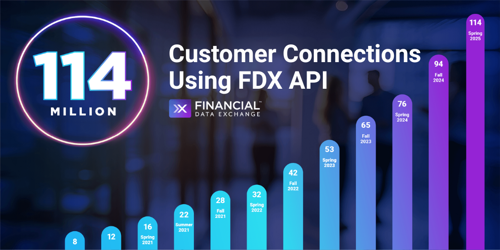
Source: FDX
This demonstrates the fragmented nature of the Open Banking space within the US. This presents challenges for Pay by Bank providers looking to grow the payment method within the US, as it means the quality of coverage varies extensively by region; limiting its appeal to major brands. In particular, Pay by Bank providers in the UK have been successful in gaining buy-in from large eCommerce marketplaces, such as Amazon and eBay, which plays an important role in normalising the payment method for eCommerce. In a market such as the US, where access to consumers’ accounts is patchy, there is less reason for a national player such as Amazon to offer Pay by Bank, as a significant proportion of its customer base will not be able to use it.
The key selling point of Pay by Bank to merchants is lower fees compared to credit and debit cards. However, this is not the only advantage to merchants: a Pay by Bank transaction is authenticated by the user’s bank when they initiate the transaction; reducing the burden of verifying the consumer on the merchant.
Another benefit for merchants is the lack of a chargeback process. Chargebacks are a significant cost for merchants, with friendly fraud being a significant concern for eCommerce merchants in particular. As there is no chargeback mechanism and transactions are finalised immediately, a merchant does not need to worry about revenue being taken and incurring costly fees on top of that. This does not remove a merchant’s requirement to offer refunds, but does speed up the process for the consumer. These are all strong motives for merchants to adopt; however, in the US, merchants are put off by the fragmented nature of consumer availability.
The fundamental issue for Pay by Bank in the US is one of connecting merchants to the customers. Without the federal government implementing nationwide Open Banking requirements, Juniper Research believes that Pay by Bank will be limited to a more niche payment option.
However, if regulations enable Open Banking to offer far wider coverage, then Pay by Bank offers solutions to significant pain points for merchants. In particular, high card fees in the US make Pay by Bank even more appealing than in markets where it has already taken off. Juniper Research recommends that Pay by Bank providers continue to work closely with Open Banking networks to broaden the number of customers able to use Pay by Bank, while proactively working with regulators to support Open Banking regulations.
As a Senior Research Analyst, Michael delivers in-depth insights into the fast-evolving worlds of digital identity and payments. His recent work spans critical topics such as B2B Payment Cards, B2B Payments, and Chargeback Management; helping industry leaders navigate change and identify new opportunities.
Related Research
-
 ReportSeptember 2025Fintech & Payments
 Thomas WilsonA2A Payments Market, 2025-2030
Our A2A Payments research suite provides detailed analysis of this rapidly changing market; enabling A2A payments service providers to gain an understanding of key payment trends and challenges, potential growth opportunities, and the competitive environment.
VIEW -
 ReportJune 2026Fintech & Payments
 Michael GreenwoodChargeback Management Market, 2026-2031
Our Chargeback Management research suite provides detailed analysis of this fast-changing market; allowing chargeback management providers to gain an understanding of key payment trends and challenges, potential growth opportunities, and the competitive environment.
VIEW -
 ReportDecember 2025Fintech & Payments
 Shane O'SullivaneCommerce Fraud Prevention Market, 2025-2030
Our eCommerce Fraud Prevention research suite provides a detailed and insightful analysis of this evolving market; enabling stakeholders from financial institutions, law enforcement agencies, regulatory bodies and technology vendors to understand future growth, key trends, and the competitive environment.
VIEW
Latest research, whitepapers & press releases
-
 ReportOctober 2026Fintech & Payments
 Michael GreenwoodAccounts Payable Automation Market: 2026-2031
Our Accounts Payable (AP) Automation research suite provides an insightful analysis of this rapidly growing market; enabling stakeholders to understand future growth, key trends and the competitive environment.
VIEW -
 ReportOctober 2026Fintech & Payments
 Jawad JahanCrypto-gaming Market: 2026-2035
Our Crypto-gaming Market research suite provides an insightful analysis of this rapidly growing market; enabling stakeholders - from crypto-gaming and sportsbooks operators, prediction market platforms, business-to-business (B2B) gambling platforms and software providers, to crypto payment processors and regulators - to understand future growth, key trends, and the competitive environment.
VIEW -
 ReportOctober 2026Telecoms & Connectivity
 Alex WebbRetail Roaming Market: 2026-2031
Our Retail Roaming research suite for mobile network operators (MNOs) and mobile virtual network operators (MVNOs) provides detailed analysis and strategic recommendations for the next era of retail roaming.
VIEW -
 ReportSeptember 2026Fintech & Payments
 Dr Manju ChhillarEmbedded Finance Market: 2026-2031
Embedded finance is one of the fastest-growing markets in financial services, and is about to accelerate even further. Our Embedded Finance Market research provides detailed analysis of the key drivers behind this growth, and what these mean for stakeholders in this market.
VIEW -
 ReportSeptember 2026Identity & Security
 Thomas WilsonApplication Security Market: 2026-2031
Our Application Security research suite provides detailed analysis of this emerging market; allowing application security providers to gain an understanding of key security trends and challenges, potential growth opportunities, and the competitive environment.
VIEW -
 ReportSeptember 2026Fintech & Payments
 Shane O'SullivanBanking Fraud Prevention Market: 2026-2031
Our Banking Fraud Prevention research suite provides a comprehensive and in-depth analysis of the types of fraud currently impacting the banking sector, and the evolving methods that can be used to overcome them.
VIEW


-
 WhitepaperOctober 2026Fintech & Payments
Michael Greenwood
WhitepaperOctober 2026Fintech & Payments
Michael GreenwoodAccounts Payable Automation ~ How Businesses Are Reducing Operational Costs
Our complimentary whitepaper, Accounts Payable Automation ~ How Businesses Are Reducing Operational Costs, analyses how AP automation is combatting costs by decreasing the need for manual processes, and provides strategic insight into a number of key trends in the AP automation space.
VIEW -
 WhitepaperOctober 2026Fintech & Payments
Jawad Jahan
WhitepaperOctober 2026Fintech & Payments
Jawad JahanCompliance or Anonymity - The Crypto-gaming Operator’s Dilemma
Our complimentary whitepaper, Compliance or Anonymity - The Crypto-gaming Operator’s Dilemma, analyses the current regulatory landscape of the crypto-gaming market.
VIEW -
 WhitepaperOctober 2026Telecoms & Connectivity
Alex Webb
WhitepaperOctober 2026Telecoms & Connectivity
Alex WebbReimagining the Future of Retail Roaming – How Mobile Network Operators Must Adapt
Our complimentary whitepaper, Reimagining the Future of Retail Roaming – How Mobile Network Operators Must Adapt, explores the emerging opportunities for MNOs within retail roaming.
VIEW -
 WhitepaperSeptember 2026Fintech & Payments
Dr Manju Chhillar
WhitepaperSeptember 2026Fintech & Payments
Dr Manju ChhillarEmerging Markets: The Next Opportunity for Embedded Finance
This free whitepaper examines how a combination of multiple factors is driving North America towards saturation for embedded finance.
VIEW -
 WhitepaperSeptember 2026Emerging Technology
Thomas Wilson
WhitepaperSeptember 2026Emerging Technology
Thomas WilsonVibe Coding: The Fastest-growing Threat to Application Security Today
Our complimentary whitepaper, Vibe Coding: The Fastest-growing Threat to Application Security Today, examines the state of the application security market; considering its impact on different verticals, and how it is being employed in these verticals to best combat malicious attackers and keep sensitive data safe.
VIEW -
 WhitepaperSeptember 2026Fintech & Payments
Shane O'Sullivan
WhitepaperSeptember 2026Fintech & Payments
Shane O'SullivanThe Fraud Frontier: Securing Banking in an AI-driven Era
Our complimentary whitepaper, The Fraud Frontier: Securing Banking in an AI-driven Era, examines the rapidly evolving state of the banking fraud prevention market.
VIEW


-
Fintech & Payments
Accounts Payable Automation to Save Global Businesses 6.2 Billion Hours by 2031, Accelerated by Business System Integration
October 2026 -
Fintech & Payments
The 25th NextGen Payments & RegTech Forum Arrives in Athens, Greece
October 2026 -
Fintech & Payments
Crypto Gaming: Wagers to Reach $1.3 Trillion by 2035, as Crypto Rails Widen Global Access Despite Regulatory Challenges
October 2026 -
Fintech & Payments
Juniper Research Unveils Identity & Security Award Winners for 2026
October 2026 -
Retail Roaming Revenue to Fall $4 Billion By 2031, as Regulatory Restrictions and Competition Bite
October 2026 -
Fintech & Payments
Soft POS to Surpass 100 Million Installations in 2030
September 2026