SpaceX’s IPO Setting the Standard for Terrestrial Telcos

SpaceX filed its S-1 with the Securities and Exchange Commission (SEC) on 20 May 2026, and coverage of the event has largely converged on the same points: the largest listing in history, a reported valuation of $1.75 trillion-$2 trillion, Musk's 85% voting control, and xAI's losses at group level. The figure that is particularly interesting, from a connectivity perspective, appears further into the prospectus. In 2025, the Connectivity segment, primarily Starlink, recorded $11.39 billion in revenue, up 50% year-on-year, with operating profit of $4.42 billion and adjusted EBITDA of $7.17 billion; a 63% margin. For terrestrial mobile operators, SpaceX’s initial public offering (IPO) sets a new precedent for what is possible, with Starlink proving that satellite connectivity can be both highly profitable and competitive against terrestrial networks.
Starlink Is the Business Actually Being Listed
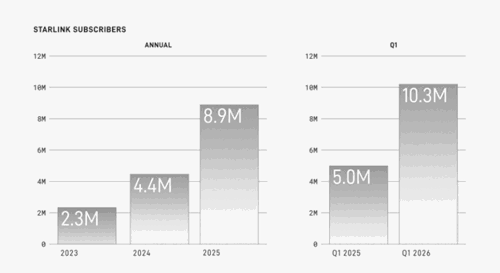
When reading the SpaceX prospectus, it is easy to get lost in the Mars rhetoric and the rocket photography; however, what becomes clear is that the cash engine inside SpaceX is a broadband operator. The connectivity segment covers SpaceX's Starlink services and accounts for the majority of the company's revenue and earnings - $11.4 billion in 2025 and $3.3 billion in the first quarter of 2026, with adjusted EBITDA of $7.2 billion in 2025 and $2.1 billion in the first quarter. Connectivity accounted for roughly 61% of overall company revenue in 2025, which includes the merged SpaceX, Starlink, and xAI entities. The subscriber base has reached scale fast: as of 31 March 2026, Starlink had 10.3 million subscribers across 164 countries and territories.
Figure 1: Starlink Subscribers
Source: SpaceX SEC Filing
Whilst it is reported that Starlink’s average monthly revenue per subscriber fell from $99 in 2023 to $66 in the first quarter of 2026, the strategy is clear: Starlink is trading volume for reach. To expand into lower-income markets, such as large parts of Africa, South Asia, and Latin America, Starlink cannot charge what it charges in Western markets. Instead, it offers cheaper tiers for access; therefore accepting a lower revenue per customer in exchange for more customers across more of the world. The 63% segment EBITDA margin is what makes this possible – and has been achieved without traditional infrastructure such as copper, fibre, or tower portfolio to maintain. This provides SpaceX a structurally different cost base from any operator.
The IPO Sets a Precedent
Before this filing, there had been no clean, public comparable for satellite broadband. Viasat and EchoStar are legacy businesses carrying heavy debt, with broadband as one line among several declining ones. Eutelsat OneWeb, the nearest equivalent, is a blended geostationary orbit (GEO) and Low Earth Orbit (LEO) operator, listed in Paris, with state involvement in its ownership and a weak market valuation. Not one of these three businesses provides a clean valuation for LEO broadband economics on their own terms. The SpaceX prospectus changes this. Its segment disclosure, combined with a daily trading price once SPCX lists on Nasdaq, gives the market far better material to value a satellite-broadband operator running a 63% segment margin and 50% revenue growth.
The benchmark SpaceX is setting illustrates the ruthlessness in economic efficiency, compared to incumbent mobile network operators (MNOs) running structurally lower margins alongside continuous capital expenditure commitment. Furthermore, with fibre build-out, 5G densification, and 6G investment in view, MNOs cannot avoid this spending without conceding competitive ground.
The EchoStar Spectrum Gives Starlink Options
Largely, Starlink’s direct to device (D2D) business is seen as a coverage-extension layer sold through mobile partners such as T-Mobile in the United States, Optus and Telstra in Australia, Rogers in Canada, and KDDI in Japan. So much so, that the framing assumes the satellite operator depends on the carrier, because the carrier supplies the licensed spectrum on which the service runs.
However, in September 2025, SpaceX agreed to buy EchoStar’s AWS-4 and H-block spectrum licences for approximately $17 billion, split between up to $8.5 billion in cash and up to $8.5 billion in stock. In November, it added EchoStar’s unpaired AWS-3 licences for roughly $2.6 billion in stock. Owning licensed terrestrial spectrum gives Starlink a route to offering D2D service without an MNO partner’s spectrum at all; with SpaceX stating that the next generation of direct to cell (D2C) satellites will be designed to use this spectrum.
This IPO funds that next-generation constellation, and that creates an awkward position for the carriers currently treated as Starlink's distribution partners. Their own subscribers' D2D usage helps pay for the build-out of a system that could eventually compete with them directly.
What This Means for Operators
The newly acquired spectrum is not compatible with the current D2D satellites; the next-generation D2C satellites still have to be designed and deployed to use it, with the constellation not expected to be operational before roughly 2027. Satellite D2D capacity per cell remains far below that which a terrestrial macro site delivers, which limits it to messaging and narrowband use rather than mass mobile broadband. Usage data, so far, points to demand that is concentrated and intermittent - useful in dead zones and during emergencies, but not a wholesale replacement for the terrestrial network. There is also a question over the economics. Starlink's model trades average revenue per user (ARPU) for scale: revenue per subscriber has fallen sharply while the subscriber count has grown faster; keeping total revenue rising. That holds only as long as subscriber growth continues to outpace both ARPU compression and operating cost. If growth slows while ARPU keeps falling, the segment economics that make the comparison with terrestrial operators so stark would weaken.
An important caveat is that terrestrial telcos are not about to be made obsolete. What has shifted is the direction of travel and the balance of power, and that is what operators should price in. The response is not to worry over coverage maps; it is to treat the prospectus as a competitive document. Operators should reassess D2D partnership terms before the next-generation constellation flies, and specifically test whether a multi-year wholesale arrangement signed today funds a future competitor. They should watch the Federal Communications Commission’s (FCC's) AWS-3 auction, where SpaceX has already signalled appetite for more terrestrial spectrum, and expect their own investors to raise the margin comparison once SPCX has a trading history. Juniper Research expects satellite D2D to move from a coverage footnote to a board-level question for MNOs within the next two to three years.
---
i: https://www.sec.gov/Archives/edgar/data/1181412/000162828026036936/spaceexplorationtechnologi.htm#id286866c4c474ba490d6531a57db9e93_60
Related Research
-
 ReportJune 2026Telecoms & Connectivity
 Alex WebbDirect to Cell Market, 2026-2031
Our newest Direct-to-Cell research provides market stakeholders, such as mobile network operators and satellite network operators, with key analysis of the future of this rapidly emerging market.
VIEW -
 ReportOctober 2025Telecoms & Connectivity
Alex WebbDirect to Satellite Market, 2025-2030
ReportOctober 2025Telecoms & Connectivity
Alex WebbDirect to Satellite Market, 2025-2030Juniper Research’s Direct to Satellite research suite provides satellite providers, investors, and partners, such as Mobile Network Operators, with an extensive analysis and insights into the direct to satellite market.
VIEW
Latest research, whitepapers & press releases
-
 ReportOctober 2026Fintech & Payments
 Jawad JahanCrypto-gaming Market: 2026-2035
Our Crypto-gaming Market research suite provides an insightful analysis of this rapidly growing market; enabling stakeholders - from crypto-gaming and sportsbooks operators, prediction market platforms, business-to-business (B2B) gambling platforms and software providers, to crypto payment processors and regulators - to understand future growth, key trends, and the competitive environment.
VIEW -
 ReportOctober 2026Telecoms & Connectivity
 Alex WebbRetail Roaming Market: 2026-2031
Our Retail Roaming research suite for mobile network operators (MNOs) and mobile virtual network operators (MVNOs) provides detailed analysis and strategic recommendations for the next era of retail roaming.
VIEW -
 ReportSeptember 2026Fintech & Payments
 Dr Manju ChhillarEmbedded Finance Market: 2026-2031
Embedded finance is one of the fastest-growing markets in financial services, and is about to accelerate even further. Our Embedded Finance Market research provides detailed analysis of the key drivers behind this growth, and what these mean for stakeholders in this market.
VIEW -
 ReportSeptember 2026Identity & Security
 Thomas WilsonApplication Security Market: 2026-2031
Our Application Security research suite provides detailed analysis of this emerging market; allowing application security providers to gain an understanding of key security trends and challenges, potential growth opportunities, and the competitive environment.
VIEW -
 ReportSeptember 2026Fintech & Payments
 Shane O'SullivanBanking Fraud Prevention Market: 2026-2031
Our Banking Fraud Prevention research suite provides a comprehensive and in-depth analysis of the types of fraud currently impacting the banking sector, and the evolving methods that can be used to overcome them.
VIEW -
 ReportSeptember 2026Telecoms & Connectivity
 Nick MaynardPrivate LTE & 5G Networks Market: 2026-2031
Our Private LTE & 5G Networks research suite provides detailed and insightful analysis of this evolving market; enabling stakeholders - from private LTE & 5G network platform specialists, mobile network operators, and diversified technology companies - to understand future growth, key trends, and the competitive environment.
VIEW


-
 WhitepaperOctober 2026Fintech & Payments
Jawad Jahan
WhitepaperOctober 2026Fintech & Payments
Jawad JahanCompliance or Anonymity - The Crypto-gaming Operator’s Dilemma
Our complimentary whitepaper, Compliance or Anonymity - The Crypto-gaming Operator’s Dilemma, analyses the current regulatory landscape of the crypto-gaming market.
VIEW -
 WhitepaperOctober 2026Telecoms & Connectivity
Alex Webb
WhitepaperOctober 2026Telecoms & Connectivity
Alex WebbReimagining the Future of Retail Roaming – How Mobile Network Operators Must Adapt
Our complimentary whitepaper, Reimagining the Future of Retail Roaming – How Mobile Network Operators Must Adapt, explores the emerging opportunities for MNOs within retail roaming.
VIEW -
 WhitepaperSeptember 2026Fintech & Payments
Dr Manju Chhillar
WhitepaperSeptember 2026Fintech & Payments
Dr Manju ChhillarEmerging Markets: The Next Opportunity for Embedded Finance
This free whitepaper examines how a combination of multiple factors is driving North America towards saturation for embedded finance.
VIEW -
 WhitepaperSeptember 2026Emerging Technology
Thomas Wilson
WhitepaperSeptember 2026Emerging Technology
Thomas WilsonVibe Coding: The Fastest-growing Threat to Application Security Today
Our complimentary whitepaper, Vibe Coding: The Fastest-growing Threat to Application Security Today, examines the state of the application security market; considering its impact on different verticals, and how it is being employed in these verticals to best combat malicious attackers and keep sensitive data safe.
VIEW -
 WhitepaperSeptember 2026Fintech & Payments
Shane O'Sullivan
WhitepaperSeptember 2026Fintech & Payments
Shane O'SullivanThe Fraud Frontier: Securing Banking in an AI-driven Era
Our complimentary whitepaper, The Fraud Frontier: Securing Banking in an AI-driven Era, examines the rapidly evolving state of the banking fraud prevention market.
VIEW -
 WhitepaperSeptember 2026Telecoms & Connectivity
Nick Maynard
WhitepaperSeptember 2026Telecoms & Connectivity
Nick MaynardHow Private Cellular Networks Are Unlocking Industry 4.0
Our complimentary whitepaper, How Private Cellular Networks Are Unlocking Industry 4.0, examines how private LTE & 5G networks are reshaping the way industry works.
VIEW


-
Fintech & Payments
Crypto Gaming: Wagers to Reach $1.3 Trillion by 2035, as Crypto Rails Widen Global Access Despite Regulatory Challenges
October 2026 -
Fintech & Payments
Juniper Research Unveils Identity & Security Award Winners for 2026
October 2026 -
Retail Roaming Revenue to Fall $4 Billion By 2031, as Regulatory Restrictions and Competition Bite
October 2026 -
Fintech & Payments
Soft POS to Surpass 100 Million Installations in 2030
September 2026 -
Fintech & Payments
The NextGen Payments & RegTech Forum Arrives in Dubai
September 2026 -
Fintech & Payments
The Global Trade Finance Expo Arrives in Dubai, UAE
September 2026