A2A: The Case for QR Code Payments in the UK

Payments in the UK have been dominated by credit and debit cards for decades. A2A (Account-to-Account) payments, instant transfers directly between bank accounts, have gained modest traction in eCommerce and P2P instances, resulting in more than 1.6 billion A2A payments globally in 2024. This number has been increasing due to the open banking developments made in recent years. However, the rate of adoption lags behind many markets, including European peers.
QR code payments are massively popular across Asia Pacific, with increasing uptake across Europe. While the factors driving adoption differ, A2A represents one of the main ways QR payments are made in these markets. The UK has an established history with QR codes, which saw significant adoption during the COVID-19 pandemic, but were not commonly for payments. Despite this, QR payments could be a contributor to A2A’s success in the UK.
A2A & QR: A Synergetic Combo
Bank-to-bank payments have existed for decades; however, only in recent years have advances in Open Banking and the proliferation of instant payment rails resulted in A2A payments becoming readily offered in markets with developed or developing digital payment landscapes. Additionally, a key feature of A2A payments that sets them apart from card payments is their lower transaction fees.
Card-based Payments vs A2A Payments Ecosystems
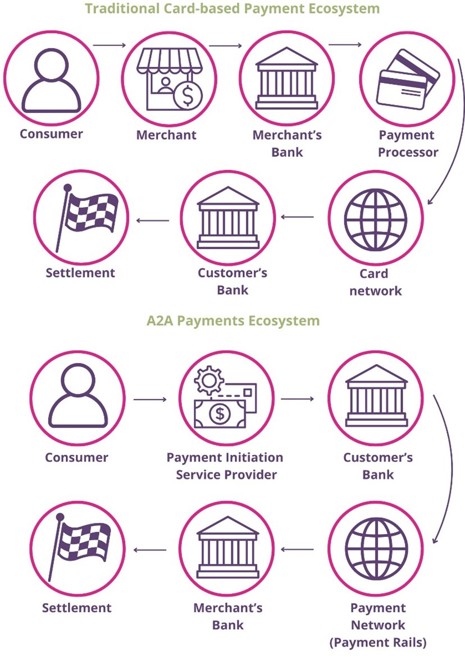
Source: Juniper Research
QR codes have existed for decades but were first applied to payments in 2011, by China’s Alipay. As a result, this payment method became one of the most popular across Asia Pacific. These payments are typically made through digital wallets integrating card details, but bank accounts can also be used as the payment source when QR transactions are made.
QR payments are gaining momentum across Europe, with the payment method seeing use for retail and P2P use cases. For example, Belgium’s Payconiq allows users to make P2P (Person-to-Person) transactions through QR codes, and Sweden’s Swish has enabled bank account-sourced, in-store QR payments for years. Europe’s payment ecosystems are more similar to the UK than their Asia Pacific counterparts are, and consequently represent the potential for QR payments and A2A in the UK. This is enhanced by Open Banking and the number of A2A vendors offering pay by QR code options for online and retail merchants, including Token and Yapily.
Why QR Codes?
Many businesses across the UK have become increasingly discontented towards card payments, due to the transaction fees imposed on merchants. These fees have risen 30% between 2019 and 2024, resulting in Mastercard and Visa being investigated by the UK’s Payment Systems Regulator. Furthermore, UK trade bodies, including the British Retail Consortium and Federation of Small Businesses, have called on the PSR to reduce these fees. This is understandable, given the prevalence of cards in the UK and the need to accept popular payment methods from consumers.
However, QR codes designed to initiate payments represent a strong opportunity for businesses seeking to accept payments without incurring high merchant fees, especially through A2A channels. QR payments are easy for businesses of any size to offer through static QR codes, meaning consumers only have to scan a single code to initiate a payment. Dynamic QR codes are another option, especially given the ease of generating codes depending on the transaction value on smartphones and specific POS terminals. This means that the payment method can be accepted by all kinds of vendors, creating a more financially inclusive market.
Furthermore, merchants that have raised prices due to card fees can potentially reduce prices to compete against other businesses, resulting in consumers benefitting from the proliferation of QR payments. Many consumers understand how QR codes operate, due to their usage in the COVID-19 Track and Trace system, meaning that educating consumers and businesses is unlikely to be a significant barrier to adoption.
NFC (Near Field Communication) is another technology that can be utilised for A2A payments, with Lithuanian fintech kevin. enabling POS terminals from European merchants to accept A2A payments. In August 2024, Apple announced that third-party developers on iOS can enable NFC for payments, potentially opening up more digital wallets in the market. However, UK developers are required to pay Apple an associated fee to enable NFC for payments, potentially resulting in costs being passed onto other parties. Thus, despite NFC being an option that would require minimal technological change for businesses who already have POS machines, QR-initiated transactions mitigate the issue of these transaction fees when making A2A payments.
Another, use case for QR code payments is in cross-border transactions. Some merchants in the UK already offer this through Alipay for Chinese tourists, but prevalence is sparse. By offering not only QR payments, but also interoperability with domestic QR standards across the world, the UK could promote more convenient payments from tourists from many markets, benefitting all parties.
Will the UK Embrace QR Payments?
Now that A2A payments are gaining traction, the potential of QR payments is clear. This is reinforced by HM Treasury suggesting QR codes as a means to facilitate A2A growth in the UK. The two payment methods could promote each other, resulting in parallel growth.
However, the main obstacle to QR payments will be normalising the solution to businesses and consumers. Even with the push from HM Treasury, regulatory pressure on card networks could result in reduced merchant fees and less incentive to adopt A2A. While some examples of QR payments in the UK exist, like Atoa, a UK fintech enabling QR-facilitated A2A payments for small businesses, the UK government should use the forthcoming National Payments Vision to articulate its attitude towards QR payments, charting a new course for consumers and merchants.
Matthew is a Research Analyst in Juniper Research’s Fintech & Payments team, providing invaluable analysis, competitive benchmarking, and forecasting on emerging payment markets. His recent reports include A2A Payments, Embedded Finance, and Buy Now, Pay Later.
Related Research
-
 ReportSeptember 2025Fintech & Payments
 Thomas WilsonA2A Payments Market, 2025-2030
Our A2A Payments research suite provides detailed analysis of this rapidly changing market; enabling A2A payments service providers to gain an understanding of key payment trends and challenges, potential growth opportunities, and the competitive environment.
VIEW -
 ReportAugust 2026QR Code Payments
 Nick MaynardQR Code Payments Market, 2026-2031
This research provides exhaustive coverage of the QR Code Payments market, including the adoption rates of QR code payment systems across retail, person-to-person (P2P), and ticketing use cases.
VIEW -
 ReportFebruary 2025Open Banking APIs
 Matthew PurnellOpen Banking APIs Market, 2025-2029
Our Global Open Banking APIs research suite provides detailed and perceptive analysis of this evolving market; enabling stakeholders such as Open Banking infrastructure and payment service providers, banks and other financial institutions, and eCommerce platforms and merchants to understand future growth, key trends, and the competitive environment.
VIEW
Latest research, whitepapers & press releases
-
 ReportOctober 2026Fintech & Payments
 Michael GreenwoodAccounts Payable Automation Market: 2026-2031
Our Accounts Payable (AP) Automation research suite provides an insightful analysis of this rapidly growing market; enabling stakeholders to understand future growth, key trends and the competitive environment.
VIEW -
 ReportOctober 2026Fintech & Payments
 Jawad JahanCrypto-gaming Market: 2026-2035
Our Crypto-gaming Market research suite provides an insightful analysis of this rapidly growing market; enabling stakeholders - from crypto-gaming and sportsbooks operators, prediction market platforms, business-to-business (B2B) gambling platforms and software providers, to crypto payment processors and regulators - to understand future growth, key trends, and the competitive environment.
VIEW -
 ReportOctober 2026Telecoms & Connectivity
 Alex WebbRetail Roaming Market: 2026-2031
Our Retail Roaming research suite for mobile network operators (MNOs) and mobile virtual network operators (MVNOs) provides detailed analysis and strategic recommendations for the next era of retail roaming.
VIEW -
 ReportSeptember 2026Fintech & Payments
 Dr Manju ChhillarEmbedded Finance Market: 2026-2031
Embedded finance is one of the fastest-growing markets in financial services, and is about to accelerate even further. Our Embedded Finance Market research provides detailed analysis of the key drivers behind this growth, and what these mean for stakeholders in this market.
VIEW -
 ReportSeptember 2026Identity & Security
 Thomas WilsonApplication Security Market: 2026-2031
Our Application Security research suite provides detailed analysis of this emerging market; allowing application security providers to gain an understanding of key security trends and challenges, potential growth opportunities, and the competitive environment.
VIEW -
 ReportSeptember 2026Fintech & Payments
 Shane O'SullivanBanking Fraud Prevention Market: 2026-2031
Our Banking Fraud Prevention research suite provides a comprehensive and in-depth analysis of the types of fraud currently impacting the banking sector, and the evolving methods that can be used to overcome them.
VIEW


-
 WhitepaperOctober 2026Fintech & Payments
Michael Greenwood
WhitepaperOctober 2026Fintech & Payments
Michael GreenwoodAccounts Payable Automation ~ How Businesses Are Reducing Operational Costs
Our complimentary whitepaper, Accounts Payable Automation ~ How Businesses Are Reducing Operational Costs, analyses how AP automation is combatting costs by decreasing the need for manual processes, and provides strategic insight into a number of key trends in the AP automation space.
VIEW -
 WhitepaperOctober 2026Fintech & Payments
Jawad Jahan
WhitepaperOctober 2026Fintech & Payments
Jawad JahanCompliance or Anonymity - The Crypto-gaming Operator’s Dilemma
Our complimentary whitepaper, Compliance or Anonymity - The Crypto-gaming Operator’s Dilemma, analyses the current regulatory landscape of the crypto-gaming market.
VIEW -
 WhitepaperOctober 2026Telecoms & Connectivity
Alex Webb
WhitepaperOctober 2026Telecoms & Connectivity
Alex WebbReimagining the Future of Retail Roaming – How Mobile Network Operators Must Adapt
Our complimentary whitepaper, Reimagining the Future of Retail Roaming – How Mobile Network Operators Must Adapt, explores the emerging opportunities for MNOs within retail roaming.
VIEW -
 WhitepaperSeptember 2026Fintech & Payments
Dr Manju Chhillar
WhitepaperSeptember 2026Fintech & Payments
Dr Manju ChhillarEmerging Markets: The Next Opportunity for Embedded Finance
This free whitepaper examines how a combination of multiple factors is driving North America towards saturation for embedded finance.
VIEW -
 WhitepaperSeptember 2026Emerging Technology
Thomas Wilson
WhitepaperSeptember 2026Emerging Technology
Thomas WilsonVibe Coding: The Fastest-growing Threat to Application Security Today
Our complimentary whitepaper, Vibe Coding: The Fastest-growing Threat to Application Security Today, examines the state of the application security market; considering its impact on different verticals, and how it is being employed in these verticals to best combat malicious attackers and keep sensitive data safe.
VIEW -
 WhitepaperSeptember 2026Fintech & Payments
Shane O'Sullivan
WhitepaperSeptember 2026Fintech & Payments
Shane O'SullivanThe Fraud Frontier: Securing Banking in an AI-driven Era
Our complimentary whitepaper, The Fraud Frontier: Securing Banking in an AI-driven Era, examines the rapidly evolving state of the banking fraud prevention market.
VIEW


-
Fintech & Payments
26th NextGen Payments & RegTech Forum Arrives in Austin, Texas
October 2026 -
Fintech & Payments
Financial Institutions to Spend Over $66.2 Billion Globally on Fraud Prevention by 2031, Driven by Growing Demand for Cross-industry Fraud Intelligence
October 2026 -
Fintech & Payments
Omnichannel Payment Platforms to See a Dramatic 172% Growth in the Value of Transactions Processed Globally by 2031, as Merchants Capitalise on Payment Data
October 2026 -
Fintech & Payments
Accounts Payable Automation to Save Global Businesses 6.2 Billion Hours by 2031, Accelerated by Business System Integration
October 2026 -
Fintech & Payments
The 25th NextGen Payments & RegTech Forum Arrives in Athens, Greece
October 2026 -
Fintech & Payments
Crypto Gaming: Wagers to Reach $1.3 Trillion by 2035, as Crypto Rails Widen Global Access Despite Regulatory Challenges
October 2026