What Do Trump's Tariffs Mean for Fintech & Payments?

(UPDATE: On April 9th, Donald Trump announced a 90-day pause on higher US tariffs for affected countries, introducing instead a universal “reciprocal tariff” of 10%. However, tariffs on Chinese imports were raised sharply to 145%.)
The latest tariffs imposed by the Trump Administration’s have sent shockwaves through the global economy, rattling markets worldwide. In just a matter of days, the Nasdaq plunged 6%, the FTSE 100 slipped 1.5%, and Germany’s DAX dropped 3%.
While the immediate hit is focused on imported goods and the industries that support them, the ripple effects are likely to reach much further: putting even untargeted sectors like fintech and payments in the firing line.
What Are the Tariffs?
The tariffs are a flat tax applied to goods entering the US, with the cost falling on the companies doing the importing. The White House has announced a baseline 10% tariff on all imports, with steeper rates targeting specific countries. Notably, Canada and Mexico were excluded from this latest round, though their goods are already subject to separate tariffs. According to the White House, these measures are being positioned as reciprocal, aiming to level the playing field.
Extent of Tariffs Imposed by the US (%)
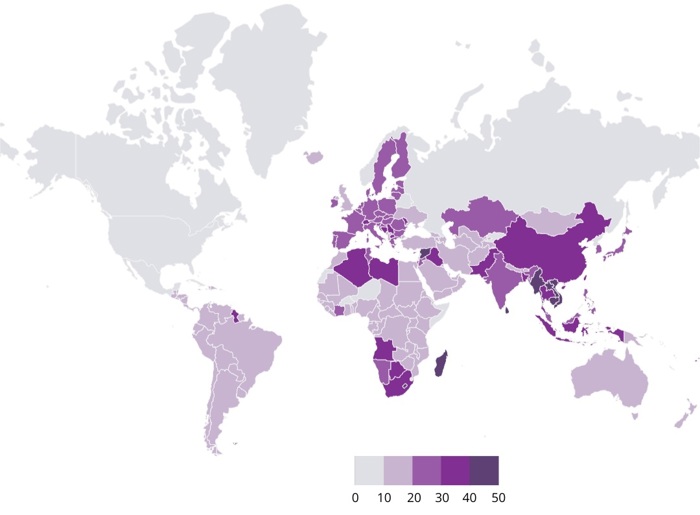
Source: White House
Impact on Cross-border Payments
The B2B cross-border payments market is likely to feel the impact of the tariffs first and most acutely. These transactions are already more complex and costly than domestic payments, and the new tariffs will only add friction.
For providers, this could mean a drop in payment volumes to and from the US, with trade routes shifting as businesses look for more cost-effective options. Heavily impacted countries like Vietnam may see a sharp decline in transaction flow, while others with similar advantages but fewer trade barriers could benefit. Still, even with new corridors gaining traction, the overall volume of transfers is expected to fall. This downturn could squeeze smaller, less resilient players in the space and dampen momentum for innovation.
With fewer incentives to connect the US to global payment systems, efforts to streamline cross-border processes may start to lose steam.
What Will Happen to the Dollar?
Since the Bretton Woods Agreement in 1944, the US dollar has held its place as the global reserve currency, becoming the de facto medium for international trade. Even when two countries trade without using the dollar domestically, transactions are often routed through it. But with US tariffs likely to dampen international trade, fewer businesses will see the need to hold or transact in dollars.
This shift comes as momentum builds behind BRICS Pay, especially following the October 2024 BRICS summit in Russia. Countries like Russia, Iran and China have been vocal about reducing their dependence on the dollar to sidestep Western sanctions and dilute the US’s financial influence. By weakening economic ties between the US and its trading partners, these tariffs may accelerate the adoption of alternative systems, particularly if China actively promotes participation.
This also ties into a broader global movement towards developing homegrown payment infrastructure. From Europe’s push for instant payment schemes to East Asia’s rise in QR code based solutions, domestic alternatives are increasingly competing with US-led networks such as Visa and Mastercard. As seen after Russia’s invasion of Ukraine, the US can pressure these networks to suspend services, exposing the risks of overreliance. In response, many nations are seeking sovereign control over payment rails, and platforms like BRICS Pay or stablecoins offer potential routes around dollar-dominated systems.
While these tariffs didn’t spark the trend, they have certainly added fuel to the fire. Combined with rising geopolitical tensions, they are acting as a catalyst; driving countries to seek more control, more resilience, and fewer ties to US-led financial systems.
What Happens Next?
The tariffs came into force on Saturday 5th April, giving businesses and payment providers very little time to prepare. A point of uncertainty in this process is that critics argue the White House does not have the authority to implement these tariffs, as such measures typically fall within Congress’s remit. This opens the door for a legal challenge, as seen with other controversial executive orders, meaning the future of these tariffs is far from guaranteed.
If the tariffs are here to stay, it’s unlikely that they will push the US out of the trading landscape for many affected countries; the US remains too large a market to ignore. However, solutions that simplify the payment of tariffs, alongside digital methods for tracking goods, verifying their origin, and determining applicable tariffs, are likely to see increasing demand. This presents an opportunity for vendors who can crack these challenges.
Ultimately, this move will only complicate cross-border payments further and is likely to speed up existing trends that diminish the US dollar’s dominance in global trade.
A Senior Research Analyst at Juniper Research, Michael primarily conducts research on digital identity and payments markets. His recent reports include Chargeback Management, Digital Wallets, and Digital Identity.
Related Research
-
 ReportSeptember 2025eCommerce Payments Market
 Nick MaynardeCommerce Payments Market, 2025-2030
Juniper Research’s eCommerce Payments research suite provides a comprehensive and insightful analysis of this market; enabling stakeholders, from eCommerce payment platform providers to merchants and payment service providers, to understand future growth, key trends, and the competitive environment.
VIEW -
 ReportAugust 2026QR Code Payments
Nick MaynardQR Code Payments Market, 2026-2031
ReportAugust 2026QR Code Payments
Nick MaynardQR Code Payments Market, 2026-2031This research provides exhaustive coverage of the QR Code Payments market, including the adoption rates of QR code payment systems across retail, person-to-person (P2P), and ticketing use cases.
VIEW
Latest research, whitepapers & press releases
-
 ReportOctober 2026Fintech & Payments
 Michael GreenwoodAccounts Payable Automation Market: 2026-2031
Our Accounts Payable (AP) Automation research suite provides an insightful analysis of this rapidly growing market; enabling stakeholders to understand future growth, key trends and the competitive environment.
VIEW -
 ReportOctober 2026Fintech & Payments
 Jawad JahanCrypto-gaming Market: 2026-2035
Our Crypto-gaming Market research suite provides an insightful analysis of this rapidly growing market; enabling stakeholders - from crypto-gaming and sportsbooks operators, prediction market platforms, business-to-business (B2B) gambling platforms and software providers, to crypto payment processors and regulators - to understand future growth, key trends, and the competitive environment.
VIEW -
 ReportOctober 2026Telecoms & Connectivity
 Alex WebbRetail Roaming Market: 2026-2031
Our Retail Roaming research suite for mobile network operators (MNOs) and mobile virtual network operators (MVNOs) provides detailed analysis and strategic recommendations for the next era of retail roaming.
VIEW -
 ReportSeptember 2026Fintech & Payments
 Dr Manju ChhillarEmbedded Finance Market: 2026-2031
Embedded finance is one of the fastest-growing markets in financial services, and is about to accelerate even further. Our Embedded Finance Market research provides detailed analysis of the key drivers behind this growth, and what these mean for stakeholders in this market.
VIEW -
 ReportSeptember 2026Identity & Security
 Thomas WilsonApplication Security Market: 2026-2031
Our Application Security research suite provides detailed analysis of this emerging market; allowing application security providers to gain an understanding of key security trends and challenges, potential growth opportunities, and the competitive environment.
VIEW -
 ReportSeptember 2026Fintech & Payments
 Shane O'SullivanBanking Fraud Prevention Market: 2026-2031
Our Banking Fraud Prevention research suite provides a comprehensive and in-depth analysis of the types of fraud currently impacting the banking sector, and the evolving methods that can be used to overcome them.
VIEW


-
 WhitepaperOctober 2026Fintech & Payments
Michael Greenwood
WhitepaperOctober 2026Fintech & Payments
Michael GreenwoodAccounts Payable Automation ~ How Businesses Are Reducing Operational Costs
Our complimentary whitepaper, Accounts Payable Automation ~ How Businesses Are Reducing Operational Costs, analyses how AP automation is combatting costs by decreasing the need for manual processes, and provides strategic insight into a number of key trends in the AP automation space.
VIEW -
 WhitepaperOctober 2026Fintech & Payments
Jawad Jahan
WhitepaperOctober 2026Fintech & Payments
Jawad JahanCompliance or Anonymity - The Crypto-gaming Operator’s Dilemma
Our complimentary whitepaper, Compliance or Anonymity - The Crypto-gaming Operator’s Dilemma, analyses the current regulatory landscape of the crypto-gaming market.
VIEW -
 WhitepaperOctober 2026Telecoms & Connectivity
Alex Webb
WhitepaperOctober 2026Telecoms & Connectivity
Alex WebbReimagining the Future of Retail Roaming – How Mobile Network Operators Must Adapt
Our complimentary whitepaper, Reimagining the Future of Retail Roaming – How Mobile Network Operators Must Adapt, explores the emerging opportunities for MNOs within retail roaming.
VIEW -
 WhitepaperSeptember 2026Fintech & Payments
Dr Manju Chhillar
WhitepaperSeptember 2026Fintech & Payments
Dr Manju ChhillarEmerging Markets: The Next Opportunity for Embedded Finance
This free whitepaper examines how a combination of multiple factors is driving North America towards saturation for embedded finance.
VIEW -
 WhitepaperSeptember 2026Emerging Technology
Thomas Wilson
WhitepaperSeptember 2026Emerging Technology
Thomas WilsonVibe Coding: The Fastest-growing Threat to Application Security Today
Our complimentary whitepaper, Vibe Coding: The Fastest-growing Threat to Application Security Today, examines the state of the application security market; considering its impact on different verticals, and how it is being employed in these verticals to best combat malicious attackers and keep sensitive data safe.
VIEW -
 WhitepaperSeptember 2026Fintech & Payments
Shane O'Sullivan
WhitepaperSeptember 2026Fintech & Payments
Shane O'SullivanThe Fraud Frontier: Securing Banking in an AI-driven Era
Our complimentary whitepaper, The Fraud Frontier: Securing Banking in an AI-driven Era, examines the rapidly evolving state of the banking fraud prevention market.
VIEW


-
Fintech & Payments
Accounts Payable Automation to Save Global Businesses 6.2 Billion Hours by 2031, Accelerated by Business System Integration
October 2026 -
Fintech & Payments
The 25th NextGen Payments & RegTech Forum Arrives in Athens, Greece
October 2026 -
Fintech & Payments
Crypto Gaming: Wagers to Reach $1.3 Trillion by 2035, as Crypto Rails Widen Global Access Despite Regulatory Challenges
October 2026 -
Fintech & Payments
Juniper Research Unveils Identity & Security Award Winners for 2026
October 2026 -
Retail Roaming Revenue to Fall $4 Billion By 2031, as Regulatory Restrictions and Competition Bite
October 2026 -
Fintech & Payments
Soft POS to Surpass 100 Million Installations in 2030
September 2026