Hype vs Reality: How Close Are We to Commercial Quantum Computing?

The quantum technology market has been making waves recently, fuelled by a surge in investment and public attention. Companies such as D-Wave Quantum, Rigetti Computing, and IONQ have seen their share prices climb sharply, reflecting growing investor enthusiasm.
This renewed interest isn’t without reason. UK-based Quantum Motion recently announced the first quantum computer made with silicon chips — a significant step forward, as scalability remains one of the biggest hurdles for quantum technologies to overcome before they become commercially viable.

Source: Quantum Motion
Earlier this year, in February, it was also announced that scientists at Oxford University had successfully linked two quantum processors using light photons. This breakthrough means multiple smaller systems can now work together in a modular fashion. Traditionally, adding more qubits to a system increased the chance of errors, but by connecting smaller modules instead, researchers hope to scale up while keeping error rates low.
The EU has also recognised quantum’s potential, launching the Quantum Europe Strategy in 2025. This initiative focuses on supporting R&D, building infrastructure, investing in quantum ventures, and boosting quantum education — all with the goal of making Europe a quantum powerhouse by 2030.
Meanwhile, JPMorgan’s announcement of a $10 billion investment across 27 industries — including quantum computing — has sent a clear signal to the market: quantum is gradually shifting from experimental science to a technology with real strategic potential.
Challenges
Today’s enthusiasm for quantum feels a lot like the early days of AI: plenty of investment, plenty of excitement, and only a handful of real-world use cases. Quantum is a complex field that even seasoned investors can struggle to fully understand. This can lead to inflated expectations and the risk of a bubble, where hype outpaces actual technological progress.
Despite the huge potential of quantum computing, its practical use cases remain limited. Quantum systems are expensive, require highly skilled specialists, and are difficult to scale. For many companies, commercialisation has proved challenging, with investments far outweighing revenue.
Much of the current buzz comes down to the idea of ‘Q-Day’ — the point when quantum computers will be able to break current encryption standards. The thought of quantum machines rendering today’s data security obsolete is understandably alarming. However, predictions for when Q-Day might arrive vary widely — anywhere from a few years to several decades.
What Success Looks Like
Despite the scepticism, quantum is still making meaningful progress. The comparison to AI isn’t a bad one — while AI took time to find its footing, it eventually revealed several strong use cases.
Major players like Amazon, IBM, Microsoft, and Google now offer Quantum-as-a-Service (QaaS), making the technology more accessible. This involvement from trusted tech giants is a promising sign.
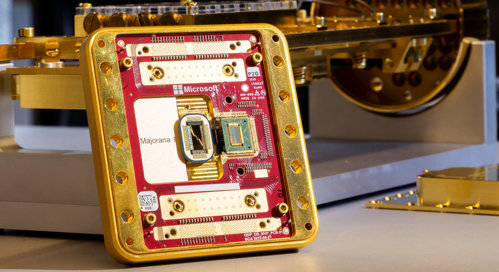
Source: Microsoft
Beyond encryption, quantum systems could be game-changing for optimisation problems — areas where quantum’s ability to explore multiple states at once really shines. This has big implications for sectors like finance, healthcare, and logistics, where optimising complex systems can deliver major efficiencies.
Hybrid quantum-classical systems may also pave the way forward. Rather than replacing traditional computing outright, these hybrid models blend both approaches — offering a more realistic, incremental path to quantum commercialisation.
Future Outlook
Quantum technology is undeniably exciting, but a lot of the current investment still seems to be driven more by hype than by practical application. Part of the problem is accessibility — quantum physics is notoriously difficult to grasp, and the concepts don’t easily connect to most people’s existing knowledge.
Quantum’s relevance has risen and fallen over the years, and while recent breakthroughs are encouraging, commercialisation remains a long way off. No amount of investment can shortcut the need for deep expertise — and building that talent base takes time. Universities worldwide are working hard to expand quantum education, but the field demands a rare combination of physics, software, and engineering skills.
Quantum computing will keep advancing, and as more specialists enter the field, we’ll likely see progress toward major milestones such as Q-Day. However, that progress is unlikely to match the pace of current investment expectations.
In the meantime, it’s worth preparing. Digital security providers should start exploring post-quantum cryptography (PQC) methods. The National Institute of Standards and Technology (NIST) selected three PQC algorithms for standardisation in 2024 — deploying these would be a smart move to protect against future quantum-enabled threats.
Louis is a Research Analyst at Juniper Research, specialising in fintech trends, market forecasting and competitive analysis. He provides in-depth analysis and strategic insight across digital identity, quantum technologies, and fintech innovation. This research helps clients stay ahead of emerging technologies and adapt to shifting regulatory landscapes.
Related Research
-
 ReportSeptember 2024Identity & Security
 Michelle JoynsonQuantum Technology Market, 2024-2030
Our Quantum Market research suite provides a detailed and insightful analysis of this emerging market, enabling governments, quantum computing service providers, and technology vendors to understand future growth in the market.
VIEW -
 ReportJanuary 2025Identity & Security
Michelle JoynsonQuantum Key Distribution Market, 2025-2030
ReportJanuary 2025Identity & Security
Michelle JoynsonQuantum Key Distribution Market, 2025-2030Our Quantum Key Distribution Market research suite provides a detailed analysis of this emerging market; enabling governments, quantum key distribution (QKD) service providers, regulators, cybersecurity companies, and telecommunication companies to capitalise on this evolving technology.
VIEW
Latest research, whitepapers & press releases
-
 ReportOctober 2026Fintech & Payments
 Jawad JahanCrypto-gaming Market: 2026-2035
Our Crypto-gaming Market research suite provides an insightful analysis of this rapidly growing market; enabling stakeholders - from crypto-gaming and sportsbooks operators, prediction market platforms, business-to-business (B2B) gambling platforms and software providers, to crypto payment processors and regulators - to understand future growth, key trends, and the competitive environment.
VIEW -
 ReportOctober 2026Telecoms & Connectivity
 Alex WebbRetail Roaming Market: 2026-2031
Our Retail Roaming research suite for mobile network operators (MNOs) and mobile virtual network operators (MVNOs) provides detailed analysis and strategic recommendations for the next era of retail roaming.
VIEW -
 ReportSeptember 2026Fintech & Payments
 Dr Manju ChhillarEmbedded Finance Market: 2026-2031
Embedded finance is one of the fastest-growing markets in financial services, and is about to accelerate even further. Our Embedded Finance Market research provides detailed analysis of the key drivers behind this growth, and what these mean for stakeholders in this market.
VIEW -
 ReportSeptember 2026Identity & Security
 Thomas WilsonApplication Security Market: 2026-2031
Our Application Security research suite provides detailed analysis of this emerging market; allowing application security providers to gain an understanding of key security trends and challenges, potential growth opportunities, and the competitive environment.
VIEW -
 ReportSeptember 2026Fintech & Payments
 Shane O'SullivanBanking Fraud Prevention Market: 2026-2031
Our Banking Fraud Prevention research suite provides a comprehensive and in-depth analysis of the types of fraud currently impacting the banking sector, and the evolving methods that can be used to overcome them.
VIEW -
 ReportSeptember 2026Telecoms & Connectivity
 Nick MaynardPrivate LTE & 5G Networks Market: 2026-2031
Our Private LTE & 5G Networks research suite provides detailed and insightful analysis of this evolving market; enabling stakeholders - from private LTE & 5G network platform specialists, mobile network operators, and diversified technology companies - to understand future growth, key trends, and the competitive environment.
VIEW


-
 WhitepaperOctober 2026Fintech & Payments
Jawad Jahan
WhitepaperOctober 2026Fintech & Payments
Jawad JahanCompliance or Anonymity - The Crypto-gaming Operator’s Dilemma
Our complimentary whitepaper, Compliance or Anonymity - The Crypto-gaming Operator’s Dilemma, analyses the current regulatory landscape of the crypto-gaming market.
VIEW -
 WhitepaperOctober 2026Telecoms & Connectivity
Alex Webb
WhitepaperOctober 2026Telecoms & Connectivity
Alex WebbReimagining the Future of Retail Roaming – How Mobile Network Operators Must Adapt
Our complimentary whitepaper, Reimagining the Future of Retail Roaming – How Mobile Network Operators Must Adapt, explores the emerging opportunities for MNOs within retail roaming.
VIEW -
 WhitepaperSeptember 2026Fintech & Payments
Dr Manju Chhillar
WhitepaperSeptember 2026Fintech & Payments
Dr Manju ChhillarEmerging Markets: The Next Opportunity for Embedded Finance
This free whitepaper examines how a combination of multiple factors is driving North America towards saturation for embedded finance.
VIEW -
 WhitepaperSeptember 2026Emerging Technology
Thomas Wilson
WhitepaperSeptember 2026Emerging Technology
Thomas WilsonVibe Coding: The Fastest-growing Threat to Application Security Today
Our complimentary whitepaper, Vibe Coding: The Fastest-growing Threat to Application Security Today, examines the state of the application security market; considering its impact on different verticals, and how it is being employed in these verticals to best combat malicious attackers and keep sensitive data safe.
VIEW -
 WhitepaperSeptember 2026Fintech & Payments
Shane O'Sullivan
WhitepaperSeptember 2026Fintech & Payments
Shane O'SullivanThe Fraud Frontier: Securing Banking in an AI-driven Era
Our complimentary whitepaper, The Fraud Frontier: Securing Banking in an AI-driven Era, examines the rapidly evolving state of the banking fraud prevention market.
VIEW -
 WhitepaperSeptember 2026Telecoms & Connectivity
Nick Maynard
WhitepaperSeptember 2026Telecoms & Connectivity
Nick MaynardHow Private Cellular Networks Are Unlocking Industry 4.0
Our complimentary whitepaper, How Private Cellular Networks Are Unlocking Industry 4.0, examines how private LTE & 5G networks are reshaping the way industry works.
VIEW


-
Fintech & Payments
Crypto Gaming: Wagers to Reach $1.3 Trillion by 2035, as Crypto Rails Widen Global Access Despite Regulatory Challenges
October 2026 -
Fintech & Payments
Juniper Research Unveils Identity & Security Award Winners for 2026
October 2026 -
Retail Roaming Revenue to Fall $4 Billion By 2031, as Regulatory Restrictions and Competition Bite
October 2026 -
Fintech & Payments
Soft POS to Surpass 100 Million Installations in 2030
September 2026 -
Fintech & Payments
The NextGen Payments & RegTech Forum Arrives in Dubai
September 2026 -
Fintech & Payments
The Global Trade Finance Expo Arrives in Dubai, UAE
September 2026