Q-Day: The Race to Secure Satellite Connectivity

Driven by the prospect of being connected no matter where on Earth you are, the satellite IoT market has grown. In particular, the introduction of LEO (Low-Earth Orbit) satellites has pushed this growth, with faster development and lower costs to both develop and launch compared to traditional satellites. LEO satellites are expected to grow by 166% globally by 2030, as seen in the figure below:
Number of LEO Satellites in Service, 2024 vs 2030
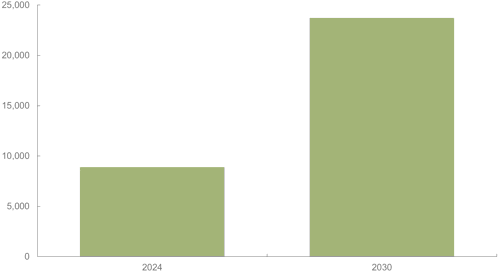
Source: Juniper Research
However, the growing threat of cyberattacks continues to remain a large issue within this market. As satellites have numerous access points through ground stations, the satellites themselves and IoT devices, monitoring and defending satellite communications against cyberattacks can be difficult, with some unauthorised entries into the network hard to trace, and some even going undetected.
In order to protect data against cyberthreats, satellite network operators have to ensure that they use advanced encryption algorithms. One of the ways in which to create an almost hack-proof defence is through the use of quantum cryptography, particularly methods such as QKD (Quantum Key Distribution). QKD uses the random state of quantum particles, such as photons, to share keys between two parties. This method is considered hack-proof because of its ability to send alerts if a key is tampered with by a third party. Any third-party interference with the key will result in the photons changing their state, which will send an alert to the sender that a new key needs to be distributed.
However, the development of quantum computing has caused deep unrest in the cybersecurity industry because of their ability to solve complex algorithms in a much shorter time frame than classical computers. In the hands of bad actors, this will mean that any advanced encryption algorithms used to protect data, including QKD, could be broken in a matter of days, leaving companies and the public incredibly vulnerable.
As we enter a post-quantum phase, operators are looking for the best possible defence to keep data safe from attacks not only from classical computers, but from quantum computers as well. This has resulted in a race to develop quantum-safe cryptography or post-quantum cryptography before what has been dubbed as Q-day – the day that quantum computers will be able to break public encryption systems. With the development of quantum computing via key players such as Google and IBM, this may be coming sooner than we expect.
So, how do we prepare for Q-day?
The use of AI and machine learning will prove vital in the development and optimisation of post-quantum encryption algorithms. These algorithms use advanced mathematical problems to ensure that they are quantum resilient. However, these algorithms may also become vulnerable to quantum attacks in the future. Machine learning and AI can help detect the best algorithm for a situation and swap algorithms to help protect against attacks. They can also aid in threat and anomaly detection, one of the first lines of defence in cybersecurity. Machine learning algorithms can be trained to analyse large amounts of data in real-time, triggering an alert if an anomaly or threat is detected.
As the satellite IoT services market continues to grow, operators have a responsibility to protecting their uses against these attacks. Investing in advanced cybersecurity practices such as post-quantum cryptography will become a necessity. Partnering with cybersecurity firms will also prove beneficial, as Starlink, a satellite Internet constellation, and Qusecure, a provider of quantum security solutions, have recently announced the development of the first quantum-resilient satellite; using post-quantum cryptography. As cyberattacks will forever evolve, cybersecurity will have to evolve with them. In order to keep data as safe as possible and mitigate attacks, operators must always develop, monitor and test their solutions, as well as remaining vigilant to the current landscape of cybersecurity.
As a Research Analyst within Juniper Research's IoT & Emerging Technology team, Michelle provides insight and analysis on the latest developments in nascent, fast-growing technology markets. Her latest reports include Smart Buildings and Satellite IoT.


Latest research, whitepapers & press releases
-
 ReportOctober 2026Fintech & Payments
 Michael GreenwoodAccounts Payable Automation Market: 2026-2031
Our Accounts Payable (AP) Automation research suite provides an insightful analysis of this rapidly growing market; enabling stakeholders to understand future growth, key trends and the competitive environment.
VIEW -
 ReportOctober 2026Fintech & Payments
 Jawad JahanCrypto-gaming Market: 2026-2035
Our Crypto-gaming Market research suite provides an insightful analysis of this rapidly growing market; enabling stakeholders - from crypto-gaming and sportsbooks operators, prediction market platforms, business-to-business (B2B) gambling platforms and software providers, to crypto payment processors and regulators - to understand future growth, key trends, and the competitive environment.
VIEW -
 ReportOctober 2026Telecoms & Connectivity
 Alex WebbRetail Roaming Market: 2026-2031
Our Retail Roaming research suite for mobile network operators (MNOs) and mobile virtual network operators (MVNOs) provides detailed analysis and strategic recommendations for the next era of retail roaming.
VIEW -
 ReportSeptember 2026Fintech & Payments
 Dr Manju ChhillarEmbedded Finance Market: 2026-2031
Embedded finance is one of the fastest-growing markets in financial services, and is about to accelerate even further. Our Embedded Finance Market research provides detailed analysis of the key drivers behind this growth, and what these mean for stakeholders in this market.
VIEW -
 ReportSeptember 2026Identity & Security
 Thomas WilsonApplication Security Market: 2026-2031
Our Application Security research suite provides detailed analysis of this emerging market; allowing application security providers to gain an understanding of key security trends and challenges, potential growth opportunities, and the competitive environment.
VIEW -
 ReportSeptember 2026Fintech & Payments
 Shane O'SullivanBanking Fraud Prevention Market: 2026-2031
Our Banking Fraud Prevention research suite provides a comprehensive and in-depth analysis of the types of fraud currently impacting the banking sector, and the evolving methods that can be used to overcome them.
VIEW


-
 WhitepaperOctober 2026Fintech & Payments
Jawad Jahan
WhitepaperOctober 2026Fintech & Payments
Jawad JahanCompliance or Anonymity - The Crypto-gaming Operator’s Dilemma
Our complimentary whitepaper, Compliance or Anonymity - The Crypto-gaming Operator’s Dilemma, analyses the current regulatory landscape of the crypto-gaming market.
VIEW -
 WhitepaperOctober 2026Telecoms & Connectivity
Alex Webb
WhitepaperOctober 2026Telecoms & Connectivity
Alex WebbReimagining the Future of Retail Roaming – How Mobile Network Operators Must Adapt
Our complimentary whitepaper, Reimagining the Future of Retail Roaming – How Mobile Network Operators Must Adapt, explores the emerging opportunities for MNOs within retail roaming.
VIEW -
 WhitepaperSeptember 2026Fintech & Payments
Dr Manju Chhillar
WhitepaperSeptember 2026Fintech & Payments
Dr Manju ChhillarEmerging Markets: The Next Opportunity for Embedded Finance
This free whitepaper examines how a combination of multiple factors is driving North America towards saturation for embedded finance.
VIEW -
 WhitepaperSeptember 2026Emerging Technology
Thomas Wilson
WhitepaperSeptember 2026Emerging Technology
Thomas WilsonVibe Coding: The Fastest-growing Threat to Application Security Today
Our complimentary whitepaper, Vibe Coding: The Fastest-growing Threat to Application Security Today, examines the state of the application security market; considering its impact on different verticals, and how it is being employed in these verticals to best combat malicious attackers and keep sensitive data safe.
VIEW -
 WhitepaperSeptember 2026Fintech & Payments
Shane O'Sullivan
WhitepaperSeptember 2026Fintech & Payments
Shane O'SullivanThe Fraud Frontier: Securing Banking in an AI-driven Era
Our complimentary whitepaper, The Fraud Frontier: Securing Banking in an AI-driven Era, examines the rapidly evolving state of the banking fraud prevention market.
VIEW -
 WhitepaperSeptember 2026Telecoms & Connectivity
 Nick Maynard
How Private Cellular Networks Are Unlocking Industry 4.0
Our complimentary whitepaper, How Private Cellular Networks Are Unlocking Industry 4.0, examines how private LTE & 5G networks are reshaping the way industry works.
VIEW


-
Fintech & Payments
The 25th NextGen Payments & RegTech Forum Arrives in Athens, Greece
October 2026 -
Fintech & Payments
Crypto Gaming: Wagers to Reach $1.3 Trillion by 2035, as Crypto Rails Widen Global Access Despite Regulatory Challenges
October 2026 -
Fintech & Payments
Juniper Research Unveils Identity & Security Award Winners for 2026
October 2026 -
Retail Roaming Revenue to Fall $4 Billion By 2031, as Regulatory Restrictions and Competition Bite
October 2026 -
Fintech & Payments
Soft POS to Surpass 100 Million Installations in 2030
September 2026 -
Fintech & Payments
The NextGen Payments & RegTech Forum Arrives in Dubai
September 2026