QKD in 2025: Innovations, Challenges, and the Path to Adoption

In the past five years, AI and IoT technologies have rapidly reshaped industries and entire economies, driving digital transformation and streamlining essential processes. But as data volumes soar and cyber threats escalate, the risks to data privacy and security have become a pressing concern. In response, tech giants and governments are ramping up investments in cutting-edge quantum security solutions, with Quantum Key Distribution (QKD) at the forefront of this new era of protection..
QKD leverages the unique principles of quantum mechanics to encrypt data, offering a level of security so advanced it’s considered virtually impossible to hack. The QKD market is advancing at a rapid pace, with exciting breakthroughs and innovations already making waves in the first quarter of this year:
- Multiplexing - In March 2025, Toshiba and KDDI Research demonstrated QKD technology for multiplexing, in what is considered a world first. Multiplexing allows QKD and data signals to share existing fibre optic networks, cutting down both the cost and complexity of deploying a dedicated QKD infrastructure. By assigning secret keys to the C-band and high-volume data to the O-Band, this solution makes it possible to transmit both over a single optical fibre - in this case, at an impressive 33.4 Tbps over 80 km, delivering stronger security and improved usability..
- Continuous-variable QKD - In March 2025, QKD company LuxQuanta released the second generation of its NOVA LQ Continuous-variable QKD (CV-QKD) system. CV-QKD systems are QKD systems that encode quantum information using properties of light. The upgraded system extends the range to 100 km and 20 db; more than double the earlier version’s capability. In addition, the new system is built as a plug and play system, allowing for easy integration with existing infrastructure and ensuring a more cost-effective solution.
- Quantum-secure Space Communications - In January 2025, the European Space Agency (ESA) and the European Commission confirmed their cooperation on the European Quantum Communication Infrastructure (EuroQCI). The EuroQCI will be an advanced network that will leverage QKD to protect Europe’s vital infrastructure, using a combination of both fibre optics and satellites. The ESA will lead the development of a satellite constellation that will enable the network to be vastly expanded across Europe. The use of satellite communications will enable the network to be vastly extended.
Despite these exciting innovations, challenges like low key rates, distance limitations, and high costs still hinder the widespread adoption of QKD technology. Nevertheless, we forecast a significant surge in adoption, with the number of businesses using QKD services set to grow from just over 1,000 in 2025 to 3,000 by 2030; representing an impressive 151% growth. This rapid expansion underscores the growing interest in QKD, even as it’s still in its early stages.
Global Number of Businesses Adopting Quantum Key Distribution Services
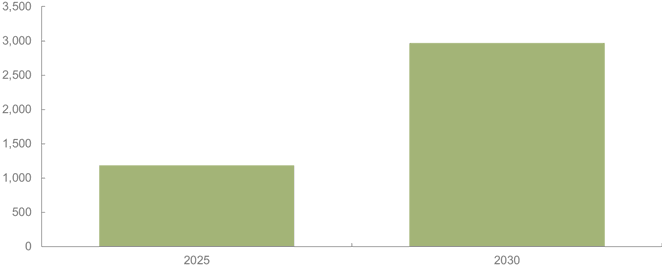
Source: Juniper Research
To seize the momentum in QKD service adoption, vendors need to act decisively across several strategic fronts:
Develop hybrid solutions:
QKD offers near-unbreakable encryption, but it lacks built-in authorisation and authentication, meaning organisations still rely on traditional methods; leaving room for cyber attacks. To close this gap, vendors should combine QKD with Post-Quantum Cryptography (PQC), creating a hybrid solution that blends quantum-secure key distribution with robust authentication. PQC uses advanced mathematical algorithms to protect against both classical and quantum threats.
However, it's worth noting that PQC’s resistance to quantum attacks isn’t mathematically proven in the same way QKD protocols are. That’s why a hybrid approach is key; but also complex. Successfully integrating these two technologies will require specialised expertise, whether developed in-house, sourced from research institutions, or secured through strategic partnerships with PQC providers.
Target industry giants:
Early adopters of QKD include major players in finance, government, and telecoms - think JP Morgan Chase, BT, and HSBC. These organisations are not only investing in quantum tech but also helping to shape its future. To tap into these opportunities, QKD vendors must continuously push innovation and offer niche capabilities - like advanced multiplexing - that set them apart. Collaborating closely with these industry leaders can unlock essential resources and accelerate development.
Accelerate quantum repeater development:
One of the biggest roadblocks to scaling QKD is the absence of quantum repeaters. Unlike classical systems, where repeaters copy and boost signals over long distances, quantum repeaters operate differently and are much harder to develop. Though they've shown promise in lab environments, real-world deployment remains elusive due to high costs and technical hurdles. Still, they are critical to expanding QKD to match the reach of today’s classical networks.
To make this leap, QKD vendors need to forge alliances with research institutions, tech giants, and even rival vendors to drive innovation and make this foundational technology a reality.
While Juniper Research forecasts commercial quantum computers are still 10–15 years away, the rising threat of cyber attacks is prompting enterprises to act now. To capitalise on this urgency, QKD vendors must form strategic partnerships, continue innovating, and deliver comprehensive solutions that meet the growing demand for quantum-secure communication.
As a Research Analyst within Juniper Research's IoT & Emerging Technology team, Michelle provides insight and analysis on the latest developments in nascent, fast-growing technology markets. Her latest reports include Private Cellular Networks, Quantum Key Distribution, and IoT Cybersecurity.
Related Research
-
 ReportJanuary 2025Identity & Security
 Michelle JoynsonQuantum Key Distribution Market, 2025-2030
Our Quantum Key Distribution Market research suite provides a detailed analysis of this emerging market; enabling governments, quantum key distribution (QKD) service providers, regulators, cybersecurity companies, and telecommunication companies to capitalise on this evolving technology.
VIEW -
 ReportSeptember 2024Identity & Security
Michelle JoynsonQuantum Technology Market, 2024-2030
ReportSeptember 2024Identity & Security
Michelle JoynsonQuantum Technology Market, 2024-2030Our Quantum Market research suite provides a detailed and insightful analysis of this emerging market, enabling governments, quantum computing service providers, and technology vendors to understand future growth in the market.
VIEW
Latest research, whitepapers & press releases
-
 ReportOctober 2026Fintech & Payments
 Michael GreenwoodAccounts Payable Automation Market: 2026-2031
Our Accounts Payable (AP) Automation research suite provides an insightful analysis of this rapidly growing market; enabling stakeholders to understand future growth, key trends and the competitive environment.
VIEW -
 ReportOctober 2026Fintech & Payments
 Jawad JahanCrypto-gaming Market: 2026-2035
Our Crypto-gaming Market research suite provides an insightful analysis of this rapidly growing market; enabling stakeholders - from crypto-gaming and sportsbooks operators, prediction market platforms, business-to-business (B2B) gambling platforms and software providers, to crypto payment processors and regulators - to understand future growth, key trends, and the competitive environment.
VIEW -
 ReportOctober 2026Telecoms & Connectivity
 Alex WebbRetail Roaming Market: 2026-2031
Our Retail Roaming research suite for mobile network operators (MNOs) and mobile virtual network operators (MVNOs) provides detailed analysis and strategic recommendations for the next era of retail roaming.
VIEW -
 ReportSeptember 2026Fintech & Payments
 Dr Manju ChhillarEmbedded Finance Market: 2026-2031
Embedded finance is one of the fastest-growing markets in financial services, and is about to accelerate even further. Our Embedded Finance Market research provides detailed analysis of the key drivers behind this growth, and what these mean for stakeholders in this market.
VIEW -
 ReportSeptember 2026Identity & Security
 Thomas WilsonApplication Security Market: 2026-2031
Our Application Security research suite provides detailed analysis of this emerging market; allowing application security providers to gain an understanding of key security trends and challenges, potential growth opportunities, and the competitive environment.
VIEW -
 ReportSeptember 2026Fintech & Payments
 Shane O'SullivanBanking Fraud Prevention Market: 2026-2031
Our Banking Fraud Prevention research suite provides a comprehensive and in-depth analysis of the types of fraud currently impacting the banking sector, and the evolving methods that can be used to overcome them.
VIEW


-
 WhitepaperOctober 2026Fintech & Payments
Michael Greenwood
WhitepaperOctober 2026Fintech & Payments
Michael GreenwoodAccounts Payable Automation ~ How Businesses Are Reducing Operational Costs
Our complimentary whitepaper, Accounts Payable Automation ~ How Businesses Are Reducing Operational Costs, analyses how AP automation is combatting costs by decreasing the need for manual processes, and provides strategic insight into a number of key trends in the AP automation space.
VIEW -
 WhitepaperOctober 2026Fintech & Payments
Jawad Jahan
WhitepaperOctober 2026Fintech & Payments
Jawad JahanCompliance or Anonymity - The Crypto-gaming Operator’s Dilemma
Our complimentary whitepaper, Compliance or Anonymity - The Crypto-gaming Operator’s Dilemma, analyses the current regulatory landscape of the crypto-gaming market.
VIEW -
 WhitepaperOctober 2026Telecoms & Connectivity
Alex Webb
WhitepaperOctober 2026Telecoms & Connectivity
Alex WebbReimagining the Future of Retail Roaming – How Mobile Network Operators Must Adapt
Our complimentary whitepaper, Reimagining the Future of Retail Roaming – How Mobile Network Operators Must Adapt, explores the emerging opportunities for MNOs within retail roaming.
VIEW -
 WhitepaperSeptember 2026Fintech & Payments
Dr Manju Chhillar
WhitepaperSeptember 2026Fintech & Payments
Dr Manju ChhillarEmerging Markets: The Next Opportunity for Embedded Finance
This free whitepaper examines how a combination of multiple factors is driving North America towards saturation for embedded finance.
VIEW -
 WhitepaperSeptember 2026Emerging Technology
Thomas Wilson
WhitepaperSeptember 2026Emerging Technology
Thomas WilsonVibe Coding: The Fastest-growing Threat to Application Security Today
Our complimentary whitepaper, Vibe Coding: The Fastest-growing Threat to Application Security Today, examines the state of the application security market; considering its impact on different verticals, and how it is being employed in these verticals to best combat malicious attackers and keep sensitive data safe.
VIEW -
 WhitepaperSeptember 2026Fintech & Payments
Shane O'Sullivan
WhitepaperSeptember 2026Fintech & Payments
Shane O'SullivanThe Fraud Frontier: Securing Banking in an AI-driven Era
Our complimentary whitepaper, The Fraud Frontier: Securing Banking in an AI-driven Era, examines the rapidly evolving state of the banking fraud prevention market.
VIEW


-
Fintech & Payments
Accounts Payable Automation to Save Global Businesses 6.2 Billion Hours by 2031, Accelerated by Business System Integration
October 2026 -
Fintech & Payments
The 25th NextGen Payments & RegTech Forum Arrives in Athens, Greece
October 2026 -
Fintech & Payments
Crypto Gaming: Wagers to Reach $1.3 Trillion by 2035, as Crypto Rails Widen Global Access Despite Regulatory Challenges
October 2026 -
Fintech & Payments
Juniper Research Unveils Identity & Security Award Winners for 2026
October 2026 -
Retail Roaming Revenue to Fall $4 Billion By 2031, as Regulatory Restrictions and Competition Bite
October 2026 -
Fintech & Payments
Soft POS to Surpass 100 Million Installations in 2030
September 2026