Advanced Air Mobility: How Can Companies Soar Above Funding Hurdles?

Flying taxis have been featured in many futuristic films. However, they have always seemed out of reach until now. The advancements in key technologies such as electric propulsion and AI-driven autonomous systems have allowed for the creation of AAM (Advanced Air Mobility) vehicles that will enhance the transportation of both human and cargo delivery, especially in cities and in remote rural locations.
By implementing green technology such as hydrogen fuel and advanced battery technologies, AAM vehicles will be able to provide a greener, faster and more agile form of transportation. This will relieve both congestion and carbon emissions in major cities, and provide rural locations with quick access to cities and to other areas, as well as to supplies.
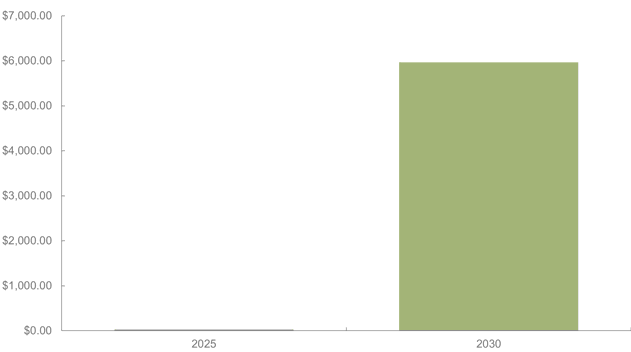
Global Revenue from AAM Services ($m), 2025 vs 2030
Source: Juniper Research
Our latest report predicts that UAM (Urban Air Mobility) services - that is, the transport of people in cities - will be the most lucrative services for AAM companies. Juniper Research also forecasts that revenue for UAM services will reach $6 billion globally by 2030 from $31 million in 2025.
However, the AAM market has many challenges to overcome before it can obtain this revenue, as AAM industry giant Lilium recently highlighted; having had to push for immediate funding to save the company from insolvency. Lilium is one of many companies that have had to urge for more funding, as German AAM company Volocopter announced earlier this year that the company required more funding to complete the testing of its latest aircraft design - which it later received.
This need for increased funding comes with decreased VC funding in AAM, which dropped after reaching its height in 2021; reaching nearly $8 billion. The increase in 2021 was due to the technology's potential to transform societies amidst COVID-19 regulations. However, as the technology was not immediately ready, funding decreased heavily in 2022 to around $3 billion.
Despite the drop in funding since 2021, AAM companies have managed to advance the technology to the point of commercialisation, with many countries, such as US and China looking to commercialise services as early as 2025. Nevertheless, AAM companies still face huge challenges, one of the most pressing being no standardised regulations.
However, given a lack of regulations among AI, aviation and cybersecurity regulators, public trust will be low, and hence, revenue will also be low. Funding remains an issue for companies as funding remains minimal and many companies must compete for a proportion of this funding. Lastly, AAM vehicles require a large amount of vertiports, or landing pads, in multiple locations for services to be profitable. Nevertheless, gaining permission from governments and municipalities to build these infrastructures can be difficult for AAM companies, especially in cities and local areas that are resistant to the technology, given safety fears.
Key Revenue Strategies
Although there are several challenges that the AAM market faces, operators can take several steps to build a strong foundation on which they can successfully implement AAM technologies into transport systems and hence maximise revenue:
- Partner with Government and Municipalities: Given that UAM services will be the most lucrative services available, companies must partner with government and local municipalities to integrate a landing infrastructure for AAM vehicles, called vertiports, into existing transportation infrastructures, such as airports, bus stops and taxi ranks.
- Public and Private Demonstrations: Companies must arrange both public and private demonstrations of the capabilities and features of AAM vehicles. In particular, this will allow them to highlight safety features, which will be key to gaining public trust. For private demonstrations, potential revenue projections and carbon emissions savings projections savings, as well as safety features, will be key to obtaining more funding from potential investors.
- Partner on Certification and Standardisation: A lack of standardisation in regulations is one of the biggest challenges the AAM market faces. As AAM vehicles use AI-driven systems for autonomy, there are fears of malfunctions and cybersecurity risks such as data theft or remote take-overs. To create a safe service for both people and cargo, a certification system against which AI systems can be measured will need to be put in place, as well as cybersecurity certifications and aviation certifications. Companies must partner with regulatory bodies such as the FAA (Federal Aviation Administration) and ISO (International Organization for Standardization) to ensure that these regulations and certifications are put in place. Certifications from regulatory bodies will be essential for companies to build public trust in their products and services and gain more funding from investors.
- Partner with MaaS Providers: MaaS (Mobility-as-a-Service) providers present a good opportunity for AAM companies to gain exposure and access to a large customer base. Juniper Research anticipates that integration into MaaS will provide a significant revenue stream for AAM companies in the next 10 years and help build public trust. For the more immediate future, companies should focus on strong branding on MaaS platforms; highlighting their safety features and certifications to further build up public engagement and trust.
Although funding for AAM has not yet reached the heights of 2021, implementing these steps will ensure that AAM companies overcome the key infrastructural and public perception challenges they currently face which will help generate more funding. As AAM services commercialise, it will also aid AAM companies in capitalising on the fast-growing revenue that the AAM market will produce.
As a Research Analyst within Juniper Research's IoT & Emerging Technology team, Michelle provides insight and analysis on the latest developments in nascent, fast-growing technology markets. Her latest reports include Advanced Air Mobility, Smart Buildings, and Satellite IoT.
Related Research
-
 ReportSeptember 2024Emerging Technology
 Michelle JoynsonAdvanced Air Mobility Market, 2024-2035
Our Advanced Air Mobility research suite provides a comprehensive and insightful analysis of this emerging aviation industry; allowing electric aircraft providers, transport and cargo services and government and municipalities to understand future growth opportunities, particularly in urban mobility and eCommerce logistics, as the market commercialises.
VIEW
Latest research, whitepapers & press releases
-
 ReportOctober 2026Fintech & Payments
 Michael GreenwoodAccounts Payable Automation Market: 2026-2031
Our Accounts Payable (AP) Automation research suite provides an insightful analysis of this rapidly growing market; enabling stakeholders to understand future growth, key trends and the competitive environment.
VIEW -
 ReportOctober 2026Fintech & Payments
 Jawad JahanCrypto-gaming Market: 2026-2035
Our Crypto-gaming Market research suite provides an insightful analysis of this rapidly growing market; enabling stakeholders - from crypto-gaming and sportsbooks operators, prediction market platforms, business-to-business (B2B) gambling platforms and software providers, to crypto payment processors and regulators - to understand future growth, key trends, and the competitive environment.
VIEW -
 ReportOctober 2026Telecoms & Connectivity
 Alex WebbRetail Roaming Market: 2026-2031
Our Retail Roaming research suite for mobile network operators (MNOs) and mobile virtual network operators (MVNOs) provides detailed analysis and strategic recommendations for the next era of retail roaming.
VIEW -
 ReportSeptember 2026Fintech & Payments
 Dr Manju ChhillarEmbedded Finance Market: 2026-2031
Embedded finance is one of the fastest-growing markets in financial services, and is about to accelerate even further. Our Embedded Finance Market research provides detailed analysis of the key drivers behind this growth, and what these mean for stakeholders in this market.
VIEW -
 ReportSeptember 2026Identity & Security
 Thomas WilsonApplication Security Market: 2026-2031
Our Application Security research suite provides detailed analysis of this emerging market; allowing application security providers to gain an understanding of key security trends and challenges, potential growth opportunities, and the competitive environment.
VIEW -
 ReportSeptember 2026Fintech & Payments
 Shane O'SullivanBanking Fraud Prevention Market: 2026-2031
Our Banking Fraud Prevention research suite provides a comprehensive and in-depth analysis of the types of fraud currently impacting the banking sector, and the evolving methods that can be used to overcome them.
VIEW


-
 WhitepaperOctober 2026Fintech & Payments
Michael Greenwood
WhitepaperOctober 2026Fintech & Payments
Michael GreenwoodAccounts Payable Automation ~ How Businesses Are Reducing Operational Costs
Our complimentary whitepaper, Accounts Payable Automation ~ How Businesses Are Reducing Operational Costs, analyses how AP automation is combatting costs by decreasing the need for manual processes, and provides strategic insight into a number of key trends in the AP automation space.
VIEW -
 WhitepaperOctober 2026Fintech & Payments
Jawad Jahan
WhitepaperOctober 2026Fintech & Payments
Jawad JahanCompliance or Anonymity - The Crypto-gaming Operator’s Dilemma
Our complimentary whitepaper, Compliance or Anonymity - The Crypto-gaming Operator’s Dilemma, analyses the current regulatory landscape of the crypto-gaming market.
VIEW -
 WhitepaperOctober 2026Telecoms & Connectivity
Alex Webb
WhitepaperOctober 2026Telecoms & Connectivity
Alex WebbReimagining the Future of Retail Roaming – How Mobile Network Operators Must Adapt
Our complimentary whitepaper, Reimagining the Future of Retail Roaming – How Mobile Network Operators Must Adapt, explores the emerging opportunities for MNOs within retail roaming.
VIEW -
 WhitepaperSeptember 2026Fintech & Payments
Dr Manju Chhillar
WhitepaperSeptember 2026Fintech & Payments
Dr Manju ChhillarEmerging Markets: The Next Opportunity for Embedded Finance
This free whitepaper examines how a combination of multiple factors is driving North America towards saturation for embedded finance.
VIEW -
 WhitepaperSeptember 2026Emerging Technology
Thomas Wilson
WhitepaperSeptember 2026Emerging Technology
Thomas WilsonVibe Coding: The Fastest-growing Threat to Application Security Today
Our complimentary whitepaper, Vibe Coding: The Fastest-growing Threat to Application Security Today, examines the state of the application security market; considering its impact on different verticals, and how it is being employed in these verticals to best combat malicious attackers and keep sensitive data safe.
VIEW -
 WhitepaperSeptember 2026Fintech & Payments
Shane O'Sullivan
WhitepaperSeptember 2026Fintech & Payments
Shane O'SullivanThe Fraud Frontier: Securing Banking in an AI-driven Era
Our complimentary whitepaper, The Fraud Frontier: Securing Banking in an AI-driven Era, examines the rapidly evolving state of the banking fraud prevention market.
VIEW


-
Fintech & Payments
Accounts Payable Automation to Save Global Businesses 6.2 Billion Hours by 2031, Accelerated by Business System Integration
October 2026 -
Fintech & Payments
The 25th NextGen Payments & RegTech Forum Arrives in Athens, Greece
October 2026 -
Fintech & Payments
Crypto Gaming: Wagers to Reach $1.3 Trillion by 2035, as Crypto Rails Widen Global Access Despite Regulatory Challenges
October 2026 -
Fintech & Payments
Juniper Research Unveils Identity & Security Award Winners for 2026
October 2026 -
Retail Roaming Revenue to Fall $4 Billion By 2031, as Regulatory Restrictions and Competition Bite
October 2026 -
Fintech & Payments
Soft POS to Surpass 100 Million Installations in 2030
September 2026