Physical AI Was Everywhere at CES '26. But What Happens Next?

Physical AI was one of the standout themes at CES 2026, spanning everything from humanoid robots to autonomous driving. At its core, physical AI refers to artificial intelligence designed to perceive and interact with the real world by being embedded in hardware — most notably, robotics.

What makes physical AI so disruptive is the way it combines advanced AI frameworks with robotics hardware to autonomously carry out complex, real-world tasks. Because these systems can learn and operate in live environments, sectors such as manufacturing, logistics, healthcare, and retail stand to unlock new levels of automation and scalability. Robotics itself isn’t new, but the emergence of foundational models for physical AI is what’s pushing the market forward; enabling far greater autonomy across a much broader range of use cases.
Autonomous Vehicles Leading the Way
While robots may have grabbed the headlines at CES, the most immediate opportunity for physical AI is likely to sit within the automotive sector; particularly autonomous vehicles (AVs) and autonomous driving. That’s largely because manufacturers can begin to monetise these capabilities over time, helped along by rapid progress in AI performance and efficiency.
One of the most notable announcements came from NVIDIA, which unveiled Alpamayo: a family of open AI models, simulation tools, and datasets designed to accelerate the development of reasoning-based AVs. The platform introduces vision-language-action (VLA) models, allowing vehicles to interpret their surroundings, reason in real time, and respond more like a human driver across a wide range of scenarios.
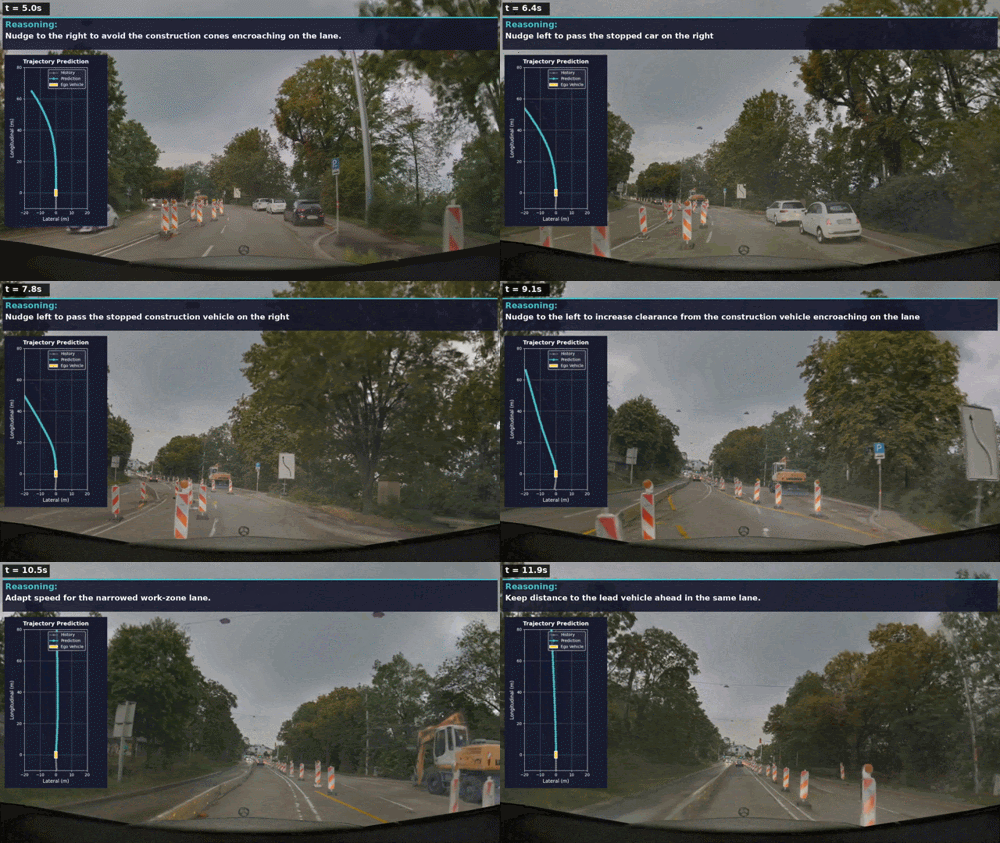 Source: NVIDIA
By making Alpamayo open source, automotive OEMs can integrate it alongside their own systems and tailor it to new use cases: from advanced off-road driving to next-generation mobility services. Just as importantly, this open approach lowers the barrier to entry across the AV ecosystem, encouraging competition and, ultimately, faster innovation.
But Humanoid Robots Are Catching Up Fast
That said, physical AI isn’t only about vehicles. We expect some of the most significant long-term momentum to come from humanoid robotics, particularly as robots begin incorporating multimodal reasoning models such as NVIDIA's Isaac GR00T N1. These models support reinforcement learning and are trained in realistic environments, which makes them especially well suited to the diverse and unpredictable tasks humanoid robots are expected to perform.
The open-source nature of these foundational models is a major reason why we believe adoption will accelerate. Smaller manufacturers and new entrants can access the same underlying intelligence as larger players, speeding up experimentation and commercial deployment.
 Source: Tony Crabtree
These models provide a strong platform for growth, but they’re only the first step. The humanoid robotics market - especially in manufacturing and training environments - is set to scale rapidly over the next few years. That growth will depend heavily on manufacturers’ ability to ramp up production, something companies like Tesla and Figure AI are already targeting, with both aiming to produce more than 10,000 units next year.
Importantly, these robots won’t be limited to enterprise settings. Many are expected to move into homes as well. This is where reinforcement learning really comes into its own, allowing robots to adapt and improve across a wide range of tasks over time; provided the hardware is capable.
A good example of this in practice came from AGIBOT, which showcased its lineup of humanoid robots at CES. The company claims to have already shipped more than 5,000 units, covering use cases ranging from hospitality reception and logistics sorting to security, manufacturing, and education. What stood out was the breadth of applications: a clear sign that general-purpose humanoid robots are already finding commercial demand.
Looking ahead to 2026, we expect AI models to continue improving accuracy for specific manufacturing tasks. However, the bigger challenge - and opportunity - will be extending these capabilities into more general consumer-focused roles. While much of the recent attention has been on training frameworks, AGIBOT’s progress shows that demand for flexible, general-purpose robots already exists.

Source: AGIBOT
Shifting from Hype to ROI
We expect governments and national bodies to introduce clearer guidance around the ethical deployment and use of AI, likely on a country-by-country basis. The priority will be end-user safety, but regulation will need to remain flexible enough to keep pace with how quickly AI is evolving.
What CES 2026 made clear is that physical AI and robotics have moved beyond pure experimentation and into early commercial deployment. That said, the robotics market has been here before - and suffered from early hype cycles. This time feels different. Broader, more capable AI frameworks significantly improve the value proposition for end users, while vendors across both hardware and AI will now need to focus on something much more grounded: proving real return on investment by onboarding and retaining customers.
 Source: Tony Crabtree
Ardit works within the Telecoms & Connectivity team; providing insights and strategic recommendations on current and future markets within the telecoms industry. His primary area of focus is on operator and CSP strategies. He previously worked at GlobalData for four years where he covered the technology and telecommunications industries, and prior to that, worked at Gartner for two years.
Related Research
-
 ReportDecember 2025Telecoms & Connectivity
 Molly GatfordAI Agents for Customer Experience Platforms Market, 2025-2030
Our comprehensive AI Agents for Customer Experience Platforms research suite comprises detailed assessment of a market that is set to disrupt mobile communications. It provides stakeholders with insight into the key opportunities within the AI agents for customer experience platforms market over the next two years.
VIEW -
 ReportJune 2026Conversational AI
 Peter BoylandConversational AI Market, 2026-2030
Our Conversational AI Market 2026-2030 research suite provides insightful analysis of a market that will experience significant growth in the next five years.
VIEW
Latest research, whitepapers & press releases
-
 ReportOctober 2026Fintech & Payments
 Jawad JahanCrypto-gaming Market: 2026-2035
Our Crypto-gaming Market research suite provides an insightful analysis of this rapidly growing market; enabling stakeholders - from crypto-gaming and sportsbooks operators, prediction market platforms, business-to-business (B2B) gambling platforms and software providers, to crypto payment processors and regulators - to understand future growth, key trends, and the competitive environment.
VIEW -
 ReportOctober 2026Telecoms & Connectivity
 Alex WebbRetail Roaming Market: 2026-2031
Our Retail Roaming research suite for mobile network operators (MNOs) and mobile virtual network operators (MVNOs) provides detailed analysis and strategic recommendations for the next era of retail roaming.
VIEW -
 ReportSeptember 2026Fintech & Payments
 Dr Manju ChhillarEmbedded Finance Market: 2026-2031
Embedded finance is one of the fastest-growing markets in financial services, and is about to accelerate even further. Our Embedded Finance Market research provides detailed analysis of the key drivers behind this growth, and what these mean for stakeholders in this market.
VIEW -
 ReportSeptember 2026Identity & Security
 Thomas WilsonApplication Security Market: 2026-2031
Our Application Security research suite provides detailed analysis of this emerging market; allowing application security providers to gain an understanding of key security trends and challenges, potential growth opportunities, and the competitive environment.
VIEW -
 ReportSeptember 2026Fintech & Payments
 Shane O'SullivanBanking Fraud Prevention Market: 2026-2031
Our Banking Fraud Prevention research suite provides a comprehensive and in-depth analysis of the types of fraud currently impacting the banking sector, and the evolving methods that can be used to overcome them.
VIEW -
 ReportSeptember 2026Telecoms & Connectivity
 Nick MaynardPrivate LTE & 5G Networks Market: 2026-2031
Our Private LTE & 5G Networks research suite provides detailed and insightful analysis of this evolving market; enabling stakeholders - from private LTE & 5G network platform specialists, mobile network operators, and diversified technology companies - to understand future growth, key trends, and the competitive environment.
VIEW


-
 WhitepaperOctober 2026Fintech & Payments
Jawad Jahan
WhitepaperOctober 2026Fintech & Payments
Jawad JahanCompliance or Anonymity - The Crypto-gaming Operator’s Dilemma
Our complimentary whitepaper, Compliance or Anonymity - The Crypto-gaming Operator’s Dilemma, analyses the current regulatory landscape of the crypto-gaming market.
VIEW -
 WhitepaperOctober 2026Telecoms & Connectivity
Alex Webb
WhitepaperOctober 2026Telecoms & Connectivity
Alex WebbReimagining the Future of Retail Roaming – How Mobile Network Operators Must Adapt
Our complimentary whitepaper, Reimagining the Future of Retail Roaming – How Mobile Network Operators Must Adapt, explores the emerging opportunities for MNOs within retail roaming.
VIEW -
 WhitepaperSeptember 2026Fintech & Payments
Dr Manju Chhillar
WhitepaperSeptember 2026Fintech & Payments
Dr Manju ChhillarEmerging Markets: The Next Opportunity for Embedded Finance
This free whitepaper examines how a combination of multiple factors is driving North America towards saturation for embedded finance.
VIEW -
 WhitepaperSeptember 2026Emerging Technology
Thomas Wilson
WhitepaperSeptember 2026Emerging Technology
Thomas WilsonVibe Coding: The Fastest-growing Threat to Application Security Today
Our complimentary whitepaper, Vibe Coding: The Fastest-growing Threat to Application Security Today, examines the state of the application security market; considering its impact on different verticals, and how it is being employed in these verticals to best combat malicious attackers and keep sensitive data safe.
VIEW -
 WhitepaperSeptember 2026Fintech & Payments
Shane O'Sullivan
WhitepaperSeptember 2026Fintech & Payments
Shane O'SullivanThe Fraud Frontier: Securing Banking in an AI-driven Era
Our complimentary whitepaper, The Fraud Frontier: Securing Banking in an AI-driven Era, examines the rapidly evolving state of the banking fraud prevention market.
VIEW -
 WhitepaperSeptember 2026Telecoms & Connectivity
Nick Maynard
WhitepaperSeptember 2026Telecoms & Connectivity
Nick MaynardHow Private Cellular Networks Are Unlocking Industry 4.0
Our complimentary whitepaper, How Private Cellular Networks Are Unlocking Industry 4.0, examines how private LTE & 5G networks are reshaping the way industry works.
VIEW


-
Fintech & Payments
The 25th NextGen Payments & RegTech Forum Arrives in Athens, Greece
October 2026 -
Fintech & Payments
Crypto Gaming: Wagers to Reach $1.3 Trillion by 2035, as Crypto Rails Widen Global Access Despite Regulatory Challenges
October 2026 -
Fintech & Payments
Juniper Research Unveils Identity & Security Award Winners for 2026
October 2026 -
Retail Roaming Revenue to Fall $4 Billion By 2031, as Regulatory Restrictions and Competition Bite
October 2026 -
Fintech & Payments
Soft POS to Surpass 100 Million Installations in 2030
September 2026 -
Fintech & Payments
The NextGen Payments & RegTech Forum Arrives in Dubai
September 2026