Inside the Trade Surveillance Market ~ Key Innovations & Future Trends

As new regulation puts pressure on financial services firms to proactively identify insider trading, misconduct, and market abuse, trade surveillance systems have become an emerging area of interest within Regtech.
Trade surveillance systems monitor and analyse trade activities, including orders, executions, and other trade-related data; with the goal of identifying potential violations of internal policies or regulatory requirements relating to trading activities.
Given the likely importance of trade surveillance systems to the future of financial services, we have compiled some insights on the key players, technologies, and trends that are driving this nascent market - and how it may evolve in the coming years.
What's Driving the Trade Surveillance Market?
One key driving force in the trade surveillance market is tightening regulations, such as MAD (Market Abuse Directive) and MiFID II (Markets in Financial Instruments Directive II) that demand mandatory compliance and reporting from registered trading firms.
These regulations require financial institutions to monitor their employees’ trades in a manner that allows them to collect data and ensure that they do not form a conflict of interest with their clients or rely on inside information. This aims to help spot potential market abuse and keep captured records of various conversations surrounding a trade, to allow a restructuring of events if investigation is required. These regulatory shifts highlight the demand for advanced trade surveillance technology.
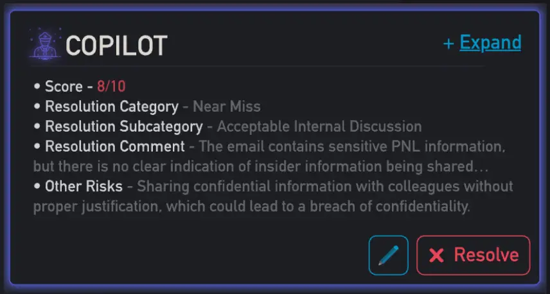
Another key driver in the trade surveillance market is continuous advancements in next generation such as AI (Artificial Intelligence) and machine learning. For instance, SteelEye’s AI-driven assistant, Compliance CoPilot, can unlock efficiencies for compliance teams, by providing intelligent alert scoring, triaging, and automation. This solution keeps human decision-making at its core, but through AI and automation, it effectively reduces workloads, boosts productivity, and precisely identifies risks that threaten financial institutions.
Source: SteelEye
Who Are the Key Innovators?
One key market player is SteelEye, who is recognised for its trade oversight, communications surveillance, and archiving for reporting compliance. Its trade surveillance module allows its clients to analyse their trading activity and monitor for a wide array of manipulative practices including insider trading, spoofing and, and wash trading.
SteelEye was founded in 2017 in London, and since its inception has amassed $45 million in funding, becoming a flourishing organisation with over 100 employees. SteelEye has over 140 clients worldwide including the likes of Kyte Broking and their strategic partnership with Wealthtech Enfusion. which integrates its solution into their asset management platform.
SteelEye’s platform can integrate and connect large volumes of data and apply automation, to simplify trade surveillance and enable users to meet market abuse monitoring demands more efficiently and accurately. Its trade surveillance solutions enable its clients to strengthen their risk detection, provide comprehensive oversight, and continuously demonstrate compliance.
What Are the Market's Biggest Challenges?
The sheer volume of regulatory requirements relating to market abuse and MiFID II can cause headaches for compliance teams, where tracking, archiving, and analysing all information requires a large number of resources and time. This becomes increasingly complex when factoring in that MiFID II requires traders to capture information on all trades, including ones that have been initiated but have not happened.
Furthermore, personal mobile phone use is increasingly common in the trading space, and to comply with MiFID II, the ability to record conversations regarding transactions needs to be installed on personal devices as well, which can prove tricky.
On the other hand, the pandemic and creation of work-from-home culture saw an explosion of communication channels and market data. This has created a proliferation of digital transaction modalities and hybrid work environments, which reduces visibility into the trading process. To capitalise on this pain point, SteelEyes’s architecture readily integrates data from 85 voice, social, video, and collaboration tools, to provide enhanced communication surveillance, by archiving, validating, and indexing structured and unstructured data from a wide range of channels.
What Does the Future Hold for the Trade Surveillance Market?
This explosion of communication channels has created an increase in the volume of data needed to be processed by surveillance systems. To improve accuracy and productivity, this new data can be utilised to train new surveillance tools such as large-language models and natural language processing.
We anticipate the deployment of cloud infrastructure that enhances the capabilities of trade surveillance platforms by providing scalable solutions and cost-effective data storage. To be successful, cloud-based systems must facilitate collaboration among financial institutions and regulators. This is vital to promote information sharing across all stakeholders and enable them to operate with collective insights.
Daniel analyses developments in financial and payments markets, and how these interplay with emerging technologies, such as blockchain and AI. His recent reports include Anti-money Laundering Systems, Banking-as-a-Service, and Regtech.
Latest research, whitepapers & press releases
-
 ReportOctober 2026Fintech & Payments
 Michael GreenwoodAccounts Payable Automation Market: 2026-2031
Our Accounts Payable (AP) Automation research suite provides an insightful analysis of this rapidly growing market; enabling stakeholders to understand future growth, key trends and the competitive environment.
VIEW -
 ReportOctober 2026Fintech & Payments
 Jawad JahanCrypto-gaming Market: 2026-2035
Our Crypto-gaming Market research suite provides an insightful analysis of this rapidly growing market; enabling stakeholders - from crypto-gaming and sportsbooks operators, prediction market platforms, business-to-business (B2B) gambling platforms and software providers, to crypto payment processors and regulators - to understand future growth, key trends, and the competitive environment.
VIEW -
 ReportOctober 2026Telecoms & Connectivity
 Alex WebbRetail Roaming Market: 2026-2031
Our Retail Roaming research suite for mobile network operators (MNOs) and mobile virtual network operators (MVNOs) provides detailed analysis and strategic recommendations for the next era of retail roaming.
VIEW -
 ReportSeptember 2026Fintech & Payments
 Dr Manju ChhillarEmbedded Finance Market: 2026-2031
Embedded finance is one of the fastest-growing markets in financial services, and is about to accelerate even further. Our Embedded Finance Market research provides detailed analysis of the key drivers behind this growth, and what these mean for stakeholders in this market.
VIEW -
 ReportSeptember 2026Identity & Security
 Thomas WilsonApplication Security Market: 2026-2031
Our Application Security research suite provides detailed analysis of this emerging market; allowing application security providers to gain an understanding of key security trends and challenges, potential growth opportunities, and the competitive environment.
VIEW -
 ReportSeptember 2026Fintech & Payments
 Shane O'SullivanBanking Fraud Prevention Market: 2026-2031
Our Banking Fraud Prevention research suite provides a comprehensive and in-depth analysis of the types of fraud currently impacting the banking sector, and the evolving methods that can be used to overcome them.
VIEW


-
 WhitepaperOctober 2026Fintech & Payments
Michael Greenwood
WhitepaperOctober 2026Fintech & Payments
Michael GreenwoodAccounts Payable Automation ~ How Businesses Are Reducing Operational Costs
Our complimentary whitepaper, Accounts Payable Automation ~ How Businesses Are Reducing Operational Costs, analyses how AP automation is combatting costs by decreasing the need for manual processes, and provides strategic insight into a number of key trends in the AP automation space.
VIEW -
 WhitepaperOctober 2026Fintech & Payments
Jawad Jahan
WhitepaperOctober 2026Fintech & Payments
Jawad JahanCompliance or Anonymity - The Crypto-gaming Operator’s Dilemma
Our complimentary whitepaper, Compliance or Anonymity - The Crypto-gaming Operator’s Dilemma, analyses the current regulatory landscape of the crypto-gaming market.
VIEW -
 WhitepaperOctober 2026Telecoms & Connectivity
Alex Webb
WhitepaperOctober 2026Telecoms & Connectivity
Alex WebbReimagining the Future of Retail Roaming – How Mobile Network Operators Must Adapt
Our complimentary whitepaper, Reimagining the Future of Retail Roaming – How Mobile Network Operators Must Adapt, explores the emerging opportunities for MNOs within retail roaming.
VIEW -
 WhitepaperSeptember 2026Fintech & Payments
Dr Manju Chhillar
WhitepaperSeptember 2026Fintech & Payments
Dr Manju ChhillarEmerging Markets: The Next Opportunity for Embedded Finance
This free whitepaper examines how a combination of multiple factors is driving North America towards saturation for embedded finance.
VIEW -
 WhitepaperSeptember 2026Emerging Technology
Thomas Wilson
WhitepaperSeptember 2026Emerging Technology
Thomas WilsonVibe Coding: The Fastest-growing Threat to Application Security Today
Our complimentary whitepaper, Vibe Coding: The Fastest-growing Threat to Application Security Today, examines the state of the application security market; considering its impact on different verticals, and how it is being employed in these verticals to best combat malicious attackers and keep sensitive data safe.
VIEW -
 WhitepaperSeptember 2026Fintech & Payments
Shane O'Sullivan
WhitepaperSeptember 2026Fintech & Payments
Shane O'SullivanThe Fraud Frontier: Securing Banking in an AI-driven Era
Our complimentary whitepaper, The Fraud Frontier: Securing Banking in an AI-driven Era, examines the rapidly evolving state of the banking fraud prevention market.
VIEW


-
Fintech & Payments
Accounts Payable Automation to Save Global Businesses 6.2 Billion Hours by 2031, Accelerated by Business System Integration
October 2026 -
Fintech & Payments
The 25th NextGen Payments & RegTech Forum Arrives in Athens, Greece
October 2026 -
Fintech & Payments
Crypto Gaming: Wagers to Reach $1.3 Trillion by 2035, as Crypto Rails Widen Global Access Despite Regulatory Challenges
October 2026 -
Fintech & Payments
Juniper Research Unveils Identity & Security Award Winners for 2026
October 2026 -
Retail Roaming Revenue to Fall $4 Billion By 2031, as Regulatory Restrictions and Competition Bite
October 2026 -
Fintech & Payments
Soft POS to Surpass 100 Million Installations in 2030
September 2026