Where Stablecoins Are Reshaping Cross-border B2B Payments

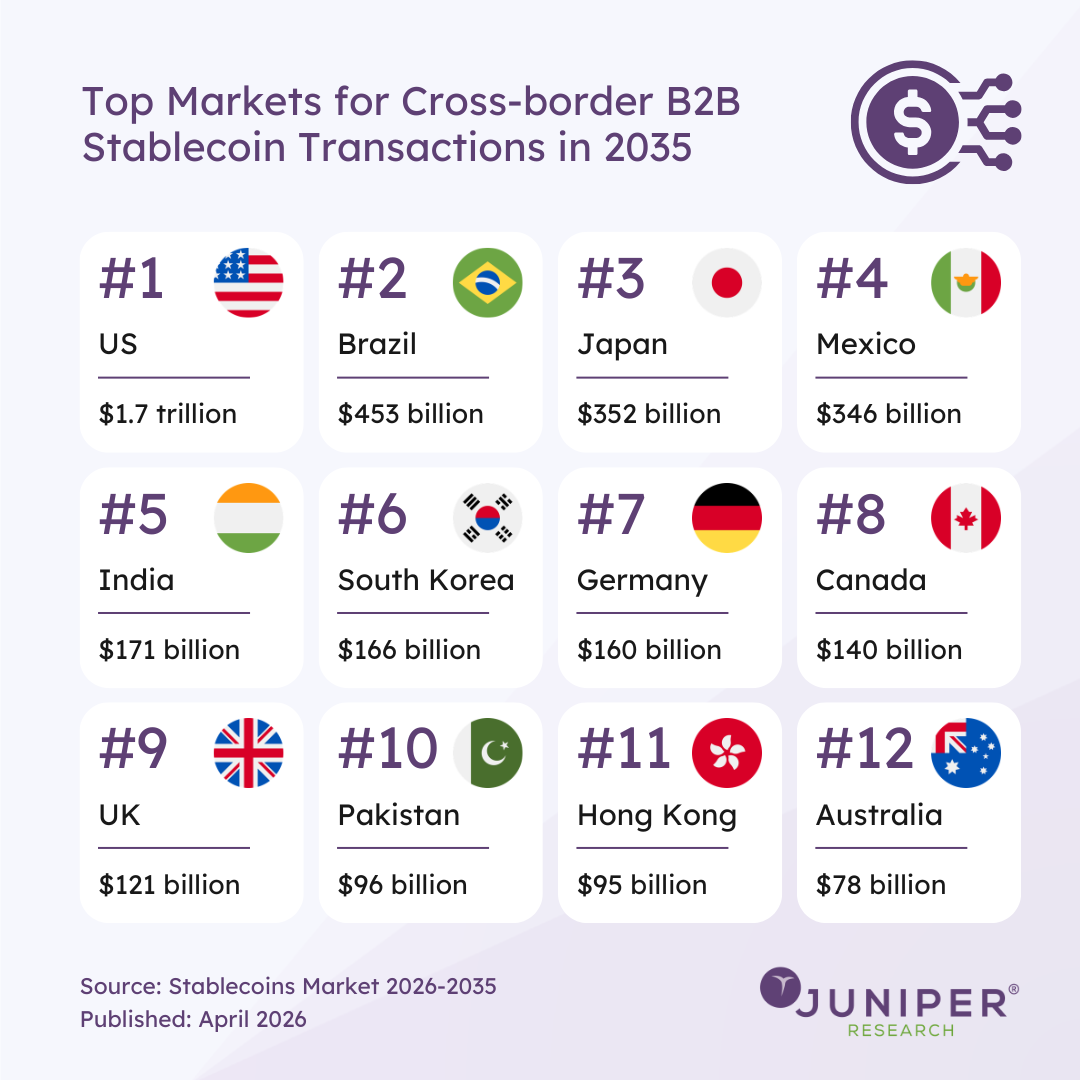
Our latest stablecoins research predicts that cross-border B2B stablecoin transactions will surpass $5 trillion by 2035, signalling a fundamental shift in how international business payments are executed. This growth reflects a wider move away from legacy banking rails, as enterprises seek faster, cheaper, and more transparent ways to move money globally.
The markets leading this shift are not uniform. As the infographic shows, adoption is concentrated in regions with high trade volumes, strong digital payment infrastructure, and growing demand for more efficient settlement. But the underlying drivers are consistent: stablecoins address long-standing inefficiencies in cross-border B2B payments.
Lower Transaction Costs
Traditional cross-border payments are burdened by multiple intermediaries, each adding fees and FX spreads. Stablecoins remove many of these layers by enabling direct, blockchain-based settlement.
This materially reduces costs for businesses, particularly in high-volume sectors such as trade, logistics, and financial services. We estimate that stablecoin adoption will generate tens of billions in savings globally, with cross-border B2B payments accounting for the majority of this value.
Faster Settlement Times
Cross-border B2B payments can take several days to settle through traditional banking systems. Stablecoins enable near-instant settlement, dramatically improving liquidity management.
By reducing settlement times from days to minutes, businesses can free up working capital, improve cash flow visibility, and reduce the operational friction associated with delayed payments.
Reduced Reliance on Intermediaries
Stablecoins operate on decentralised networks, allowing transactions to bypass correspondent banking chains.
This removes complexity from the payment process and reduces points of failure. It also enables more direct payment routes between counterparties, particularly in emerging markets where banking infrastructure may be less developed.
Greater Transparency & Traceability
Legacy cross-border payments often lack visibility, making it difficult to track funds in transit.
Blockchain-based stablecoin transactions provide a transparent, auditable record of each payment. This improves reconciliation processes, reduces disputes, and enhances compliance; particularly for large, multi-party B2B transactions.
Programmability Through Smart Contracts
Stablecoins enable programmable payments via smart contracts, allowing transactions to be automatically executed when predefined conditions are met.
This is particularly valuable in B2B contexts such as trade finance, where payments can be tied to delivery milestones, documentation, or contractual triggers. The result is reduced settlement risk and greater automation across payment workflows.
A Shift Towards Borderless Payment Rails
Stablecoins are not just improving existing systems, but redefining them. By enabling money to move globally with fewer constraints, they are creating a more fluid, interconnected payments ecosystem.
As adoption scales, the competitive advantage will shift towards businesses that can integrate these new rails effectively, particularly across key trade corridors highlighted in the data.
Source: Stablecoins Market 2026-2035
Read the Press Release: Stablecoin Cross-border B2B Transactions to Reach $5 Trillion by 2035, Causing Disruption to Correspondent Banking Channels
Download the Whitepaper: Payment Rails Without Borders: The Rise of Stablecoins
Latest research, whitepapers & press releases
-
 ReportOctober 2026Fintech & Payments
 Michael GreenwoodAccounts Payable Automation Market: 2026-2031
Our Accounts Payable (AP) Automation research suite provides an insightful analysis of this rapidly growing market; enabling stakeholders to understand future growth, key trends and the competitive environment.
VIEW -
 ReportOctober 2026Fintech & Payments
 Jawad JahanCrypto-gaming Market: 2026-2035
Our Crypto-gaming Market research suite provides an insightful analysis of this rapidly growing market; enabling stakeholders - from crypto-gaming and sportsbooks operators, prediction market platforms, business-to-business (B2B) gambling platforms and software providers, to crypto payment processors and regulators - to understand future growth, key trends, and the competitive environment.
VIEW -
 ReportOctober 2026Telecoms & Connectivity
 Alex WebbRetail Roaming Market: 2026-2031
Our Retail Roaming research suite for mobile network operators (MNOs) and mobile virtual network operators (MVNOs) provides detailed analysis and strategic recommendations for the next era of retail roaming.
VIEW -
 ReportSeptember 2026Fintech & Payments
 Dr Manju ChhillarEmbedded Finance Market: 2026-2031
Embedded finance is one of the fastest-growing markets in financial services, and is about to accelerate even further. Our Embedded Finance Market research provides detailed analysis of the key drivers behind this growth, and what these mean for stakeholders in this market.
VIEW -
 ReportSeptember 2026Identity & Security
 Thomas WilsonApplication Security Market: 2026-2031
Our Application Security research suite provides detailed analysis of this emerging market; allowing application security providers to gain an understanding of key security trends and challenges, potential growth opportunities, and the competitive environment.
VIEW -
 ReportSeptember 2026Fintech & Payments
 Shane O'SullivanBanking Fraud Prevention Market: 2026-2031
Our Banking Fraud Prevention research suite provides a comprehensive and in-depth analysis of the types of fraud currently impacting the banking sector, and the evolving methods that can be used to overcome them.
VIEW


-
 WhitepaperOctober 2026Fintech & Payments
Michael Greenwood
WhitepaperOctober 2026Fintech & Payments
Michael GreenwoodAccounts Payable Automation ~ How Businesses Are Reducing Operational Costs
Our complimentary whitepaper, Accounts Payable Automation ~ How Businesses Are Reducing Operational Costs, analyses how AP automation is combatting costs by decreasing the need for manual processes, and provides strategic insight into a number of key trends in the AP automation space.
VIEW -
 WhitepaperOctober 2026Fintech & Payments
Jawad Jahan
WhitepaperOctober 2026Fintech & Payments
Jawad JahanCompliance or Anonymity - The Crypto-gaming Operator’s Dilemma
Our complimentary whitepaper, Compliance or Anonymity - The Crypto-gaming Operator’s Dilemma, analyses the current regulatory landscape of the crypto-gaming market.
VIEW -
 WhitepaperOctober 2026Telecoms & Connectivity
Alex Webb
WhitepaperOctober 2026Telecoms & Connectivity
Alex WebbReimagining the Future of Retail Roaming – How Mobile Network Operators Must Adapt
Our complimentary whitepaper, Reimagining the Future of Retail Roaming – How Mobile Network Operators Must Adapt, explores the emerging opportunities for MNOs within retail roaming.
VIEW -
 WhitepaperSeptember 2026Fintech & Payments
Dr Manju Chhillar
WhitepaperSeptember 2026Fintech & Payments
Dr Manju ChhillarEmerging Markets: The Next Opportunity for Embedded Finance
This free whitepaper examines how a combination of multiple factors is driving North America towards saturation for embedded finance.
VIEW -
 WhitepaperSeptember 2026Emerging Technology
Thomas Wilson
WhitepaperSeptember 2026Emerging Technology
Thomas WilsonVibe Coding: The Fastest-growing Threat to Application Security Today
Our complimentary whitepaper, Vibe Coding: The Fastest-growing Threat to Application Security Today, examines the state of the application security market; considering its impact on different verticals, and how it is being employed in these verticals to best combat malicious attackers and keep sensitive data safe.
VIEW -
 WhitepaperSeptember 2026Fintech & Payments
Shane O'Sullivan
WhitepaperSeptember 2026Fintech & Payments
Shane O'SullivanThe Fraud Frontier: Securing Banking in an AI-driven Era
Our complimentary whitepaper, The Fraud Frontier: Securing Banking in an AI-driven Era, examines the rapidly evolving state of the banking fraud prevention market.
VIEW


-
Fintech & Payments
Financial Institutions to Spend Over $66.2 Billion Globally on Fraud Prevention by 2031, Driven by Growing Demand for Cross-industry Fraud Intelligence
October 2026 -
Fintech & Payments
Omnichannel Payment Platforms to See a Dramatic 172% Growth in the Value of Transactions Processed Globally by 2031, as Merchants Capitalise on Payment Data
October 2026 -
Fintech & Payments
Accounts Payable Automation to Save Global Businesses 6.2 Billion Hours by 2031, Accelerated by Business System Integration
October 2026 -
Fintech & Payments
The 25th NextGen Payments & RegTech Forum Arrives in Athens, Greece
October 2026 -
Fintech & Payments
Crypto Gaming: Wagers to Reach $1.3 Trillion by 2035, as Crypto Rails Widen Global Access Despite Regulatory Challenges
October 2026 -
Fintech & Payments
Juniper Research Unveils Identity & Security Award Winners for 2026
October 2026