Where (and Why) Agentic Commerce Is Scaling in 2026

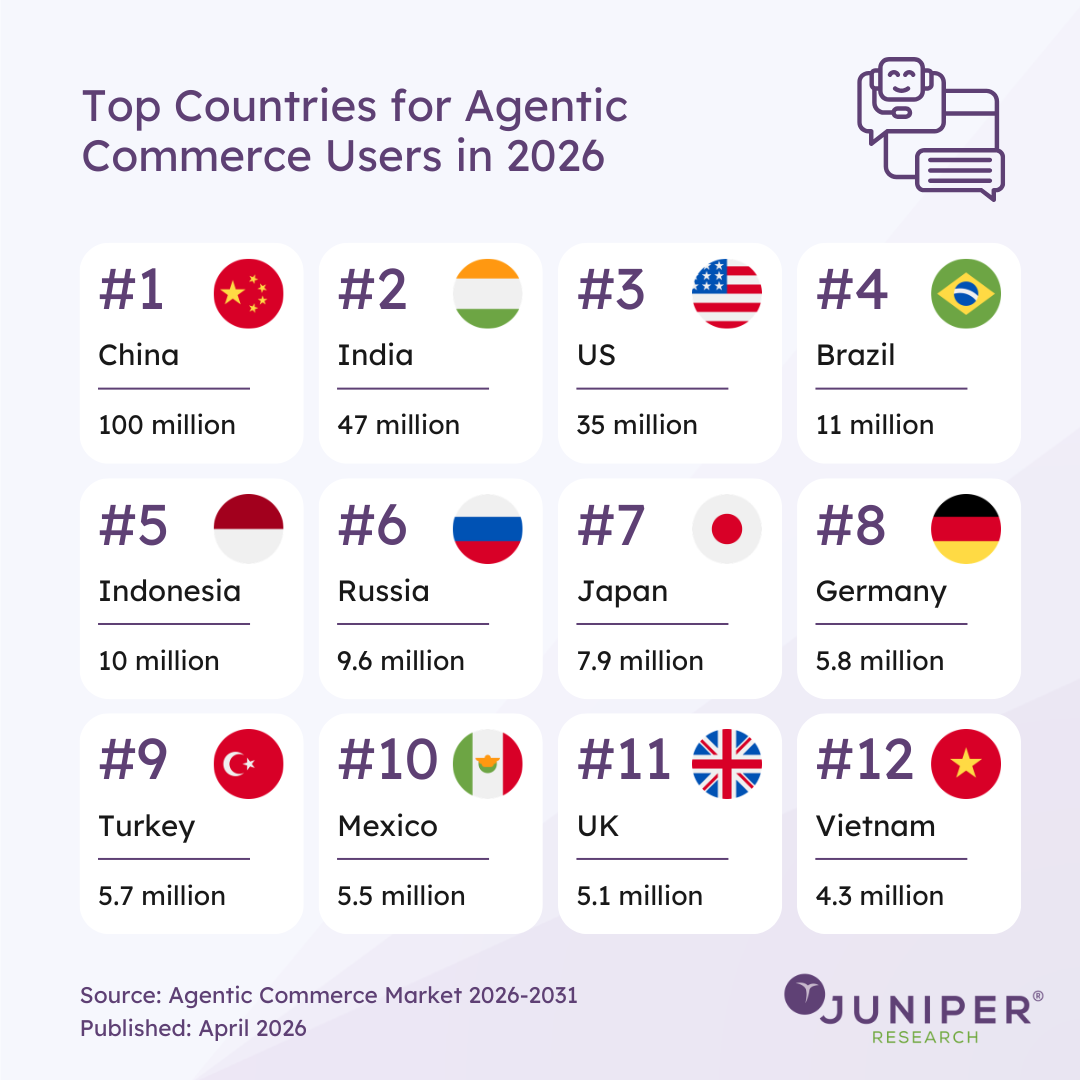
Agentic commerce is moving from concept to commercial reality. According to our latest research, the market is set to generate $15 trillion globally by 2030; signalling a fundamental shift in how transactions are initiated and completed.
This growth is not being driven by AI innovation alone.
Instead, adoption is being shaped by a set of underlying structural factors. Markets leading in agentic commerce users are those where payments, commerce infrastructure, and user behaviour are already aligned with automation. As a result, the ability for AI systems to execute transactions is less about technical capability, and more about environmental readiness.
Digital Payment Maturity
Agentic commerce depends on the ability to complete transactions seamlessly.
Markets with high penetration of digital wallets, stored credentials, and tokenised payments remove the need for repeated authentication. This allows AI agents to execute transactions within predefined rules, without disrupting the user experience.
Ecosystem Integration
The ability to execute transactions relies on how connected the commerce journey is.
Agentic commerce requires alignment across discovery, decisioning, payment, and fulfilment. In markets where these functions are integrated within platforms or ecosystems, agents can operate with minimal friction.
Fragmented environments, by contrast, introduce complexity and failure points that limit automation. The tighter the ecosystem, the more viable agentic commerce becomes.
Mobile-first Infrastructure
Mobile-first markets provide a natural foundation for agentic commerce.
App-based environments enable persistent user identities, embedded payment credentials, and continuous interaction with services. This creates the conditions for AI systems to act in the background, without requiring repeated user input.
Markets that have evolved around mobile ecosystems are therefore better positioned to support autonomous transactions at scale.
API Accessibility
Agentic commerce is fundamentally dependent on access to infrastructure.
Payments, identity verification, inventory, and fulfilment must all be exposed via APIs for AI agents to execute transactions. The expansion of open banking, network APIs, and platform-based commerce is turning previously closed systems into accessible environments.
Without API exposure, even the most advanced AI systems are unable to act.
Trust & Risk Management
The shift to agent-executed transactions increases the importance of trust.
Users and businesses must be confident that transactions will be executed securely, within defined parameters, and with appropriate safeguards in place. This places greater emphasis on fraud detection, authentication frameworks, and liability models.
Markets with mature risk management systems are therefore more likely to support higher levels of automation.
Source: Agentic Commerce Market 2026-2031
Read the Press Release: Agentic Commerce Set to Generate $1.5 Trillion Globally by 2030, as Payments Infrastructure Leaders Revealed
Download the Whitepaper: Agentic Commerce - Revolution or False Dawn?
Latest research, whitepapers & press releases
-
 ReportApril 2026IoT & Emerging Technology
 Molly GatfordPhysical AI in Manufacturing & Logistics Market: 2026-2030
Our Physical AI in Manufacturing and Logistics research suite provides in-depth analysis of the key economic, operational, and technological factors driving growth in this fast-growing market.
VIEW -
 ReportApril 2026Fintech & Payments
 Nick MaynardAgentic Commerce Market: 2026-2031
Juniper Research’s Agentic Commerce research suite provides an insightful analysis of this rapidly emerging market; enabling stakeholders, including AI developers, payment infrastructure providers, eCommerce marketplaces, merchants and many others, to understand future growth, key trends, and the competitive environment.
VIEW -
 ReportMarch 2026Fintech & Payments
 Michael GreenwoodB2B Payment Cards Market: 2026-2030
Our B2B card payments research suite provides detailed analysis of this rapidly changing market; allowing B2B card providers to gain an understanding of key payment trends and challenges, potential growth opportunities, and the competitive environment.
VIEW -
 ReportMarch 2026Telecoms & Connectivity
 Alex WebbDirect Carrier Billing Market: 2026-2030
Our Direct Carrier Billing research suite for mobile network operators provides detailed analysis and strategic recommendations for the direct carrier billing market over the next four years.
VIEW -
 ReportMarch 2026Fintech & Payments
 Lorien CarterCross-border Payments Market: 2026-2030
Our Cross-border Payments research suite provides a comprehensive and in-depth analysis of the evolving cross-border payments landscape; enabling stakeholders such as businesses, financial institutions, payment service providers, card networks, regulators, and technology infrastructure providers to understand future growth, key trends, and the competitive environment.
VIEW -
 ReportFebruary 2026Telecoms & Connectivity
 Ardit BallhysaMobile Messaging Market: 2026-2030
Juniper Research’s Mobile Messaging research suite provides mobile messaging vendors, mobile network operators, and enterprises with intelligence on how to capitalise on changing market dynamics within the mobile messaging market.
VIEW


-
 WhitepaperApril 2026IoT & Emerging Technology
Molly Gatford
WhitepaperApril 2026IoT & Emerging Technology
Molly GatfordKey Growth Opportunities for Physical AI in 2026
Our complimentary whitepaper, Key Growth Opportunities for Physical AI in 2026, provides insight into the rapidly evolving physical AI in manufacturing and logistics market; highlighting the countries in which high demand for automation in these industries is anticipated over the next five years.
VIEW -
 WhitepaperApril 2026Fintech & Payments
Nick Maynard
WhitepaperApril 2026Fintech & Payments
Nick MaynardAgentic Commerce - Revolution or False Dawn?
Our complimentary whitepaper assesses the trends that are increasing agentic commerce adoption, and challenges to agentic commerce usage. Additionally, it includes a forecast summary of the global spend on agentic commerce by 2030.
VIEW -
 WhitepaperMarch 2026Fintech & Payments
Michael Greenwood
WhitepaperMarch 2026Fintech & Payments
Michael GreenwoodHow B2B Payment Cards Are Streamlining Corporate Expenses
Our complimentary whitepaper, How B2B Payment Cards Are Streamlining Corporate Expenses, examines the state of the B2B payment cards market; considering its impact on different geographies and how it is shaping the modern B2B payments landscape through card controls, payment data analysis tools, and fully integrated spend management solutions.
VIEW -
 WhitepaperMarch 2026Telecoms & Connectivity
Alex Webb
WhitepaperMarch 2026Telecoms & Connectivity
Alex WebbDirect Carrier Billing: Unlocking Emerging Revenue Streams for Operators
Our complimentary whitepaper, Direct Carrier Billing: Unlocking Emerging Revenue Streams for Operators, explores the emerging opportunities for mobile network operators to monetise direct carrier billing.
VIEW -
 WhitepaperMarch 2026Telecoms & Connectivity
Molly Gatford
WhitepaperMarch 2026Telecoms & Connectivity
Molly GatfordMWC 2026: What's Next for Mobile?
Our latest whitepaper distils the most important announcements from MWC Barcelona 2026 and examines what they mean for the telecoms market over the year ahead. From network APIs and 5G monetisation to AI-RAN, direct-to-cell connectivity, and 5G-Advanced, it explains where the biggest opportunities — and challenges — will emerge next.
VIEW -
 WhitepaperMarch 2026Fintech & Payments
Lorien Carter
WhitepaperMarch 2026Fintech & Payments
Lorien CarterThe Transformation of Cross-border Payment Infrastructure
Our complimentary whitepaper, The Transformation of Cross-border Payment Infrastructure, examines the state of the cross-border payments market; explaining the role of key actors in transforming the cross-border payment experience, as well as the current landscape and recent developments within the cross-border payments industry.
VIEW


-
IoT & Emerging Technology
Physical AI Deployments in Manufacturing & Logistics to Reach 400,000 Systems by 2030
April 2026 -
Fintech & Payments
Agentic Commerce Set to Generate $1.5 Trillion Globally by 2030, as Payments Infrastructure Leaders Revealed
April 2026 -
Fintech & Payments
B2B Card Payments to Reach $11 Trillion Globally in 2030, Accelerated by Increased Corporate Use
March 2026 -
Telecoms & Connectivity
Direct Carrier Billing to Grow by $35 Billion Globally Over the Next Four Years, as Anti-fraud Capabilities Are Enhanced by Network APIs
March 2026 -
Fintech & Payments
Sophisticated Microfinance Services Spend to Surpass $22 billion By 2030, as Mobile Money Services in Emerging Markets Mature
March 2026 -
Fintech & Payments
Top Three Global Leaders in Cross-border Payment Infrastructure Revealed
March 2026