Inside the Launderer’s Toolkit: How Criminals Clean Dirty Money in 2025

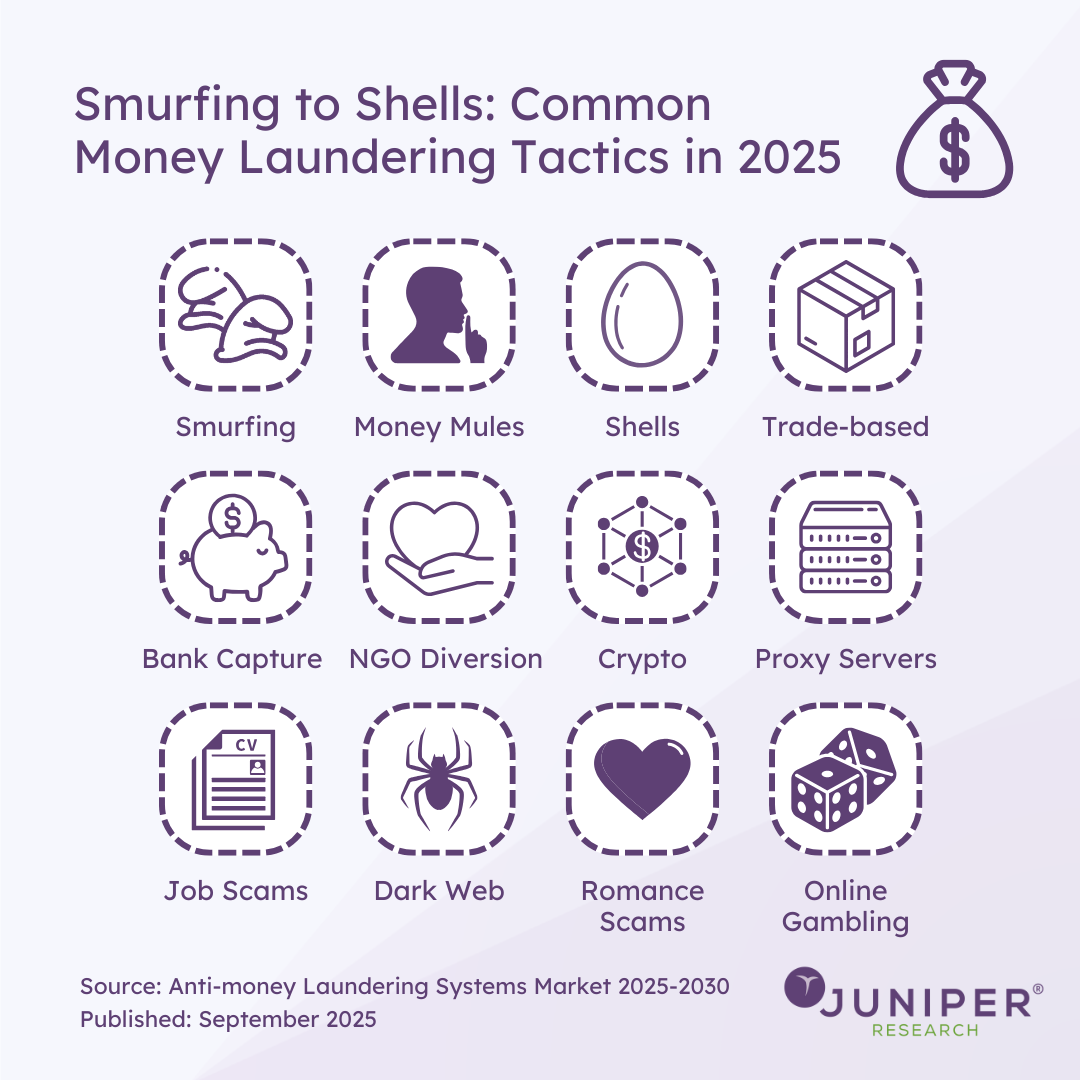
As global regulations tighten and financial systems become more digital, money launderers are evolving their methods to stay one step ahead. Our latest research on the subject has identified 12 tactics most likely to dominate in 2026 — a mix of old-school deception and cutting-edge digital manoeuvres.
Smurfing
Named after the small blue cartoon characters, smurfing involves splitting large sums of money into smaller, seemingly harmless deposits to avoid detection. Rather than one suspicious transaction, criminals scatter hundreds of micro-deposits across multiple accounts. It’s low-tech but surprisingly effective, especially in markets where banks still rely on manual oversight for smaller transfers.
Money Mules
Money mules are the unwitting middlemen of the laundering world. They’re recruited—often through social media or job ads—to transfer money through their accounts, under the pretence of legitimate employment. Some know what they’re doing; many don’t. Either way, the result is the same: dirty money appears to move through a clean individual’s hands.
Shells
Shell companies are hollow corporate entities—businesses that exist on paper but do little or no real trading. They’re perfect for masking ownership and moving funds under the guise of legitimate business activity. From offshore tax havens to complex multi-jurisdictional structures, shells remain one of the most enduring tools for hiding illicit wealth.
Trade-based Laundering
This method dresses financial crime up as global commerce. Criminals manipulate trade invoices—overstating or understating prices, faking shipments, or disguising the nature of goods—to move value across borders. The sheer complexity of international trade makes this a challenge to detect, even for advanced compliance systems.
Bank Capture
In some cases, criminals take the boldest route possible: they capture the bank itself. By infiltrating or outright controlling smaller, poorly regulated financial institutions, they gain direct access to systems that can legitimise illicit funds. Once inside, transactions can be masked, records altered, and oversight quietly neutralised.
NGO Diversion
Non-governmental organisations are built on trust—something money launderers exploit. By routing illegal funds through charities or aid projects, criminals can make their money appear as philanthropic support. In regions affected by conflict or disaster, where financial oversight is limited, this tactic is particularly difficult to uncover.
Crypto
Cryptocurrencies have opened a new frontier for financial crime. Their decentralised, pseudonymous nature allows launderers to move funds quickly across borders without banks or regulators in the way. Sophisticated criminals use mixers and privacy coins to further obscure transaction trails, challenging even the most advanced AML systems.
Proxy Servers
Not all laundering is financial—sometimes it’s digital camouflage. By routing activity through multiple proxy servers or VPNs, criminals can disguise their online identities and locations. This makes it far harder for investigators to connect suspicious financial movements to real-world individuals or organisations.
Job Scams
A new twist on an old con, job scams lure victims with fake employment offers—often in “payment processing” or “financial coordination.” The catch? These workers are actually laundering money for criminals without realising it. Once authorities trace the activity, the “employee” is left carrying the blame.
Dark Web
The dark web remains a thriving ecosystem for illicit trade. From stolen data to illegal substances, everything has a price—and nearly all transactions are in cryptocurrency. Money launderers use dark web markets to mix, move, and disguise their funds, often layering transactions across multiple wallets to throw off digital investigators.
Romance Scams
Few tactics are as emotionally manipulative as romance scams. Fraudsters build online relationships with victims, then invent emergencies or business opportunities to extract money. In some cases, they go further—asking victims to transfer funds on their behalf, turning them into unwitting accomplices in laundering operations.
Online Gambling
Casinos and betting sites—especially unregulated ones—offer the perfect front for laundering. Criminals deposit dirty money as betting funds, place a few strategic wagers, then withdraw their balance as “winnings.” It’s an elegant disguise, with the added benefit of plausible deniability.
As regulators and AML systems adapt, one thing is clear: financial crime is a moving target. Understanding how these tactics work is the first step towards staying ahead of those who aim to exploit the system.
Source: Anti-money Laundering Systems Market 2025-2030
Read the Press Release: AML Systems Market to Surpass $75 Billion by 2030 Globally, With LexisNexis Risk Solutions, Oracle, and Experian Leading the Defence
Download the Whitepaper: From Detection to Prevention: The Next Era of Anti-money Laundering
Latest research, whitepapers & press releases
-
 ReportOctober 2026Fintech & Payments
 Jawad JahanCrypto-gaming Market: 2026-2035
Our Crypto-gaming Market research suite provides an insightful analysis of this rapidly growing market; enabling stakeholders - from crypto-gaming and sportsbooks operators, prediction market platforms, business-to-business (B2B) gambling platforms and software providers, to crypto payment processors and regulators - to understand future growth, key trends, and the competitive environment.
VIEW -
 ReportOctober 2026Telecoms & Connectivity
 Alex WebbRetail Roaming Market: 2026-2031
Our Retail Roaming research suite for mobile network operators (MNOs) and mobile virtual network operators (MVNOs) provides detailed analysis and strategic recommendations for the next era of retail roaming.
VIEW -
 ReportSeptember 2026Fintech & Payments
 Dr Manju ChhillarEmbedded Finance Market: 2026-2031
Embedded finance is one of the fastest-growing markets in financial services, and is about to accelerate even further. Our Embedded Finance Market research provides detailed analysis of the key drivers behind this growth, and what these mean for stakeholders in this market.
VIEW -
 ReportSeptember 2026Identity & Security
 Thomas WilsonApplication Security Market: 2026-2031
Our Application Security research suite provides detailed analysis of this emerging market; allowing application security providers to gain an understanding of key security trends and challenges, potential growth opportunities, and the competitive environment.
VIEW -
 ReportSeptember 2026Fintech & Payments
 Shane O'SullivanBanking Fraud Prevention Market: 2026-2031
Our Banking Fraud Prevention research suite provides a comprehensive and in-depth analysis of the types of fraud currently impacting the banking sector, and the evolving methods that can be used to overcome them.
VIEW -
 ReportSeptember 2026Telecoms & Connectivity
 Nick MaynardPrivate LTE & 5G Networks Market: 2026-2031
Our Private LTE & 5G Networks research suite provides detailed and insightful analysis of this evolving market; enabling stakeholders - from private LTE & 5G network platform specialists, mobile network operators, and diversified technology companies - to understand future growth, key trends, and the competitive environment.
VIEW


-
 WhitepaperOctober 2026Fintech & Payments
Jawad Jahan
WhitepaperOctober 2026Fintech & Payments
Jawad JahanCompliance or Anonymity - The Crypto-gaming Operator’s Dilemma
Our complimentary whitepaper, Compliance or Anonymity - The Crypto-gaming Operator’s Dilemma, analyses the current regulatory landscape of the crypto-gaming market.
VIEW -
 WhitepaperOctober 2026Telecoms & Connectivity
Alex Webb
WhitepaperOctober 2026Telecoms & Connectivity
Alex WebbReimagining the Future of Retail Roaming – How Mobile Network Operators Must Adapt
Our complimentary whitepaper, Reimagining the Future of Retail Roaming – How Mobile Network Operators Must Adapt, explores the emerging opportunities for MNOs within retail roaming.
VIEW -
 WhitepaperSeptember 2026Fintech & Payments
Dr Manju Chhillar
WhitepaperSeptember 2026Fintech & Payments
Dr Manju ChhillarEmerging Markets: The Next Opportunity for Embedded Finance
This free whitepaper examines how a combination of multiple factors is driving North America towards saturation for embedded finance.
VIEW -
 WhitepaperSeptember 2026Emerging Technology
Thomas Wilson
WhitepaperSeptember 2026Emerging Technology
Thomas WilsonVibe Coding: The Fastest-growing Threat to Application Security Today
Our complimentary whitepaper, Vibe Coding: The Fastest-growing Threat to Application Security Today, examines the state of the application security market; considering its impact on different verticals, and how it is being employed in these verticals to best combat malicious attackers and keep sensitive data safe.
VIEW -
 WhitepaperSeptember 2026Fintech & Payments
Shane O'Sullivan
WhitepaperSeptember 2026Fintech & Payments
Shane O'SullivanThe Fraud Frontier: Securing Banking in an AI-driven Era
Our complimentary whitepaper, The Fraud Frontier: Securing Banking in an AI-driven Era, examines the rapidly evolving state of the banking fraud prevention market.
VIEW -
 WhitepaperSeptember 2026Telecoms & Connectivity
Nick Maynard
WhitepaperSeptember 2026Telecoms & Connectivity
Nick MaynardHow Private Cellular Networks Are Unlocking Industry 4.0
Our complimentary whitepaper, How Private Cellular Networks Are Unlocking Industry 4.0, examines how private LTE & 5G networks are reshaping the way industry works.
VIEW


-
Fintech & Payments
Crypto Gaming: Wagers to Reach $1.3 Trillion by 2035, as Crypto Rails Widen Global Access Despite Regulatory Challenges
October 2026 -
Fintech & Payments
Juniper Research Unveils Identity & Security Award Winners for 2026
October 2026 -
Retail Roaming Revenue to Fall $4 Billion By 2031, as Regulatory Restrictions and Competition Bite
October 2026 -
Fintech & Payments
Soft POS to Surpass 100 Million Installations in 2030
September 2026 -
Fintech & Payments
The NextGen Payments & RegTech Forum Arrives in Dubai
September 2026 -
Fintech & Payments
The Global Trade Finance Expo Arrives in Dubai, UAE
September 2026