What’s Next for PayPal: Reinvention or Acquisition?

PayPal finds itself in an interesting position. One of the early leaders in eCommerce, PayPal has a longer history than many fintechs, and a major market presence. With revenue of around $33 billion and still delivering year-on-year growth, PayPal is undeniably an important player. So, why the doom and gloom around its future prospects?
One element is PayPal’s share price. This has seen around an 80% drop in value over the last five years, which will be a major cause of concern for investors. This was reinforced by disappointing Q4 and full-year 2025 financial results, which failed to meet guidance. Related to this, PayPal’s CEO and President Alex Chriss - in position since February 2023 - was removed by PayPal’s board and replaced by Enrique Lores, effective 1st March 2026.
Lores, a veteran who ran HP Inc for several years, had been instrumental in the separation of Hewlett Packard Enterprise and HP Inc. He commented the following with his appointment: "The payments industry is changing faster than ever, driven by new technologies, evolving regulations, an increasingly competitive landscape, and the rapid acceleration of AI that is reshaping commerce daily. PayPal sits at the centre of this change, and I look forward to leading the team to accelerate the delivery of new innovations and to shape the future of digital payments and commerce."
Broadly, while PayPal has been innovating for some time, it has struggled to take the lead in certain innovations, such as agentic commerce, where Mastercard and Visa have gained an early advantage. Following this, reports emerged in late February that Stripe was considering acquiring PayPal, or some of it. After this, speculation has been rife that PayPal may be ripe for acquisition.
Is PayPal a Good Candidate for Acquisition?
PayPal, despite the negative recent news, has a major presence within payments, both at the consumer and infrastructure levels. The key figures below demonstrate that PayPal has a major role to play, with vast user reach.
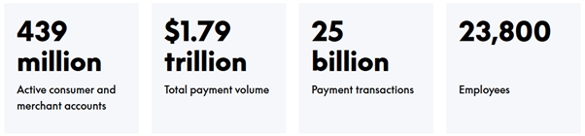
Source: PayPal
Indeed, PayPal has much to be interested in from an acquisition point of view:
- Owns and runs Venmo, one of the leading digital payments services in the US.
- Major branded checkout business, which boasts large payment volume and strong merchant support.
- Has Buy Now, Pay Later capabilities, which are directly offered to users alongside checkout features.
- Strong person-to-person (P2P) capabilities, alongside remittances via Xoom, stablecoin capabilities via PYUSD, and a strong international presence.
Therefore, it is clear to see why a third party would be interested in an acquisition. For a business such as Stripe, this would net them a huge number of merchants in North America in particular; accelerating its market position significantly. For many other potential suitors, acquiring all or parts of PayPal could be very appealing to fast-track their activities.
This could, however, result in a break up of PayPal’s different elements; for example, with the merchant-facing elements being sold, and the consumer-facing ones becoming separate. This might be of interest, but also could be technically challenging to achieve.
How Can PayPal Reinvent Itself?
If an acquisition does not emerge, then PayPal still has major opportunities. That said, it needs to advance boldly, rather than simply proceeding with a normal leadership transition.
While in the digital wallet area for consumers it has faced major challenges from competing methods, such as Apple Pay and Google Pay, it does have potential. PayPal still has significant usage from consumers, and if it can successfully take advantage of AI developments it could reinforce its consumer appeal.
In a world where many governments, in particular, are looking for alternatives to card networks, PayPal also has a major opportunity. It already has its PayPal World platform, which promises to enable interoperability between different wallets internationally - United Payments Interface (UPI) and WeChat Pay have already been announced as participants - with nearly 2 billion potential users. If this approach is expanded, PayPal could become a key ‘network of networks’ within payments; helping to solve digital wallet interoperability, which is increasingly important in a cross-border-centric eCommerce world.
The rise of account-to-account (A2A) payments and Open Banking create further opportunities for PayPal to bypass traditional rails; further cementing its unique role in the market. Additionally, its PYUSD stablecoin holds potential in cross-border use cases such as marketplace payouts. PYUSD boasts around $4.1 billion in market cap; the sixth-largest market cap of any stablecoin.
For these reasons, PayPal does have strong potential. But any future success will depend on whether it can act more confidently and move much faster, especially if it seeks to reinvent itself.
Concluding Thoughts
Whether PayPal is acquired or not, it clearly has work to do, as reflected by its recent change of leadership. Among fintechs, PayPal is generally perceived as moving extremely slowly. As a result, it is imperative that it accelerates its pace of change; identifying key trends and proactively anticipating them at a strategic level.
Regardless of its future structure, PayPal must get back to its original mission: solving key pain points for consumers and merchants. If it can move faster and innovate, focused on genuine need, it could carve out a greater role for itself in the future of payments. However, if history is any indication, turning that ambition into reality will prove far harder.
Nick Maynard is VP of Fintech Market Research at Juniper Research, where he leads analysis on key trends shaping the future of finance. With deep expertise across digital payments and commerce, his recent work includes reports on Instant Payments, eCommerce Payments, and Chargeback Management; helping stakeholders stay ahead in a rapidly evolving market.
Related Research
-
 ReportSeptember 2025eCommerce Payments Market
 Nick MaynardeCommerce Payments Market, 2025-2030
Juniper Research’s eCommerce Payments research suite provides a comprehensive and insightful analysis of this market; enabling stakeholders, from eCommerce payment platform providers to merchants and payment service providers, to understand future growth, key trends, and the competitive environment.
VIEW -
 ReportApril 2024Fintech & Payments
 Cara MaloneDigital Money Transfer & Remittances, 2024-2028
Our Digital Money Transfer & Remittances research report provides a detailed evaluation and analysis of both the domestic and international markets, including the impact of instant payments, blockchain and CBDC and other initiatives disrupting the market such as mobile money, neobanks, mobile wallets and payment gateways.
VIEW -
 ReportMay 2025Fintech & Payments
 Daniel BedfordmPOS Terminals & Soft POS Market, 2025-2030
Our mPOS Terminals & Soft POS market research suite provides detailed and insightful analysis of this evolving market; enabling stakeholders, from POS hardware manufacturers, payment infrastructure providers, software developers, and hospitality and retail vendors, to understand future growth, key trends and the competitive environment.
VIEW
Latest research, whitepapers & press releases
-
 ReportMarch 2026Fintech & Payments
 Lorien CarterCross-border Payments Market: 2026-2030
Our Cross-border Payments research suite provides a comprehensive and in-depth analysis of the evolving cross-border payments landscape; enabling stakeholders such as businesses, financial institutions, payment service providers, card networks, regulators, and technology infrastructure providers to understand future growth, key trends, and the competitive environment.
VIEW -
 ReportFebruary 2026Telecoms & Connectivity
 Ardit BallhysaMobile Messaging Market: 2026-2030
Juniper Research’s Mobile Messaging research suite provides mobile messaging vendors, mobile network operators, and enterprises with intelligence on how to capitalise on changing market dynamics within the mobile messaging market.
VIEW -
 ReportFebruary 2026Fintech & Payments
 Shane O'SullivanKYC/KYB Systems Market: 2026-2030
Our KYC/KYB Systems research suite provides a detailed and insightful analysis of an evolving market; enabling stakeholders such as financial institutions, eCommerce platforms, regulatory agencies and technology vendors to understand future growth, key trends and the competitive environment.
VIEW -
 ReportFebruary 2026Telecoms & Connectivity
 Molly GatfordRCS for Business Market: 2026-2030
Our comprehensive RCS for Business research suite provides an in‑depth evaluation of a market poised for rapid expansion over the next five years. It equips stakeholders with clear insight into the most significant opportunities emerging over the next two years.
VIEW -
 ReportFebruary 2026Fintech & Payments
 Jawad JahanMobile Money in Emerging Markets: 2026-2030
Our Mobile Money in Emerging Markets research report provides detailed evaluation and analysis of the ways in which the mobile financial services space is evolving and developing.
VIEW -
 ReportJanuary 2026IoT & Emerging Technology
 Louis AtkinPost-quantum Cryptography Market: 2026-2035
Juniper Research’s Post-quantum Cryptography (PQC) research suite provides a comprehensive and insightful analysis of this market; enabling stakeholders, including PQC-enabled platform providers, specialists, cybersecurity consultancies, and many others, to understand future growth, key trends, and the competitive environment.
VIEW


-
 WhitepaperMarch 2026Telecoms & Connectivity
Molly Gatford
WhitepaperMarch 2026Telecoms & Connectivity
Molly GatfordMWC 2026: What's Next for Mobile?
Our latest whitepaper distils the most important announcements from MWC Barcelona 2026 and examines what they mean for the telecoms market over the year ahead. From network APIs and 5G monetisation to AI-RAN, direct-to-cell connectivity, and 5G-Advanced, it explains where the biggest opportunities — and challenges — will emerge next.
VIEW -
 WhitepaperMarch 2026Fintech & Payments
Lorien Carter
WhitepaperMarch 2026Fintech & Payments
Lorien CarterThe Transformation of Cross-border Payment Infrastructure
Our complimentary whitepaper, The Transformation of Cross-border Payment Infrastructure, examines the state of the cross-border payments market; explaining the role of key actors in transforming the cross-border payment experience, as well as the current landscape and recent developments within the cross-border payments industry.
VIEW -
 WhitepaperFebruary 2026Telecoms & Connectivity
Ardit Ballhysa
WhitepaperFebruary 2026Telecoms & Connectivity
Ardit BallhysaHow Social Media Will Disrupt Mobile Messaging Channels in 2026
Our complimentary whitepaper, How Social Media Will Disrupt Mobile Messaging Channels in 2026, explores the challenges and opportunities for operators and enterprises as social media traffic continues to increase.
VIEW -
 WhitepaperFebruary 2026Telecoms & Connectivity
 Sam Barker
Protecting Users from Scam Ads: A Call for Social Media Platform Accountability
In this new whitepaper commissioned by Revolut, Juniper Research examines how scam advertising has become embedded across major social media platforms, quantifies the scale of user exposure and financial harm, and explains why current detection and enforcement measures are failing to keep pace.
VIEW -
 WhitepaperFebruary 2026Fintech & Payments
Shane O'Sullivan
WhitepaperFebruary 2026Fintech & Payments
Shane O'SullivanKnow Your Agents (KYA): The Next Frontier in KYC/KYB Systems
Our complimentary whitepaper, Know Your Agents (KYA): The Next Frontier in KYC/KYB Systems, examines the state of the KYC/KYB systems market; considering the impact of regulatory development, emerging risk factors such as identity enabled fraud, and how identity and business verification is evolving beyond traditional customer and merchant onboarding toward agent-level governance.
VIEW -
 WhitepaperFebruary 2026Telecoms & Connectivity
Molly Gatford
WhitepaperFebruary 2026Telecoms & Connectivity
Molly Gatford3 Key Strategies for Capitalising on RCS Growth in 2026
Our complimentary whitepaper, 3 Key Strategies for Capitalising on RCS Growth in 2026, explores key trends shaping the RCS for Business market and outlines how mobile operators and platforms can accelerate adoption and maximise revenue over the next 12 months.
VIEW


-
Fintech & Payments
Sophisticated Microfinance Services Spend to Surpass $22 billion By 2030, as Mobile Money Services in Emerging Markets Mature
March 2026 -
Fintech & Payments
Top Three Global Leaders in Cross-border Payment Infrastructure Revealed
March 2026 -
Telecoms & Connectivity
MVNO Subscriber Revenue to Exceed $50 Billion Globally in 2030
March 2026 -
Fintech & Payments
QUBE Events is excited to bring back the 24th NextGen Payments & RegTech Forum - Switzerland
February 2026 -
Telecoms & Connectivity
OTT Messaging Apps to Exceed 5 Billion Users Globally by 2028; Driving Shift in Enterprise Communication Strategies
February 2026 -
Fintech & Payments
Calling All Fintech & Payment Innovators: Future Digital Awards Now Open for 2026
February 2026