Touch and Go: Will Biometric Payment Terminals Succeed?

Biometric authentication has already reshaped payments, from fingerprint-enabled smartphones to biometric payment cards. Now, the next step is cutting out the middleman entirely - paying with just a touch or a glance. But can vendors win over consumers wary of privacy risks and data security concerns?
 Source: Juniper Research
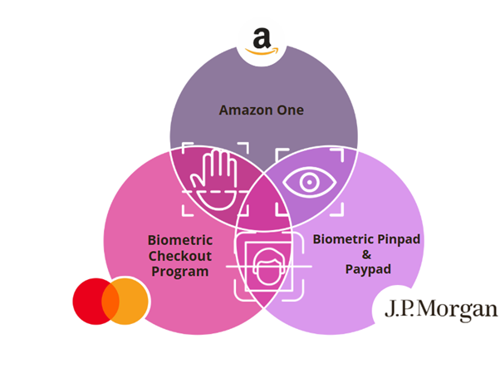
We take a deep dive into three major players trialing this technology - a tech giant, a leading bank, and a global card network - while uncovering the challenges they need to overcome to succeed.
Mastercard
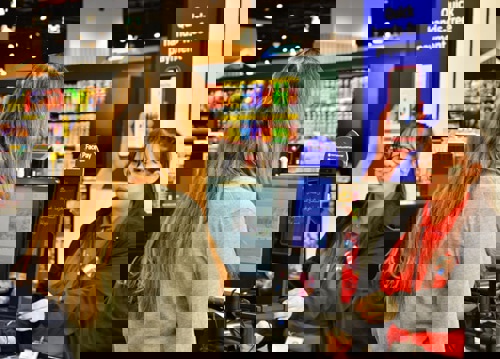
Mastercard has announced a biometric checkout programme that allows consumers to smile into a camera or wave their hand over a reader to pay. The first pilot was launched in five Brazilian supermarkets in 2022, with future pilots planned for roll-out in the Middle East and Asia region. Similarly, Visa and PopID, a consumer authentication service provider based on facial identity, partnered to launch a facial ID service for companies in the Middle East.
Source: PopID
It is notable that these innovations by the card networks are focusing on Latin America, and the Middle East and Asia region; suggesting these corporations believe these regions will be the most receptive to biometric innovations. This may be due to existing biometric systems for national identification, such as biometric voter registration systems, which create consumer familiarity with the technology. While there are no European users, almost half of the countries in Africa and Latin America use these systems. This, along with stricter regulations in the European Union regarding biometric data, suggests that Western Europe may be one of the last regions to experience biometric payments.
Mastercard has announced that their technology will be governed by their principles for data responsibility, which assert that consumers should control and own their personal data. However, without wider regulations to enforce these rules, consumers may not be reassured.
JPMorgan
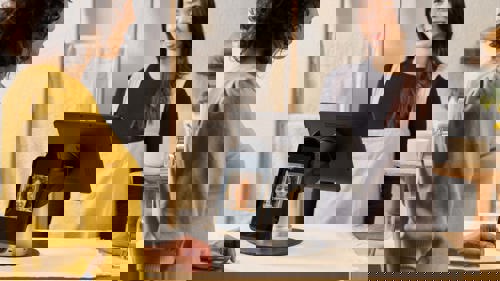
JPMorgan has announced a roll-out of biometric payment terminals in the second half of 2025, in the US, also in partnership with PopID. These are designed to accept a wide range of payments, including contactless, QR code and biometric identification, enabling ‘Pay by Smile’ to complete transactions seamlessly. JPMorgan is aiming this at quick-service restaurants, event venues, and grocery stores in the US.
Source: JPMorgan
This represents the first step by major banks into developing biometric terminals, which is a logical move as customers already trust banks to safeguard their payment data. Merchants may be more willing to adopt payment solutions pushed by banks rather than private corporations, as banks have a long-established reputation for fraud protection.
Amazon
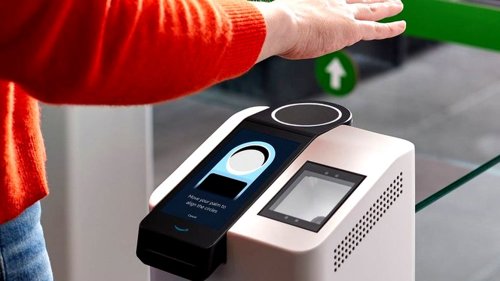
Amazon has introduced a biometric retail payment technology in all of its Whole Foods stores in the US, called Amazon One. This is a palm recognition solution allowing users to pay, enter, or identify themselves. In the last year, Amazon One has launched an app to simplify palm recognition sign-up; letting users sign up by taking a picture of their palm and adding a payment method.
According to Amazon, the service has been used over 8 million times since its launch in 2021 up until 2024.
Source: Amazon
While Apple and Samsung store their biometric data in the user’s device, Amazon is unique in that it stores palm data in the AWS cloud. This has raised concerns amongst US Senators about the safety of this encryption method. After all, if credit and debit card information is hacked, the card can be replaced; your palm cannot. However, Amazon has sought to address these privacy concerns by using temporary digital signatures which can be matched to the data and deleted in the case of hacking. According to Amazon, the palm data is not used for direct, one-to-one mapping (as seen with systems such as Apple Pay), but rather to link the data to a specific user account.
To enhance security, Amazon has implemented liveness detection to prevent spoofing and ensure that palm data is unmatchable with data from other sources; making it useless to third parties. These measures are vital for companies like Amazon; guaranteeing that even if the company was to relax its data-selling policies, the palm data could not be tied to a user’s identity beyond its intended use, such as linking it to a shopping account. This approach not only protects users' privacy but also helps to build and maintain trust in Amazon's biometric authentication system.
Future Outlook
Juniper Research believes biometric payments have huge potential in retail - but there are key hurdles to clear first.
Shoppers are growing frustrated with juggling multiple apps and loyalty cards just to access discounts. Seamlessly linking accounts to payment methods would be a game-changer in convenience.
However, adoption won’t happen overnight. Merchants must invest in new hardware and integrate it into existing systems, slowing the rollout. As a result, expect to see biometric terminals first appear in high-profile retailers looking to lead the charge in customer-centric innovation.
Lorien is a Research Analyst in the Fintech and Payments team at Juniper Research, and specialises in analysing and forecasting emerging trends and innovations in financial markets. Her latest reports have covered topics including Virtual Cards, Network Tokenisation, and CBDCs & Stablecoins.
Related Research
-
 ReportOctober 2025Identity & Security
 Louis AtkinDigital Identity Market, 2025-2030
Juniper Research’s Digital Identity research suite provides a comprehensive and insightful analysis of this market; enabling stakeholders, including digital identity platform providers, digital identity verification providers, government agencies, banks, and many others, to understand future growth, key trends, and the competitive environment.
VIEW -
 ReportMay 2026Identity & Security
 Shane O'SullivanDigital Identity Verification Market, 2026-2030
Our Digital Identity Verification research suite provides detailed analysis of this rapidly changing market; allowing digital identity verification solution providers, financial institutions, and other stakeholders to gain an understanding of key trends and growth opportunities.
VIEW
Latest research, whitepapers & press releases
-
 ReportOctober 2026Fintech & Payments
 Jawad JahanCrypto-gaming Market: 2026-2035
Our Crypto-gaming Market research suite provides an insightful analysis of this rapidly growing market; enabling stakeholders - from crypto-gaming and sportsbooks operators, prediction market platforms, business-to-business (B2B) gambling platforms and software providers, to crypto payment processors and regulators - to understand future growth, key trends, and the competitive environment.
VIEW -
 ReportOctober 2026Telecoms & Connectivity
 Alex WebbRetail Roaming Market: 2026-2031
Our Retail Roaming research suite for mobile network operators (MNOs) and mobile virtual network operators (MVNOs) provides detailed analysis and strategic recommendations for the next era of retail roaming.
VIEW -
 ReportSeptember 2026Fintech & Payments
 Dr Manju ChhillarEmbedded Finance Market: 2026-2031
Embedded finance is one of the fastest-growing markets in financial services, and is about to accelerate even further. Our Embedded Finance Market research provides detailed analysis of the key drivers behind this growth, and what these mean for stakeholders in this market.
VIEW -
 ReportSeptember 2026Identity & Security
 Thomas WilsonApplication Security Market: 2026-2031
Our Application Security research suite provides detailed analysis of this emerging market; allowing application security providers to gain an understanding of key security trends and challenges, potential growth opportunities, and the competitive environment.
VIEW -
 ReportSeptember 2026Fintech & Payments
 Shane O'SullivanBanking Fraud Prevention Market: 2026-2031
Our Banking Fraud Prevention research suite provides a comprehensive and in-depth analysis of the types of fraud currently impacting the banking sector, and the evolving methods that can be used to overcome them.
VIEW -
 ReportSeptember 2026Telecoms & Connectivity
 Nick MaynardPrivate LTE & 5G Networks Market: 2026-2031
Our Private LTE & 5G Networks research suite provides detailed and insightful analysis of this evolving market; enabling stakeholders - from private LTE & 5G network platform specialists, mobile network operators, and diversified technology companies - to understand future growth, key trends, and the competitive environment.
VIEW


-
 WhitepaperOctober 2026Fintech & Payments
Jawad Jahan
WhitepaperOctober 2026Fintech & Payments
Jawad JahanCompliance or Anonymity - The Crypto-gaming Operator’s Dilemma
Our complimentary whitepaper, Compliance or Anonymity - The Crypto-gaming Operator’s Dilemma, analyses the current regulatory landscape of the crypto-gaming market.
VIEW -
 WhitepaperOctober 2026Telecoms & Connectivity
Alex Webb
WhitepaperOctober 2026Telecoms & Connectivity
Alex WebbReimagining the Future of Retail Roaming – How Mobile Network Operators Must Adapt
Our complimentary whitepaper, Reimagining the Future of Retail Roaming – How Mobile Network Operators Must Adapt, explores the emerging opportunities for MNOs within retail roaming.
VIEW -
 WhitepaperSeptember 2026Fintech & Payments
Dr Manju Chhillar
WhitepaperSeptember 2026Fintech & Payments
Dr Manju ChhillarEmerging Markets: The Next Opportunity for Embedded Finance
This free whitepaper examines how a combination of multiple factors is driving North America towards saturation for embedded finance.
VIEW -
 WhitepaperSeptember 2026Emerging Technology
Thomas Wilson
WhitepaperSeptember 2026Emerging Technology
Thomas WilsonVibe Coding: The Fastest-growing Threat to Application Security Today
Our complimentary whitepaper, Vibe Coding: The Fastest-growing Threat to Application Security Today, examines the state of the application security market; considering its impact on different verticals, and how it is being employed in these verticals to best combat malicious attackers and keep sensitive data safe.
VIEW -
 WhitepaperSeptember 2026Fintech & Payments
Shane O'Sullivan
WhitepaperSeptember 2026Fintech & Payments
Shane O'SullivanThe Fraud Frontier: Securing Banking in an AI-driven Era
Our complimentary whitepaper, The Fraud Frontier: Securing Banking in an AI-driven Era, examines the rapidly evolving state of the banking fraud prevention market.
VIEW -
 WhitepaperSeptember 2026Telecoms & Connectivity
Nick Maynard
WhitepaperSeptember 2026Telecoms & Connectivity
Nick MaynardHow Private Cellular Networks Are Unlocking Industry 4.0
Our complimentary whitepaper, How Private Cellular Networks Are Unlocking Industry 4.0, examines how private LTE & 5G networks are reshaping the way industry works.
VIEW


-
Fintech & Payments
Crypto Gaming: Wagers to Reach $1.3 Trillion by 2035, as Crypto Rails Widen Global Access Despite Regulatory Challenges
October 2026 -
Fintech & Payments
Juniper Research Unveils Identity & Security Award Winners for 2026
October 2026 -
Retail Roaming Revenue to Fall $4 Billion By 2031, as Regulatory Restrictions and Competition Bite
October 2026 -
Fintech & Payments
Soft POS to Surpass 100 Million Installations in 2030
September 2026 -
Fintech & Payments
The NextGen Payments & RegTech Forum Arrives in Dubai
September 2026 -
Fintech & Payments
The Global Trade Finance Expo Arrives in Dubai, UAE
September 2026