The First Agentic Black Friday

The capabilities of agentic commerce have advanced drastically since last November; marking the first time that AI agents will be able to personally experience the joys of hunting Black Friday bargains. But will users be willing to allow them? This weekend will act as a major test of whether users are ready to trust agents with their holiday spending, or whether agentic commerce will remain in the more mundane realm of groceries and household essentials.
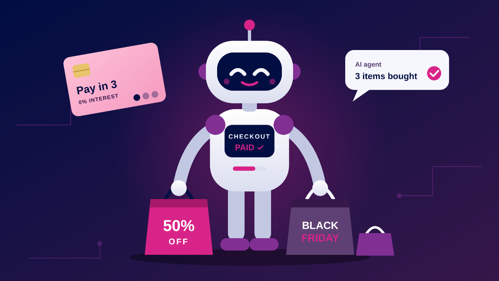
Last year, AI agents mostly acted as personal shoppers. Until recently, AI agents could search and compare products; personalising their recommendations to the tastes of the user, but checkout remained a human-only undertaking. This year, AI agents can go one step further by actually completing checkout themselves; moving from influencing customer decisions to executing them.
As AI agents gain the ability to spend money, advances around this technology must come with caveats regarding payment choice, fraud, and consumer protection.
From Recommendations to Transactions
The infrastructure facilitating agentic commerce has rapidly developed. On September 8th, Meta launched Muse; a personal AI agent designed to perform multi-step tasks such as shopping and booking across mobile, desktop, and WhatsApp. This launched with an integration with Link, Stripe’s instant checkout product; allowing Muse to check out instantly with the customer’s preferred payment method at over 1 million businesses that accept Link. In places that do not, it issues Muse with a single-use virtual card scoped to the approved purchase. However, some companies, such as Amazon, have blocked Meta’s Muse from its sites; citing concerns regarding data security.
Despite the hesitancy by some major retailers to allow AI agents to enter their domains, agentic commerce is still forecast to explode this holiday season. Adobe predicts that AI traffic to US retail sites will grow 95% year-on-year this Black Friday; a substantial increase since Adobe first started tracking the space in October 2024. The commercial opportunity has also shifted in favour of agentic purchases. In September, the conversion rate for purchases from AI traffic was 90% greater compared with non-AI traffic. This is a dramatic shift from August last year, when AI traffic conversion rates were 9% lower than those for non-AI traffic. This switch up is likely the result of improved algorithms making recommendations more sophisticated, as well as increased acceptance on the merchant side; meaning that agents can show a wider range of products to consumers. Agentic traffic also generated 83% higher revenue per visit; an increase from last year’s value of half of human traffic. This advantage will likely grow going into Black Friday as users seek out the best value deals. It also means that retailers choosing to block agentic traffic completely from their website may miss out; making it vital to be able to distinguish between authorised and malicious agentic traffic.
Bots Buy Now, You Pay Later
Just a week before Black Friday, major checkout company Adyen has announced that Klarna has been added as a payment option at agentic checkouts, which previously only offered stored cards as a payment option. When an AI agent is completing a purchase on behalf of a user through Adyen Agentic, it can now display the same Klarna options that the merchant usually offers at checkout, such as paying in interest-free instalments or using financing.
This is a significant expansion of agentic payment choice; however, it comes as the UK’s Financial Ombudsman Service urges Black Friday shoppers to check their Buy Now, Pay Later (BNPL) terms before they spend. This marks the first Black Friday since new Financial Conduct Authority (FCA) regulations came into force, which brought BNPL agreements under the remit of the ombudsman. According to the service, it has received 400 complaints since July 2026, regarding unaffordable lending and poor customer service in the case of issues. While it received 16x the number of credit card complaints compared to those for BNPL, the much lower rate of BNPL use suggests that its users may be disproportionately more likely to make a complaint.
Mixing agentic commerce with BNPL may make these risks more pronounced. As users are already making BNPL payments without fully reading the terms, allowing agents to make payments with only a quick authorisation from users may lead to more blind acceptance of unaffordable purchases.
The Dark Side of Black Friday: Fraud
While AI agents can make holiday shopping more convenient, the same advances in AI are also making it easier to exploit consumers. Generative AI makes it cheap to clone retailer websites; meaning users may log into a fake site with their real details and pay using credit card details, which fraudsters will then sell on. Barclays reported that purchase scams such as these accounted for 71% of all scam claims in 2025; making them the most common method of falling for scams.
Scam efforts will intensify around Black Friday, as demonstrated last year. In November 2025, detection and mitigation company HUMAN registered that the day before Black Friday, almost one in four login attempts was an account takeover attempt; five times the previous week’s rate.
Gen Z may be overly vulnerable to scams, as 7% of Gen Z respondents have reported to have lost money to a Black Friday scam; more than double the recorded rate amongst adults overall. Gen Z is also the fastest-growing demographic falling victim to scams. Barclays disclosed that the number of Gen Z customers reporting a scam claim increased by 17% in the first half of 2026; double the 8% increase across all its customers. This is likely a knock-on effect of the overall participation in social commerce. Over half of Gen Z use social commerce sites, such as TikTok Shop or Pinterest, when shopping online; twice the rate of other age groups. Social commerce sites are particularly vulnerable to purchase scams from AI-generated clone websites, as they expose users to a wide range of sellers and promotional content, often without verification.
As AI has improved since last year, it is likely that scam efforts will increase. HUMAN reported that AI agent traffic has already jumped 210% in September 2026, which will likely rise further into November. The scale of these visits has made it vital for websites to be able to distinguish whether agents are acting maliciously; as otherwise, merchants could be blocking real purchases and losing money.
Will the First Agentic Friday Also Be the Last?
This Black Friday is the first major retail event in which AI agents are fully equipped to complete the entire purchasing journey. For retailers, this creates an opportunity to capture more sales, but this must be balanced by the ability to distinguish between malicious bots and authorised agents. On the user side, consumers must make sure they fully review all terms of purchases before buying. Long-term success of agentic commerce will depend on ensuring that greater convenience does not come at the expense of control or financial wellbeing.
Related Research
-
 ReportApril 2026Fintech & Payments
 Nick Maynard
Agentic Commerce Market, 2026-2031
Juniper Research’s Agentic Commerce research suite provides an insightful analysis of this rapidly emerging market; enabling stakeholders, including AI developers, payment infrastructure providers, eCommerce marketplaces, merchants and many others, to understand future growth, key trends, and the competitive environment.
VIEW -
 ReportOctober 2026Fintech & Payments
 Michael Greenwood
Accounts Payable Automation Market, 2026-2031
Our Accounts Payable (AP) Automation research suite provides an insightful analysis of this rapidly growing market; enabling stakeholders to understand future growth, key trends and the competitive environment.
VIEW -
 ReportSeptember 2026Fintech & Payments
 Shane O'Sullivan
Banking Fraud Prevention Market, 2026-2031
Our Banking Fraud Prevention research suite provides a comprehensive and in-depth analysis of the types of fraud currently impacting the banking sector, and the evolving methods that can be used to overcome them.
VIEW
Latest research, whitepapers & press releases
-
 ReportDecember 2026Telecoms & Connectivity
 Fred Savage
Operator Revenue Strategies Market: 2026-2031
Discover invaluable insights into trends and strategies for network operator revenue in our latest report, Network Operator Revenue Strategies. With data split across 60 countries, this extensive forecast analyses the dynamic and competitive network operator market and the current market challenges posed by slowing revenue, high market saturation in the consumer market, rising network ownership costs, and challenges in 5G monetisation.
VIEW -
 ReportDecember 2026Fintech & Payments
 Dr Manju Chhillar
eCommerce Payments Market: 2026-2031
Our eCommerce Payments Market 2026-2031 report offers an in-depth assessment of this fast-changing market. It provides stakeholders - from eCommerce payment platform providers to merchants and payment service providers - the insight they need to anticipate growth, respond to emerging trends, and benchmark themselves against the competition.
VIEW -
 ReportNovember 2026Telecoms & Connectivity
 Thomas Wilson
Network APIs Market: 2026-2031
Our Network APIs Market research suite provides operators, Communications Platform-as-a-Service (CPaaS) providers, and other GSMA channel partners with extensive analysis and actionable insights into the rapidly growing network API market.
VIEW -
 ReportNovember 2026Fintech & Payments
 Lorien Carter
Virtual Cards Market: 2026-2031
Our Virtual Cards research suite provides a comprehensive and in-depth analysis of the role of virtual cards in the digital payments landscape
VIEW -
 ReportNovember 2026Fintech & Payments
 Shane O'Sullivan
B2B Payments Market: 2026-2031
Our B2B Payments research suite provides a wide-ranging and rigorous analysis of this massive market; enabling stakeholders from B2B payment platform providers to regulators and banks, to understand future growth, key trends and the competitive environment.
VIEW -
 ReportNovember 2026Telecoms & Connectivity
 Ardit Ballhysa
Robocalling & Branded Calling Market: 2026-2031
Our Robocalling & Branded Calling Market research suite provides insightful analysis of a market that is becoming increasingly dynamic and complex.
VIEW


-
 WhitepaperNovember 2026Telecoms & Connectivity
Thomas Wilson
How Operators Can Monetise Network APIs without Compromising Trust
Our complimentary whitepaper, How Operators Can Monetise Network APIs without Compromising Trust, explores how operators can capitalise on the opportunities in the network API market, both now and in the future.
VIEW -
 WhitepaperNovember 2026Fintech & Payments
Lorien Carter
Is Agentic Commerce on the (Virtual) Cards?
Our complimentary whitepaper, Is Agentic Commerce on the (Virtual) Cards?, examines the state of the virtual cards market; explaining the role of key actors in the virtual cards landscape and recent developments within the virtual cards industry.
VIEW -
 WhitepaperNovember 2026Fintech & Payments
Shane O'Sullivan
The End of Wire Transfer – the Battle for B2B Payments
Our complimentary whitepaper, The End of Wire Transfer – the Battle for B2B Payments, examines the rapidly evolving state of the B2B payments market.
VIEW -
 WhitepaperNovember 2026Telecoms & Connectivity
Ardit Ballhysa
Deepfakes in Robocalling Fraud – the Need for Advanced Solutions and Frameworks in 2027 and Beyond
Our complimentary whitepaper, Deepfakes in Robocalling Fraud – the Need for Advanced Solutions and Frameworks in 2027 and Beyond, explores the challenges and opportunities for fraud prevention.
VIEW -
 WhitepaperNovember 2026Telecoms & Connectivity
 Peter Boyland
Rich Messaging, Real Growth: the Rise of RCS and OTT in CPaaS
Our complimentary whitepaper, Rich Messaging, Real Growth: the Rise of RCS and OTT in CPaaS, explores the challenges and opportunities for operators and enterprises as CPaaS becomes more embedded in the consumer experience.
VIEW -
 WhitepaperOctober 2026Fintech & Payments
 Michael Greenwood
Accounts Payable Automation ~ How Businesses Are Reducing Operational Costs
Our complimentary whitepaper, Accounts Payable Automation ~ How Businesses Are Reducing Operational Costs, analyses how AP automation is combatting costs by decreasing the need for manual processes, and provides strategic insight into a number of key trends in the AP automation space.
VIEW


-
Telecoms & Connectivity
Fraud & Authentication Network API Revenue to Pass $6 Billion Globally by 2031, Thanks to New KYC Opportunities
November 2026 -
Telecoms & Connectivity
Private Networks in Service to Exceed 47,000 Globally by 2031, as Industry Specialisation & 5G Drive Expands
November 2026 -
Fintech & Payments
Virtual Cards Market Leaders Revealed by Juniper Research, as Revenue Forecast to Hit $148 Billion by 2031
November 2026 -
Fintech & Payments
B2B Payment Transactions to Exceed 612 Billion by 2031, as Fintechs Challenge Banks for Business Payment Relationships
November 2026 -
Fintech & Payments
27th NextGen Payments & RegTech Forum Returns to Limassol, Cyprus
November 2026 -
Telecoms & Connectivity
North American Consumer Losses from Fraudulent Robocalls to Fall by a Third by 2031; Driven by Robust Solutions and Branded Calling
November 2026