Paying at Agentic Speed: Inside Visa, Mastercard, and Stripe’s Agentic Commerce Push

The term agentic commerce describes a new class of software, usually called an AI agent, that can be handed a budget and a task and left to finish a purchase on its own. For example, reordering supplies, paying for computing power, or subscribing to a data feed with no person in the loop. For most of the Internet’s history, buying something online meant a person clicking buttons and approving the final payment- that step is now being removed.
Agentic commerce is beginning to move from a theoretical idea towards a practical part of the payments industry, although it remains at an early stage. The infrastructure is being laid well ahead of any meaningful transaction volume. Over the past several weeks, three companies that sit at the centre of online payments – Visa, Mastercard, and Stripe – have each made a notable move to prepare for agentic commerce. Taken singularly, these look like three separate events. Taken together, they point to a convergence not only over who processes agentic payments, but in what instrument those payments will be made.
Stripe: A Shared Language for Machines to Pay
The first initiative was put in place by Stripe earlier this year, with the Machine Payments Protocol (MPP); an open, HTTP-native standard for agent-to-agent and agent-to-service payments. Stripe co-authored the protocol with Tempo; a payments-focused L1 blockchain co-developed with Paradigm. MPP was launched in March 2026; shipping alongside Tempo’s Mainnet launch. The problem addressed by MPP is that the current payment system was built for people. To buy something, an agent would normally have to create an account, read a pricing page, pick a plan, type in card details, and set up billing; aspects that all require human approval. MPP replaces this with a direct exchange, by standardising the HTTP 402 ‘Payment Required’ status code with a Challenge-Credential-Receipt flow. The agent hits a paid endpoint, and the server then returns a payment challenge listing price/methods/cadence/metadata. The agent then authorises, retries with a credential, and receives the resource plus a receipt. For businesses and merchants already using Stripe, these payments appear in the same dashboard, settle in the same balance, and follow the same reporting as any ordinary sale.
MPP differs its method from Coinbase’s x402 ‘one-shot’ approach by wrapping the HTTP 402 handshake in a multi-method, lifecycle-aware envelope; extending one-shot calls into recurring subscriptions, and streaming usage, cancellation, and reconciliation. Notably, Stripe backs both the MPP and x402 as part of its wider agentic commerce stack, which also spans the Agentic Commerce Suite, Model Context Protocol (MCP), and the Agentic Commerce Protocol (ACP). Stripe is hedging across protocols, rather than betting on one.
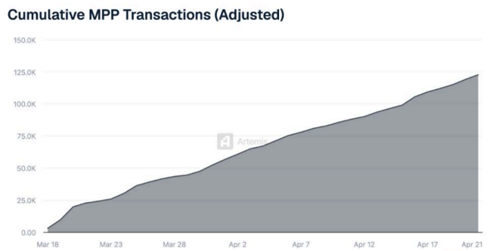
Figure 1: Cumulative MPP Transactions (Adjusted), 2026
Source: Artemis Analytics
Figure 1 shows the cumulative series of MPP transactions; rising steeply on the day of its initial launch, March 18th. This is where integrators, testers, and early developers began experimenting with and using the protocol. Since then, the number of transactions has been steadily increasing. A near-linear cumulative line translates to consistent daily volume, which, for a young protocol, is a bullish read.
Mastercard: Settlement for Payments That Never Stop
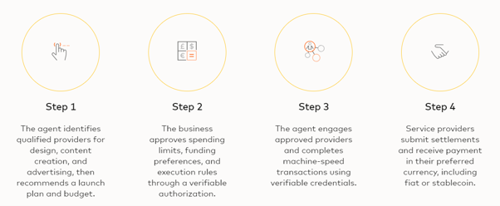
In June 2026, Mastercard launched its Agent Pay for Machines (AP4M); a new service that will allow agentic transactions to be permissioned, orchestrated, and settled at machine speed across its global payments network. Its existing Agent Pay programme, introduced in 2025, allows trusted agents to make normal purchases on a person’s behalf. AP4M is aimed at the constant, automatic, machine-to-machine payments that happen in the background. For example, an entrepreneur starting a new brick-and-mortar business may instruct an AI agent to build and launch its digital presence. The agent will then create a list of tasks it needs to complete, such as buying a domain name and hosting service, copying text and images, or integrating commerce - all within a defined budget. This turns a human-initiated request into a chain of transactions executed automatically across providers. To support this, AP4M gives every agent a verified credential, allows businesses to set spending rules that are enforced automatically, and guarantees settlement across several payment types, including cards, bank accounts, and stablecoins.
Figure 2: Mastercard’s AP4M Flow
Source: Mastercard
This is all in preparation for a future where Mastercard and its partners envision businesses that create services for AI agents. This shift could unlock a wave of innovation, business models. and economic activity, where any company - big or small - can become a supplier for agentic demands. Mastercard’s Chief Product Officer, Jorn Lambert, said the services could create the conditions for a “superbloom of AI business models”, with the launch of AP4M garnering more than 30 partners signed on at the start. This spans payment processors such as Adyen and Checkout.com, infrastructure providers including Cloudflare, and a long list of stablecoin and blockchain firms. Notably, Tempo, Stripe’s partner on MPP, is among the list; working with Mastercard to make the two systems compatible.
Visa: The Data Behind the Stablecoin Case
Visa’s contribution, published in mid-July in collaboration with Artemis Analytics, provides an argument backed by evidence supporting the case for agentic commerce. In the joint report, titled ‘Agentic Payments from the Ground Up’, Visa separates agentic commerce into two kinds. The first is macro commerce: an agent acting for a person on typical-sized purchases such as booking a flight. The second is micro commerce: tiny, frequent payments, often under a dollar, for items such as a single data query or a slice of computing power.
The report’s central finding is that these small payments break the economics of card networks. A card transaction carries a fixed cost of a few cents, at minimum. On payments worth a fraction of a penny, the fixed cost can be larger than the payment itself; so, cards cannot serve these payments profitably. On the other hand, Stablecoins - which settle for a fraction of a cent on newer blockchains - can. This is evident in the data: x402, which originated at Coinbase and Cloudflare, has handled roughly $15 million across 109.6 million transactions since May 2025 ($0.14 per transaction). Stripe’s MPP, released in March 2026, has settled approximately $25,000 across almost 115,000 transactions in its first weeks ($0.22 per transaction). Whilst these average transaction values exceed the stated ‘fraction of a penny’, it is important to note that these figures are a blended average inflated by larger transactions, testing, and dummy transactions.
Visa is careful not to declare any winners in the report. Its stated conclusion is that both cards and stablecoins will have a place. What matters is that Visa is now putting its own data behind the case for stablecoins in the part of the market it expects to grow fastest.
Why this Connects to Open USD
In June 2026, a consortium of more than 140 companies, called the Open Standard, announced Open USD (OUSD); a shared stablecoin governed by an independent body, rather than a single issuer. The founding partners include Visa, Mastercard, and Stripe – the same three names mentioned above – alongside BlackRock, Coinbase, Standard Chartered, and others. What makes OUSD different from the likes of Tether’s USDT, or Circle’s USDC, is that businesses can create and redeem OUSD with no fees or volume limits, and nearly all of the reserve income is handed back to the partners that use it, rather than kept by an issuer. Stripe intends to make OUSD the default stablecoin across its commerce platform.
Placed next to the agentic launches, OUSD reads less like a coincidence and more like the other half of the same plan. If machine payments run on stablecoins, and the networks are building the rails on which those payments run, then owning the stablecoin settlement layer decides who collects the float on what could be an enormous volume of activity. Building the rails and issuing the asset are two moves toward one position. The agentic commerce push gives OUSD a valid use case.
What to Watch
The clearest signal from these announcements is the convergence of products and services, rather than a simple coincidence. Stripe’s MPP, Mastercard’s AP4M, and Visa’s Artemis Report each put forward the same underlying thesis – that agentic commerce will settle in stablecoins. Furthermore, each of these names sits behind Open USD; aligning with a greater strategic objective of owning both the rails and the settlement asset used for agentic transactions. What opens the door for this thesis is that payment cards carry friction that restricts the efficiency garnered from agentic commerce; leaving the micro tier structurally unprofitable to serve at scale with traditional means. The logic becomes clearer when the pieces are read together: the building of settlement infrastructure (MPP, AP4M) and issuing the stablecoin (OUSD) are potentially two halves of one move. At the same time, the vendors are remaining hedged. Stripe supports both MPP and x402, while Tempo bridges MPP into Mastercard’s network. What is clear is that, as yet, no single standard has won. Until the market converges around a common approach, fragmentation risks constraining the very growth that agentic commerce is meant to unlock.
Related Research
-
 ReportApril 2026Fintech & Payments
 Nick MaynardAgentic Commerce Market, 2026-2031
Juniper Research’s Agentic Commerce research suite provides an insightful analysis of this rapidly emerging market; enabling stakeholders, including AI developers, payment infrastructure providers, eCommerce marketplaces, merchants and many others, to understand future growth, key trends, and the competitive environment.
VIEW -
 ReportApril 2026Fintech & Payments
 Jawad JahanStablecoins Market, 2026-2035
Our Stablecoins market research suite provides detailed and insightful analysis of this evolving market; enabling stakeholders such as central banks, commercial banks, stablecoin issuers, and payment service providers to understand future growth, key trends, and the competitive environment.
VIEW -
 ReportJune 2026Fintech & Payments
 Michael GreenwoodChargeback Management Market, 2026-2031
Our Chargeback Management research suite provides detailed analysis of this fast-changing market; allowing chargeback management providers to gain an understanding of key payment trends and challenges, potential growth opportunities, and the competitive environment.
VIEW -
 ReportJuly 2026Fintech & Payments
 Thomas WilsonNetwork Tokenisation Market, 2026-2031
Our Network Tokenisation research suite provides a comprehensive and in-depth analysis of the ecosystem surrounding network tokenisation, enabling stakeholders such as merchants, payment gateways, token service providers and token requestors to understand future growth, key trends and the competitive environment.
VIEW
Latest research, whitepapers & press releases
-
 ReportOctober 2026Fintech & Payments
 Michael GreenwoodAccounts Payable Automation Market: 2026-2031
Our Accounts Payable (AP) Automation research suite provides an insightful analysis of this rapidly growing market; enabling stakeholders to understand future growth, key trends and the competitive environment.
VIEW -
 ReportOctober 2026Fintech & Payments
 Jawad JahanCrypto-gaming Market: 2026-2035
Our Crypto-gaming Market research suite provides an insightful analysis of this rapidly growing market; enabling stakeholders - from crypto-gaming and sportsbooks operators, prediction market platforms, business-to-business (B2B) gambling platforms and software providers, to crypto payment processors and regulators - to understand future growth, key trends, and the competitive environment.
VIEW -
 ReportOctober 2026Telecoms & Connectivity
 Alex WebbRetail Roaming Market: 2026-2031
Our Retail Roaming research suite for mobile network operators (MNOs) and mobile virtual network operators (MVNOs) provides detailed analysis and strategic recommendations for the next era of retail roaming.
VIEW -
 ReportSeptember 2026Fintech & Payments
 Dr Manju ChhillarEmbedded Finance Market: 2026-2031
Embedded finance is one of the fastest-growing markets in financial services, and is about to accelerate even further. Our Embedded Finance Market research provides detailed analysis of the key drivers behind this growth, and what these mean for stakeholders in this market.
VIEW -
 ReportSeptember 2026Identity & Security
 Thomas WilsonApplication Security Market: 2026-2031
Our Application Security research suite provides detailed analysis of this emerging market; allowing application security providers to gain an understanding of key security trends and challenges, potential growth opportunities, and the competitive environment.
VIEW -
 ReportSeptember 2026Fintech & Payments
 Shane O'SullivanBanking Fraud Prevention Market: 2026-2031
Our Banking Fraud Prevention research suite provides a comprehensive and in-depth analysis of the types of fraud currently impacting the banking sector, and the evolving methods that can be used to overcome them.
VIEW


-
 WhitepaperOctober 2026Fintech & Payments
Michael Greenwood
WhitepaperOctober 2026Fintech & Payments
Michael GreenwoodAccounts Payable Automation ~ How Businesses Are Reducing Operational Costs
Our complimentary whitepaper, Accounts Payable Automation ~ How Businesses Are Reducing Operational Costs, analyses how AP automation is combatting costs by decreasing the need for manual processes, and provides strategic insight into a number of key trends in the AP automation space.
VIEW -
 WhitepaperOctober 2026Fintech & Payments
Jawad Jahan
WhitepaperOctober 2026Fintech & Payments
Jawad JahanCompliance or Anonymity - The Crypto-gaming Operator’s Dilemma
Our complimentary whitepaper, Compliance or Anonymity - The Crypto-gaming Operator’s Dilemma, analyses the current regulatory landscape of the crypto-gaming market.
VIEW -
 WhitepaperOctober 2026Telecoms & Connectivity
Alex Webb
WhitepaperOctober 2026Telecoms & Connectivity
Alex WebbReimagining the Future of Retail Roaming – How Mobile Network Operators Must Adapt
Our complimentary whitepaper, Reimagining the Future of Retail Roaming – How Mobile Network Operators Must Adapt, explores the emerging opportunities for MNOs within retail roaming.
VIEW -
 WhitepaperSeptember 2026Fintech & Payments
Dr Manju Chhillar
WhitepaperSeptember 2026Fintech & Payments
Dr Manju ChhillarEmerging Markets: The Next Opportunity for Embedded Finance
This free whitepaper examines how a combination of multiple factors is driving North America towards saturation for embedded finance.
VIEW -
 WhitepaperSeptember 2026Emerging Technology
Thomas Wilson
WhitepaperSeptember 2026Emerging Technology
Thomas WilsonVibe Coding: The Fastest-growing Threat to Application Security Today
Our complimentary whitepaper, Vibe Coding: The Fastest-growing Threat to Application Security Today, examines the state of the application security market; considering its impact on different verticals, and how it is being employed in these verticals to best combat malicious attackers and keep sensitive data safe.
VIEW -
 WhitepaperSeptember 2026Fintech & Payments
Shane O'Sullivan
WhitepaperSeptember 2026Fintech & Payments
Shane O'SullivanThe Fraud Frontier: Securing Banking in an AI-driven Era
Our complimentary whitepaper, The Fraud Frontier: Securing Banking in an AI-driven Era, examines the rapidly evolving state of the banking fraud prevention market.
VIEW


-
Fintech & Payments
Accounts Payable Automation to Save Global Businesses 6.2 Billion Hours by 2031, Accelerated by Business System Integration
October 2026 -
Fintech & Payments
The 25th NextGen Payments & RegTech Forum Arrives in Athens, Greece
October 2026 -
Fintech & Payments
Crypto Gaming: Wagers to Reach $1.3 Trillion by 2035, as Crypto Rails Widen Global Access Despite Regulatory Challenges
October 2026 -
Fintech & Payments
Juniper Research Unveils Identity & Security Award Winners for 2026
October 2026 -
Retail Roaming Revenue to Fall $4 Billion By 2031, as Regulatory Restrictions and Competition Bite
October 2026 -
Fintech & Payments
Soft POS to Surpass 100 Million Installations in 2030
September 2026