Navigating the Smart Traffic Boom: 5 Ways Vendors Can Drive ROI & Adoption

Last week was an exemplary week for the smart traffic management market, with the UK government announcing a transport AI action plan that aims to deliver smarter, safer and greener journeys. The 23-point action plan aims to integrate AI across the UK’s transport systems, to optimise traffic flows, infrastructure management and public transport systems, as well as accelerate decarbonisation goals in the transportation sector.
In addition to this, Milestone Systems, a video technology software company announced that its Project Hafnia would be coming to Europe, beginning with the city of Genova. The project aims to provide developers with high-quality video data to accurately train visual AI models. Project Hafnia is in partnership with NVIDIA, and leverages NVIDIA’s NeMo Curator platform which is designed to enhance AI training. In Italy, the project will be used to enhance traffic management systems using video data trained on the NVIDIA platform.
These two projects highlight the acceleration of smart traffic adoption, which has previously been slowed by budget constraints, especially when transportation departments and agencies have to upgrade or update legacy systems.
A key driver of the accelerated adoption of smart traffic management solutions is the cost saving that can result from reducing emissions and congestion; which our latest research anticipates will reach $281 billion by 2030.
Total Congestion & Emissions Cost Savings by Smart Traffic Management Systems ($m)
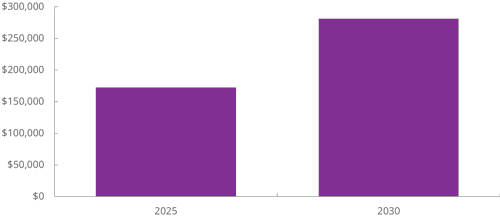
Source: Juniper Research
Driven by the substantial cost savings smart traffic management systems can deliver, Juniper Research predicts the market will surge to $32.7 billion by 2030; a 121% increase from $14.8 billion in 2025.
To take full advantage of this rapid growth over the next five years, smart traffic management providers should focus on the following strategic priorities:
Strategy #1: Development of Hybrid Solutions
With the proliferation of cloud computing, Juniper Research expects hybrid deployments, which combine on-premises deployments with a cloud and edge computing element, to be the most popular deployment model.
This deployment model strikes a balance between the flexibility, scalability and real-time response of cloud and edge computing, and the security and control of on-premises deployments. In addition, it allows vendors to ensure predictable recurring income through the use of subscription-based business models for services such as device equipment maintenance or traffic analytics; thereby maximising revenue.
Strategy #2: Highlight Return on Investment (ROI)
Given that budget constraints have previously slowed growth in the market, smart traffic management vendors must ensure they collect data on how effective their products and solutions are at providing a fast ROI, as well as for reducing carbon emissions. As the market becomes more competitive this will become a key marketing tool for vendors.
In addition, smart traffic management vendors must offer flexible payment services, as this will be a key factor in transportation departments choosing them over other competitors. Vendors can do this by offering monthly repayments to spread the purchase cost, or by adopting modular solutions which allow clients to upgrade over time. This will lower the barrier to entry, enabling more transportation departments to adopt smart traffic management solutions.
Strategy #3: Data Monetisation
In the era of Big Data, smart traffic management vendors have a unique opportunity to tap into a new revenue stream: data monetisation. The data they collect on traffic flows is useful to a number of industries, including insurance, marketing, tourism, retail and telecommunications.
To take full advantage of this opportunity, vendors must ensure that they offer access to both raw data and key analytic insights on a tiered subscription model, with raw data being offered in lower tiers and the premium tiers including access to more insights and analytics. Vendors must ensure they have the right permissions to monetise data before they offer these services; ensuring the use of data with customers in their contracts.
Strategy 4: Adopt an Interoperability-first Approach
As legacy systems are still widely used, smart traffic management vendors must ensure they create solutions that are highly interoperable. They can do this by developing and supporting open APIs and plug-and-play solutions.
Vendors should also incorporate middleware into their solutions, to enable clients with legacy software to enhance their systems without completely replacing them. To do this, smart traffic management vendors must ensure they adopt a modular system architecture, enabling clients to enhance their systems without overhauling them.
Strategy 5: Implement Robust Data Privacy
Data privacy remains a key concern in gaining public acceptance of smart traffic management solutions. Smart traffic management vendors must tackle this issue by using privacy-enhancing technology (PETs), which are methods of minimising personal data collection. These methods range from using AI to generate synthetic datasets that mimic real datasets, to using data anonymisation techniques that remove personal data.
In addition to implementing enhanced data privacy techniques, smart traffic management vendors must also adopt a secure-by-design approach to developing their traffic monitoring products, as well as incorporating robust security into their products. Juniper Research anticipates that cyber security threats will continue to increase, and thus adopting these solutions will be key to ensuring data privacy and integrity, as well as gaining public acceptance and trust.
Michelle is a Research Analyst in Juniper Research’s IoT & Emerging Technology team, where she explores some of the most dynamic and fast-moving areas of tech. She delivers insight and analysis on rapidly evolving markets, such as Smart Traffic Management, Private Cellular Networks, and Quantum Technology.
Related Research
-
 ReportMay 2025Emerging Technology
 Michelle JoynsonSmart Traffic Management Market, 2025-2030
Juniper Research’s Smart Traffic Management research suite provides a detailed and insightful analysis of this progressing market; enabling stakeholders, from smart traffic management providers to regulators and technology vendors, to understand future growth, key trends and the competitive environment.
VIEW
Latest research, whitepapers & press releases
-
 ReportOctober 2026Fintech & Payments
 Jawad JahanCrypto-gaming Market: 2026-2035
Our Crypto-gaming Market research suite provides an insightful analysis of this rapidly growing market; enabling stakeholders - from crypto-gaming and sportsbooks operators, prediction market platforms, business-to-business (B2B) gambling platforms and software providers, to crypto payment processors and regulators - to understand future growth, key trends, and the competitive environment.
VIEW -
 ReportOctober 2026Telecoms & Connectivity
 Alex WebbRetail Roaming Market: 2026-2031
Our Retail Roaming research suite for mobile network operators (MNOs) and mobile virtual network operators (MVNOs) provides detailed analysis and strategic recommendations for the next era of retail roaming.
VIEW -
 ReportSeptember 2026Fintech & Payments
 Dr Manju ChhillarEmbedded Finance Market: 2026-2031
Embedded finance is one of the fastest-growing markets in financial services, and is about to accelerate even further. Our Embedded Finance Market research provides detailed analysis of the key drivers behind this growth, and what these mean for stakeholders in this market.
VIEW -
 ReportSeptember 2026Identity & Security
 Thomas WilsonApplication Security Market: 2026-2031
Our Application Security research suite provides detailed analysis of this emerging market; allowing application security providers to gain an understanding of key security trends and challenges, potential growth opportunities, and the competitive environment.
VIEW -
 ReportSeptember 2026Fintech & Payments
 Shane O'SullivanBanking Fraud Prevention Market: 2026-2031
Our Banking Fraud Prevention research suite provides a comprehensive and in-depth analysis of the types of fraud currently impacting the banking sector, and the evolving methods that can be used to overcome them.
VIEW -
 ReportSeptember 2026Telecoms & Connectivity
 Nick MaynardPrivate LTE & 5G Networks Market: 2026-2031
Our Private LTE & 5G Networks research suite provides detailed and insightful analysis of this evolving market; enabling stakeholders - from private LTE & 5G network platform specialists, mobile network operators, and diversified technology companies - to understand future growth, key trends, and the competitive environment.
VIEW


-
 WhitepaperOctober 2026Fintech & Payments
Jawad Jahan
WhitepaperOctober 2026Fintech & Payments
Jawad JahanCompliance or Anonymity - The Crypto-gaming Operator’s Dilemma
Our complimentary whitepaper, Compliance or Anonymity - The Crypto-gaming Operator’s Dilemma, analyses the current regulatory landscape of the crypto-gaming market.
VIEW -
 WhitepaperOctober 2026Telecoms & Connectivity
Alex Webb
WhitepaperOctober 2026Telecoms & Connectivity
Alex WebbReimagining the Future of Retail Roaming – How Mobile Network Operators Must Adapt
Our complimentary whitepaper, Reimagining the Future of Retail Roaming – How Mobile Network Operators Must Adapt, explores the emerging opportunities for MNOs within retail roaming.
VIEW -
 WhitepaperSeptember 2026Fintech & Payments
Dr Manju Chhillar
WhitepaperSeptember 2026Fintech & Payments
Dr Manju ChhillarEmerging Markets: The Next Opportunity for Embedded Finance
This free whitepaper examines how a combination of multiple factors is driving North America towards saturation for embedded finance.
VIEW -
 WhitepaperSeptember 2026Emerging Technology
Thomas Wilson
WhitepaperSeptember 2026Emerging Technology
Thomas WilsonVibe Coding: The Fastest-growing Threat to Application Security Today
Our complimentary whitepaper, Vibe Coding: The Fastest-growing Threat to Application Security Today, examines the state of the application security market; considering its impact on different verticals, and how it is being employed in these verticals to best combat malicious attackers and keep sensitive data safe.
VIEW -
 WhitepaperSeptember 2026Fintech & Payments
Shane O'Sullivan
WhitepaperSeptember 2026Fintech & Payments
Shane O'SullivanThe Fraud Frontier: Securing Banking in an AI-driven Era
Our complimentary whitepaper, The Fraud Frontier: Securing Banking in an AI-driven Era, examines the rapidly evolving state of the banking fraud prevention market.
VIEW -
 WhitepaperSeptember 2026Telecoms & Connectivity
Nick Maynard
WhitepaperSeptember 2026Telecoms & Connectivity
Nick MaynardHow Private Cellular Networks Are Unlocking Industry 4.0
Our complimentary whitepaper, How Private Cellular Networks Are Unlocking Industry 4.0, examines how private LTE & 5G networks are reshaping the way industry works.
VIEW


-
Fintech & Payments
Crypto Gaming: Wagers to Reach $1.3 Trillion by 2035, as Crypto Rails Widen Global Access Despite Regulatory Challenges
October 2026 -
Fintech & Payments
Juniper Research Unveils Identity & Security Award Winners for 2026
October 2026 -
Retail Roaming Revenue to Fall $4 Billion By 2031, as Regulatory Restrictions and Competition Bite
October 2026 -
Fintech & Payments
Soft POS to Surpass 100 Million Installations in 2030
September 2026 -
Fintech & Payments
The NextGen Payments & RegTech Forum Arrives in Dubai
September 2026 -
Fintech & Payments
The Global Trade Finance Expo Arrives in Dubai, UAE
September 2026