Is There Room for Local Card Schemes in a Visa-Mastercard World?

The card payments space has been a challenging place to be for many years, as the duopoly of Visa and Mastercard has long since taken a dominant role. While local card schemes have existed for a long time, they have typically not fared well against the leading international schemes. Even card networks such as Discover and American Express have struggled to grow their acceptance to similar levels as Visa and Mastercard; showing the scale of the challenge.
However, domestic card networks are fighting back, with two new announcements in recent days: a new pan-African card scheme, and a strategic realignment of Dankort.
Pan-African Card Scheme Launches to Harmonise Payments
Unveiled at the 32nd Afreximbank Annual Meetings in Abuja, Nigeria, the PAPSSCARD is designed to be the first Africa-wide card scheme. A joint venture between the African Export-Import Bank, the Pan-African Payment and Settlement System (PAPSS) and Mercury Payment Services, PAPSSCARD is designed to help Africa secure its payments sovereignty.
The launch of this service will enable card processing to stay within Africa; creating local economic benefits. The timing and roll-out plans of the new system is unclear, but the system could have a significant impact on the African payments market, particularly as the next few years are set to see a significant increase in banked population, with growth of 44% in the number of banked individuals expected between 2024 and 2030.
Number of Banked Individuals in Africa & Middle East (m), 2024-2030
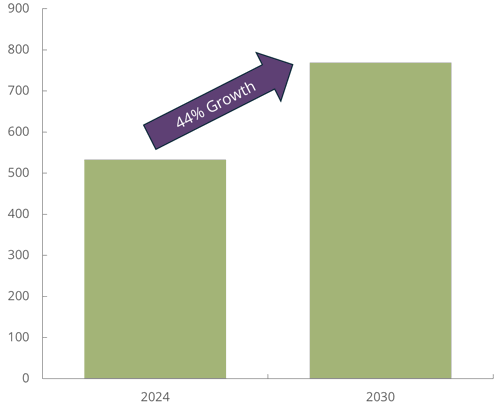
Source: Juniper Research
Big Changes for Dankort as Landscape Shifts
Denmark has historically been a very popular market in terms of domestic card payments. Dankort was first issued as a national debit card in 1983, and has had a very important role as a key payment system in use within Denmark. However, its popularity within the payments ecosystem has been slipping, with the Ministry of Business & Industry sharing that while Dankort accounted for nearly 80% of card transactions nine years ago, now it is far closer to 40%.
This diminished importance is heavily related to the shift towards mobile payments which has been seen in many countries, particularly in Denmark. Where Dankort cards are typically co-branded with Visa or Mastercard, mobile wallets have relied on the international aspects of those cards; diminishing the importance of Dankort’s network over time. Payment system operator Nets has already begun to change this, by working with card issuers to ensure that the Dankort portion of these cards can be used within mobile wallets.
The Danish government’s new deal for Dankort will make several changes:
- Raising the limit on fees so Nets can charge more; funding technological upgrades
- Adding a balance check feature
- Targeting businesses and associations which struggle with high costs of existing payment options
Fundamentally, we believe that the move will make Dankort more competitive; increasing its presence within the digital portion of the market at a time where this progress is sorely needed. However, given that Dankort’s market share has already significantly dropped, reversing this trend will be challenging to achieve.
Domestic Card Schemes – Backing the Wrong Horse?
There is an extent to which it is surprising that domestic card schemes are a focus on efforts at this stage. Mobile payments have transformed the way payments markets operate across the world, so when trying to gain sovereignty over payments, mobile payments, such as Account-to-Account (A2A) payment schemes, have strong potential. A2A payments have been highly popular, and are seeing massive growth, with our latest research on the topic projecting that the number of A2A transactions for consumers expected to growth by 209% globally between 2024 and 2029, based on our data.
Indeed, the European Payments Initiative has chosen to focus on Wero, a mobile wallet solution, rather than a pan-European card scheme as was originally suggested. A2A payments can also been cost-effective to implement, as they do not require the same fixed infrastructure as card payments do. Visa, Mastercard and many of the other card schemes also do a good job of serving customer needs, so competing effectively with them is not an easy task.
Fundamentally, there is no one size fits all approach in payments. In certain countries, new A2A schemes or domestic card schemes will succeed massively, and in others they will fall flat. Choosing the right solution, based on cultural factors and country-level requirements, will be the key to success. In future, we expect more domestic card schemes to be introduced, but their success will be uncertain in a highly competitive payments landscape.
Nick Maynard is VP of Fintech Market Research at Juniper Research, where he leads analysis on key trends shaping the future of finance. With deep expertise across digital payments and commerce, his recent work includes reports on Chargeback Management, Digital Commerce, and Payment Card Technologies; helping stakeholders stay ahead in a rapidly evolving market.
Related Research
-
 ReportSeptember 2025Fintech & Payments
 Thomas WilsonA2A Payments Market, 2025-2030
Our A2A Payments research suite provides detailed analysis of this rapidly changing market; enabling A2A payments service providers to gain an understanding of key payment trends and challenges, potential growth opportunities, and the competitive environment.
VIEW -
 ReportMarch 2026Cross-border Payments
 Lorien CarterCross-border Payments Market, 2026-2030
Our Cross-border Payments research suite provides a comprehensive and in-depth analysis of the evolving cross-border payments landscape; enabling stakeholders such as businesses, financial institutions, payment service providers, card networks, regulators, and technology infrastructure providers to understand future growth, key trends, and the competitive environment.
VIEW
Latest research, whitepapers & press releases
-
 ReportOctober 2026Fintech & Payments
 Michael GreenwoodAccounts Payable Automation Market: 2026-2031
Our Accounts Payable (AP) Automation research suite provides an insightful analysis of this rapidly growing market; enabling stakeholders to understand future growth, key trends and the competitive environment.
VIEW -
 ReportOctober 2026Fintech & Payments
 Jawad JahanCrypto-gaming Market: 2026-2035
Our Crypto-gaming Market research suite provides an insightful analysis of this rapidly growing market; enabling stakeholders - from crypto-gaming and sportsbooks operators, prediction market platforms, business-to-business (B2B) gambling platforms and software providers, to crypto payment processors and regulators - to understand future growth, key trends, and the competitive environment.
VIEW -
 ReportOctober 2026Telecoms & Connectivity
 Alex WebbRetail Roaming Market: 2026-2031
Our Retail Roaming research suite for mobile network operators (MNOs) and mobile virtual network operators (MVNOs) provides detailed analysis and strategic recommendations for the next era of retail roaming.
VIEW -
 ReportSeptember 2026Fintech & Payments
 Dr Manju ChhillarEmbedded Finance Market: 2026-2031
Embedded finance is one of the fastest-growing markets in financial services, and is about to accelerate even further. Our Embedded Finance Market research provides detailed analysis of the key drivers behind this growth, and what these mean for stakeholders in this market.
VIEW -
 ReportSeptember 2026Identity & Security
 Thomas WilsonApplication Security Market: 2026-2031
Our Application Security research suite provides detailed analysis of this emerging market; allowing application security providers to gain an understanding of key security trends and challenges, potential growth opportunities, and the competitive environment.
VIEW -
 ReportSeptember 2026Fintech & Payments
 Shane O'SullivanBanking Fraud Prevention Market: 2026-2031
Our Banking Fraud Prevention research suite provides a comprehensive and in-depth analysis of the types of fraud currently impacting the banking sector, and the evolving methods that can be used to overcome them.
VIEW


-
 WhitepaperOctober 2026Fintech & Payments
Jawad Jahan
WhitepaperOctober 2026Fintech & Payments
Jawad JahanCompliance or Anonymity - The Crypto-gaming Operator’s Dilemma
Our complimentary whitepaper, Compliance or Anonymity - The Crypto-gaming Operator’s Dilemma, analyses the current regulatory landscape of the crypto-gaming market.
VIEW -
 WhitepaperOctober 2026Telecoms & Connectivity
Alex Webb
WhitepaperOctober 2026Telecoms & Connectivity
Alex WebbReimagining the Future of Retail Roaming – How Mobile Network Operators Must Adapt
Our complimentary whitepaper, Reimagining the Future of Retail Roaming – How Mobile Network Operators Must Adapt, explores the emerging opportunities for MNOs within retail roaming.
VIEW -
 WhitepaperSeptember 2026Fintech & Payments
Dr Manju Chhillar
WhitepaperSeptember 2026Fintech & Payments
Dr Manju ChhillarEmerging Markets: The Next Opportunity for Embedded Finance
This free whitepaper examines how a combination of multiple factors is driving North America towards saturation for embedded finance.
VIEW -
 WhitepaperSeptember 2026Emerging Technology
Thomas Wilson
WhitepaperSeptember 2026Emerging Technology
Thomas WilsonVibe Coding: The Fastest-growing Threat to Application Security Today
Our complimentary whitepaper, Vibe Coding: The Fastest-growing Threat to Application Security Today, examines the state of the application security market; considering its impact on different verticals, and how it is being employed in these verticals to best combat malicious attackers and keep sensitive data safe.
VIEW -
 WhitepaperSeptember 2026Fintech & Payments
Shane O'Sullivan
WhitepaperSeptember 2026Fintech & Payments
Shane O'SullivanThe Fraud Frontier: Securing Banking in an AI-driven Era
Our complimentary whitepaper, The Fraud Frontier: Securing Banking in an AI-driven Era, examines the rapidly evolving state of the banking fraud prevention market.
VIEW -
 WhitepaperSeptember 2026Telecoms & Connectivity
 Nick Maynard
How Private Cellular Networks Are Unlocking Industry 4.0
Our complimentary whitepaper, How Private Cellular Networks Are Unlocking Industry 4.0, examines how private LTE & 5G networks are reshaping the way industry works.
VIEW


-
Fintech & Payments
The 25th NextGen Payments & RegTech Forum Arrives in Athens, Greece
October 2026 -
Fintech & Payments
Crypto Gaming: Wagers to Reach $1.3 Trillion by 2035, as Crypto Rails Widen Global Access Despite Regulatory Challenges
October 2026 -
Fintech & Payments
Juniper Research Unveils Identity & Security Award Winners for 2026
October 2026 -
Retail Roaming Revenue to Fall $4 Billion By 2031, as Regulatory Restrictions and Competition Bite
October 2026 -
Fintech & Payments
Soft POS to Surpass 100 Million Installations in 2030
September 2026 -
Fintech & Payments
The NextGen Payments & RegTech Forum Arrives in Dubai
September 2026