Is It Time for Digital Travel Credentials to Take Off?

International travel is a massive industry; over 800 million people travelled internationally in 2023, according to Juniper Research data. Over half (53.2%) travel by air, with land travel being the second most common mode (43%). The number of travellers will continue to grow, driven by the growth of international tourism and business trips in high-growth developing markets, especially China.
Global Number of People Travelling Internationally (m), 2024 vs. 2029
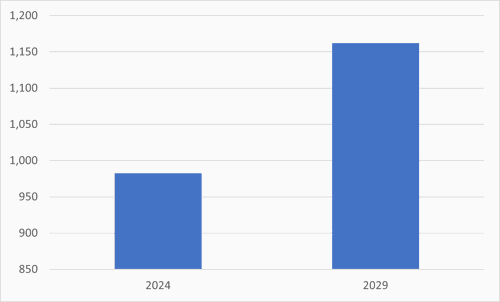
Source: Juniper Research
As in all other industries, international travellers are increasingly demanding a more streamlined and digital service. Air travel in particular is notorious for its slow check-in process, although identity checks at any border can be time-consuming. It is this friction that is driving the move towards DTCs (Digital Travel Credentials).
There are three categories of DTCs:
- Type 1: Type 1 DTCs are eMRTDs (Machine Readable Travel Documents) that are generated by reading the physical travel credential’s chip, with either a smartphone or a self-service kiosk. For Type 1 DTCs, the user must still carry the physical document, with the eMRTD acting as a form of authentication.
- Type 2: Type 2 DTCs are issued by the same authority as a physical passport, signed by the authority, and linked to the physical passport. The DTC is linked to physical devices and can be used independently of the physical document, which acts as a backup to the DTC. It is important to note that the DTC is based on a physical document, which must still be issued first.
- Type 3: Type 3 DTCs are issued and signed by the issuing authority, and stored on devices. The DTC is not linked to a physical component, which means it can be issued to an individual who does not have a physical passport.
These three different varieties of DTCs offer a progression of how DTCs can be introduced, with the need for physical travel credentials phased out over the three types. This is important, as many governments do not want to abandon physical passports at this point in time. This can be largely attributed to security concerns, with the established system being trusted by authorities. In many markets, a section of the population is either opposed to the principle to digital identity documents of any kind, or not technologically proficient. It is important that governments maintain services to these groups, necessitating the maintenance of physical passport services.
As things stand, no country has fully implemented DTCs, although several pilot schemes have been carried out. This includes a trial which ran between August 2023 and March 2024 in Finland, and another carried out from the 29th February to the 31st of March 2024 in the Netherlands. These pilots were considered successful, with the Finnish pilot carrying out 355 successful DTC checks, with the average check taking eight seconds. The pilots, which both used Type 1 DTCs, were used to inform the EU’s regulation of border checks with DTCs.
The positive results of these pilots indicates that the EU will be introducing regulation to allow the implementation of Type 1 DTCs. These will be combined with automated facial recognition technology, to allow DTC users to progress more quickly through airport check-in. These DTCs will be focused on air travel, as passports are not needed to travel through the Schengen Area, and international travel across sea borders is rarer and generally poses less friction.
In the future, DTCs within the EU will be able to be held within a European Identity Wallet, as set out in the eIDAS2 regulation; this will be the ideal place to store a Type 2 or Type 3 DTC. Based on this knowledge, Juniper Research expects the EU to lead the way in the adoption of DTCs over the medium term.
Outside of the EU, there is less concrete movement towards Type 1 DTCs. However, the ICAO (International Civil Aviation Organisation) has been active in promoting standards, defining the categories of Type 1, 2 and 3 DTCs. This work will make it easier for countries to adopt DTCs, as the credentials will operate on the same standards at both ends of the journey. Countries looking to implement DTCs must ensure that they offer a smoother customer experience than the current system provides, to ensure consumer adoption.
Michael is a Senior Research Analyst at Juniper Research, and primarily conducts research on digital identity and payments markets. His recent reports include Digital Identity, Instant Payments, and B2B Payments.
Related Research
-
 ReportAugust 2026Digital Ticketing
 Nick MaynardDigital Ticketing Market Data, 2026-2031
Our Digital Ticketing report provides exhaustive coverage of the digital ticketing market, including the adoption rates of digital ticketing across different ticketing segments, as well as the use of wearable payments and chatbots.
VIEW
Latest research, whitepapers & press releases
-
 ReportOctober 2026Fintech & Payments
 Jawad JahanCrypto-gaming Market: 2026-2035
Our Crypto-gaming Market research suite provides an insightful analysis of this rapidly growing market; enabling stakeholders - from crypto-gaming and sportsbooks operators, prediction market platforms, business-to-business (B2B) gambling platforms and software providers, to crypto payment processors and regulators - to understand future growth, key trends, and the competitive environment.
VIEW -
 ReportOctober 2026Telecoms & Connectivity
 Alex WebbRetail Roaming Market: 2026-2031
Our Retail Roaming research suite for mobile network operators (MNOs) and mobile virtual network operators (MVNOs) provides detailed analysis and strategic recommendations for the next era of retail roaming.
VIEW -
 ReportSeptember 2026Fintech & Payments
 Dr Manju ChhillarEmbedded Finance Market: 2026-2031
Embedded finance is one of the fastest-growing markets in financial services, and is about to accelerate even further. Our Embedded Finance Market research provides detailed analysis of the key drivers behind this growth, and what these mean for stakeholders in this market.
VIEW -
 ReportSeptember 2026Identity & Security
 Thomas WilsonApplication Security Market: 2026-2031
Our Application Security research suite provides detailed analysis of this emerging market; allowing application security providers to gain an understanding of key security trends and challenges, potential growth opportunities, and the competitive environment.
VIEW -
 ReportSeptember 2026Fintech & Payments
 Shane O'SullivanBanking Fraud Prevention Market: 2026-2031
Our Banking Fraud Prevention research suite provides a comprehensive and in-depth analysis of the types of fraud currently impacting the banking sector, and the evolving methods that can be used to overcome them.
VIEW -
 ReportSeptember 2026Telecoms & Connectivity
 Nick MaynardPrivate LTE & 5G Networks Market: 2026-2031
Our Private LTE & 5G Networks research suite provides detailed and insightful analysis of this evolving market; enabling stakeholders - from private LTE & 5G network platform specialists, mobile network operators, and diversified technology companies - to understand future growth, key trends, and the competitive environment.
VIEW


-
 WhitepaperOctober 2026Fintech & Payments
Jawad Jahan
WhitepaperOctober 2026Fintech & Payments
Jawad JahanCompliance or Anonymity - The Crypto-gaming Operator’s Dilemma
Our complimentary whitepaper, Compliance or Anonymity - The Crypto-gaming Operator’s Dilemma, analyses the current regulatory landscape of the crypto-gaming market.
VIEW -
 WhitepaperOctober 2026Telecoms & Connectivity
Alex Webb
WhitepaperOctober 2026Telecoms & Connectivity
Alex WebbReimagining the Future of Retail Roaming – How Mobile Network Operators Must Adapt
Our complimentary whitepaper, Reimagining the Future of Retail Roaming – How Mobile Network Operators Must Adapt, explores the emerging opportunities for MNOs within retail roaming.
VIEW -
 WhitepaperSeptember 2026Fintech & Payments
Dr Manju Chhillar
WhitepaperSeptember 2026Fintech & Payments
Dr Manju ChhillarEmerging Markets: The Next Opportunity for Embedded Finance
This free whitepaper examines how a combination of multiple factors is driving North America towards saturation for embedded finance.
VIEW -
 WhitepaperSeptember 2026Emerging Technology
Thomas Wilson
WhitepaperSeptember 2026Emerging Technology
Thomas WilsonVibe Coding: The Fastest-growing Threat to Application Security Today
Our complimentary whitepaper, Vibe Coding: The Fastest-growing Threat to Application Security Today, examines the state of the application security market; considering its impact on different verticals, and how it is being employed in these verticals to best combat malicious attackers and keep sensitive data safe.
VIEW -
 WhitepaperSeptember 2026Fintech & Payments
Shane O'Sullivan
WhitepaperSeptember 2026Fintech & Payments
Shane O'SullivanThe Fraud Frontier: Securing Banking in an AI-driven Era
Our complimentary whitepaper, The Fraud Frontier: Securing Banking in an AI-driven Era, examines the rapidly evolving state of the banking fraud prevention market.
VIEW -
 WhitepaperSeptember 2026Telecoms & Connectivity
Nick Maynard
WhitepaperSeptember 2026Telecoms & Connectivity
Nick MaynardHow Private Cellular Networks Are Unlocking Industry 4.0
Our complimentary whitepaper, How Private Cellular Networks Are Unlocking Industry 4.0, examines how private LTE & 5G networks are reshaping the way industry works.
VIEW


-
Fintech & Payments
Crypto Gaming: Wagers to Reach $1.3 Trillion by 2035, as Crypto Rails Widen Global Access Despite Regulatory Challenges
October 2026 -
Fintech & Payments
Juniper Research Unveils Identity & Security Award Winners for 2026
October 2026 -
Retail Roaming Revenue to Fall $4 Billion By 2031, as Regulatory Restrictions and Competition Bite
October 2026 -
Fintech & Payments
Soft POS to Surpass 100 Million Installations in 2030
September 2026 -
Fintech & Payments
The NextGen Payments & RegTech Forum Arrives in Dubai
September 2026 -
Fintech & Payments
The Global Trade Finance Expo Arrives in Dubai, UAE
September 2026