From Monzo to Barclays: What’s Behind the Recent Wave of AML Failures?

Earlier this month, Monzo was hit with a £21 million fine for "systematic financial crime control failings." The penalty sent ripples across the fintech landscape; prompting heated debates around whether challenger banks, which often scale rapidly, are outgrowing their compliance capabilities.
However, just a week later, Barclays was fined a staggering £41 million for similar lapses; demonstrating that legacy institutions are also struggling to meet anti-money laundering (AML) standards.
The Financial Conduct Authority (FCA) stated that Barclays had “facilitated the movement of funds linked to financial crime” by misclassifying two high-risk clients -Stunt & Co, and WealthTek - as low-risk. Both clients were already under investigation for money laundering; raising serious questions about how they passed through Barclays’ due diligence net.
These fines are the largest the FCA has issued so far this year; underlining how seriously the regulator views these breaches. In fact, Barclays’ £41m penalty surpasses any AML-related fines issued in 2023 and 2024. Only Santander UK's £107 million fine in 2022 - which was also levied for deficient AML controls - stands out as a larger historic case in recent years.
But Barclays and Monzo are not alone. Other commercial banks in the UK have also faced scrutiny for similar lapses. In 2024, Metro Bank was fined £16.7 million after flaws in its transaction monitoring system left gaps in financial crime detection. The issue originated when Metro automated parts of its AML processes, only to discover that incorrect data inputs between 2016 and 2020 compromised the effectiveness of the entire system.
Starling Bank, another digital challenger, was fined £29 million after its automated screening tool failed to properly identify customers on sanctions lists. It turned out the system had only been checking against a subset of the official list of sanctioned individuals and entities.
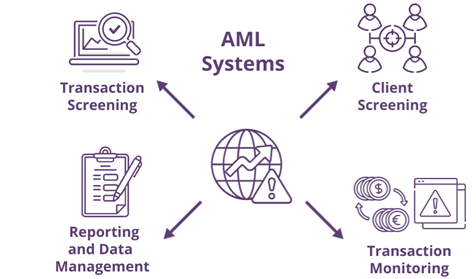
Types of AML Processes
Source: Juniper Research
So, the question begs: why have banks old and new been failing to provide adequate AML checks?
Established banks are hampered by legacy systems; many of which are siloed and lack interoperability. Santander planned to upgrade its transaction monitoring system by integrating it with its Customer Risk Assessment (CRA) system. However, this was technologically complex and deemed unachievable; leaving Santander relying on temporary fixes and exposed to compliance risks.
In contrast, challenger banks are built on modern tech stacks and should, in theory, be more agile. Yet rapid deployment without sufficient oversight presents its own risks. Both Metro and Starling were fined after their automated systems failed. Metro’s Automated Transaction Monitoring System had operational deficiencies, while Starling’s sanctions screening system only checked a partial list. To avoid such issues, significant resources need to be invested into skilled human oversight during implementation.
Unfortunately, a shared challenge across both types of banks is under-resourcing in AML teams. The FCA found that Monzo’s monitoring tasks were handled by inexperienced staff, while Santander’s Suspicious Activity Reporting (SAR) unit faced a five-month backlog on medium-risk alerts due to staff shortages. Technology, no matter how advanced, cannot compensate for a lack of human oversight.
Whether hampered by legacy tech or hindered by rushed innovation, banks are repeatedly falling into the same traps. These cases reveal a common lesson: effective financial crime prevention is not just about having the right tools, it’s about how those tools are integrated, supported, and governed. Automation can significantly enhance transaction monitoring, but only when paired with experienced personnel and robust processes.
Lorien is a Research Analyst in the Fintech and Payments team at Juniper Research, and specialises in analysing and forecasting emerging trends and innovations in financial markets. Her latest reports have covered topics including Contactless Payments, Virtual Cards, and Network Tokenisation.
Related Research
-
 ReportSeptember 2025Identity & Security
 Shane O'SullivanAnti-money Laundering Systems Market, 2025-2030
Our AML Systems research suite provides a detailed and insightful analysis of this evolving market; enabling stakeholders from financial institutions, law enforcement agencies, regulatory bodies and technology vendors to understand future growth, key trends, and the competitive environment.
VIEW -
 ReportSeptember 2026Fintech & Payments
Shane O'SullivanBanking Fraud Prevention Market, 2026-2031
ReportSeptember 2026Fintech & Payments
Shane O'SullivanBanking Fraud Prevention Market, 2026-2031Our Banking Fraud Prevention research suite provides a comprehensive and in-depth analysis of the types of fraud currently impacting the banking sector, and the evolving methods that can be used to overcome them.
VIEW -
 ReportJuly 2024Fintech & Payments
 Cara MaloneUK Fraud Detection & Prevention in the Banking Market, 2024-2029
Our UK Fraud Detection & Prevention in Banking research suite provides detailed evaluation and analysis of the evolving fraud landscape in the UK for banking and the financial industry, including fraud trends and the impact of evolving payment types, such as instant payments, blockchain and CBDCs (Central Bank Digital Currencies).
VIEW
Latest research, whitepapers & press releases
-
 ReportOctober 2026Fintech & Payments
 Michael GreenwoodAccounts Payable Automation Market: 2026-2031
Our Accounts Payable (AP) Automation research suite provides an insightful analysis of this rapidly growing market; enabling stakeholders to understand future growth, key trends and the competitive environment.
VIEW -
 ReportOctober 2026Fintech & Payments
 Jawad JahanCrypto-gaming Market: 2026-2035
Our Crypto-gaming Market research suite provides an insightful analysis of this rapidly growing market; enabling stakeholders - from crypto-gaming and sportsbooks operators, prediction market platforms, business-to-business (B2B) gambling platforms and software providers, to crypto payment processors and regulators - to understand future growth, key trends, and the competitive environment.
VIEW -
 ReportOctober 2026Telecoms & Connectivity
 Alex WebbRetail Roaming Market: 2026-2031
Our Retail Roaming research suite for mobile network operators (MNOs) and mobile virtual network operators (MVNOs) provides detailed analysis and strategic recommendations for the next era of retail roaming.
VIEW -
 ReportSeptember 2026Fintech & Payments
 Dr Manju ChhillarEmbedded Finance Market: 2026-2031
Embedded finance is one of the fastest-growing markets in financial services, and is about to accelerate even further. Our Embedded Finance Market research provides detailed analysis of the key drivers behind this growth, and what these mean for stakeholders in this market.
VIEW -
 ReportSeptember 2026Identity & Security
 Thomas WilsonApplication Security Market: 2026-2031
Our Application Security research suite provides detailed analysis of this emerging market; allowing application security providers to gain an understanding of key security trends and challenges, potential growth opportunities, and the competitive environment.
VIEW -
 ReportSeptember 2026Fintech & Payments
 Shane O'SullivanBanking Fraud Prevention Market: 2026-2031
Our Banking Fraud Prevention research suite provides a comprehensive and in-depth analysis of the types of fraud currently impacting the banking sector, and the evolving methods that can be used to overcome them.
VIEW


-
 WhitepaperOctober 2026Fintech & Payments
Jawad Jahan
WhitepaperOctober 2026Fintech & Payments
Jawad JahanCompliance or Anonymity - The Crypto-gaming Operator’s Dilemma
Our complimentary whitepaper, Compliance or Anonymity - The Crypto-gaming Operator’s Dilemma, analyses the current regulatory landscape of the crypto-gaming market.
VIEW -
 WhitepaperOctober 2026Telecoms & Connectivity
Alex Webb
WhitepaperOctober 2026Telecoms & Connectivity
Alex WebbReimagining the Future of Retail Roaming – How Mobile Network Operators Must Adapt
Our complimentary whitepaper, Reimagining the Future of Retail Roaming – How Mobile Network Operators Must Adapt, explores the emerging opportunities for MNOs within retail roaming.
VIEW -
 WhitepaperSeptember 2026Fintech & Payments
Dr Manju Chhillar
WhitepaperSeptember 2026Fintech & Payments
Dr Manju ChhillarEmerging Markets: The Next Opportunity for Embedded Finance
This free whitepaper examines how a combination of multiple factors is driving North America towards saturation for embedded finance.
VIEW -
 WhitepaperSeptember 2026Emerging Technology
Thomas Wilson
WhitepaperSeptember 2026Emerging Technology
Thomas WilsonVibe Coding: The Fastest-growing Threat to Application Security Today
Our complimentary whitepaper, Vibe Coding: The Fastest-growing Threat to Application Security Today, examines the state of the application security market; considering its impact on different verticals, and how it is being employed in these verticals to best combat malicious attackers and keep sensitive data safe.
VIEW -
 WhitepaperSeptember 2026Fintech & Payments
Shane O'Sullivan
WhitepaperSeptember 2026Fintech & Payments
Shane O'SullivanThe Fraud Frontier: Securing Banking in an AI-driven Era
Our complimentary whitepaper, The Fraud Frontier: Securing Banking in an AI-driven Era, examines the rapidly evolving state of the banking fraud prevention market.
VIEW -
 WhitepaperSeptember 2026Telecoms & Connectivity
 Nick Maynard
How Private Cellular Networks Are Unlocking Industry 4.0
Our complimentary whitepaper, How Private Cellular Networks Are Unlocking Industry 4.0, examines how private LTE & 5G networks are reshaping the way industry works.
VIEW


-
Fintech & Payments
The 25th NextGen Payments & RegTech Forum Arrives in Athens, Greece
October 2026 -
Fintech & Payments
Crypto Gaming: Wagers to Reach $1.3 Trillion by 2035, as Crypto Rails Widen Global Access Despite Regulatory Challenges
October 2026 -
Fintech & Payments
Juniper Research Unveils Identity & Security Award Winners for 2026
October 2026 -
Retail Roaming Revenue to Fall $4 Billion By 2031, as Regulatory Restrictions and Competition Bite
October 2026 -
Fintech & Payments
Soft POS to Surpass 100 Million Installations in 2030
September 2026 -
Fintech & Payments
The NextGen Payments & RegTech Forum Arrives in Dubai
September 2026