Digital Identity Cards in the UK – Controversial, But Will They Work?

The UK Government has announced that it intends to introduce digital identity cards, held on people’s phones. The proposed 'Brit Card' would be a digital form of identification held in a UK government app and would be mandatory for certain uses, such as proving one’s right to work in the country.
Prime Minister Kier Starmer described the plans as follows: “Digital ID is an enormous opportunity for the UK. It will make it tougher to work illegally in this country, making our borders more secure. And it will also offer ordinary citizens countless benefits, like being able to prove your identity to access key services swiftly – rather than hunting around for an old utility bill.”
These plans will see the Brit Card become available to all UK citizens and legal residents in the UK by the end of the current Parliament, currently scheduled for August 2029, though the plans will require legislation and a public consultation.
Identity Cards in the UK – A Troubled Past, But Promising Future?
Any mention of the issuing of identity cards is a contentious one in the UK, with former Prime Minister Tony Blair’s government in the early 2000s proposing, under the Identity Cards Act 2006, and subsequently failing to roll-out a national identity card scheme.
While identity cards are mandatory, or at least offered, in a large number of countries, they have been controversial in the UK due to civil liberties concerns. The focus on using digital identity as a method to curb illegal working in the UK economy represents a different strategy from before, but it is still a highly debatable move.
However, if the political challenges can be navigated, there is high potential for such an approach. By providing cards free of charge and providing the ability to check right to work versus a government database, this would make right to work checks quicker and easier, and could potentially simplify enforcement. Outside of the immigration argument, there are numerous benefits to digital identity use – easier access to government services, the ability to seamlessly age verify during online and in-person transactions, and many others. The potential is there, but the path to making a success of digital identity in the UK will be challenging.
Initiative Must Learn the Lessons of Other Countries and the Past
In order to make a success of digital identity in the UK, the UK Government must learn from both technology failures in the UK as well as best practice from other markets. Learning from key examples, such as Norway’s BankID, Singapore’s SingPass, and India’s Aadhaar, is vital to success. A few key considerations are the following:
- Benefits must be clear - The benefits of the scheme, rather than the requirement to have a digital ID for legal reasons, should be communicated clearly, such as easy access to government services.
- Third-party support and interoperability are vital - The UK has a vibrant digital identity market, particularly in the verification space, so ensuring the market is included is important. Also, interoperability with existing identity elements, verification types, and international schemes would be desirable.
- Accessibility matters - While a large majority of users have the means to access online services, ensuring that vulnerable users - such as the elderly, disabled or the homeless - can still access systems is vitally important. Excluding users from accessing services they are entitled to, due to a lack of a smartphone or Internet access, would be extremely damaging.
- Consider fraud - When any digital service launches, considering the potential for fraud is vital. Ensuring that identities are verified when entering the system will be important to ensuring the stability of the system.
When considering other initiatives in flight, the EU’s eIDAS 2.0 initiative, which is creating a broad EU ID wallet system for roll-out in 2026, is an important scheme to consider. From a collaborative point of view, with the EU as the UK’s biggest neighbour, interoperability between systems would be desirable.
Taking the design of the EU system to heart is important too. eIDAS 2.0 places the citizen in control of their data: what is shared to whom and when, and so building the Brit Card with this citizen-permissioned philosophy will go a long way to securing buy-in for the scheme.
The UK Government should also consider the history of IT project overspends and failures in the UK public sector, such as the hugely costly National Programme for IT in the NHS, which was estimated to have cost £10 billion ($13.4 billion) when it was shelved in 2011. Ensuring that this kind of failure does not reoccur is important. The UK Government should ensure that its approach to digital identity remains focused and consistent, with a previous private-led approach to digital identity being disrupted by a public-led model.
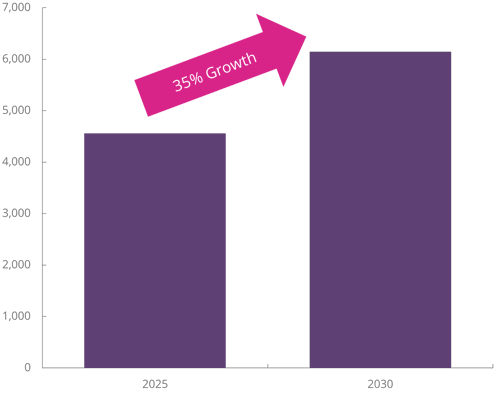
Despite the many challenges involved, digital identity cards, overall, have strong potential. For this reason, our latest research points to a 35% growth in the number of people with digital identity cards between 2025 and 2030.
Number of People Globally With Digital Identity Cards (m) 2025 vs. 2030
Source: Juniper Research
Future Outlook
Clearly, the use of identity cards of any type in the UK will always be divisive, and whether the scheme actually comes into service is a matter for debate. However, despite the difficult challenges to navigate, there is strong potential for digital identity use.
Digital identity can empower citizens, provide them with streamlined access to services, and give them control over how their identity is used. As the UK Government moves forward with Brit Card, it must make a positive argument for how the scheme will empower citizens, and how civil liberties will be enshrined. If it fails to articulate a positive case with robust controls, adoption and usage of the system - if implemented - will struggle to gain traction.
Nick Maynard is VP of Fintech Market Research at Juniper Research, where he leads analysis on key trends shaping the future of finance. With deep expertise across digital payments and commerce, his recent work includes reports on Chargeback Management, Digital Commerce, and Payment Card Technologies; helping stakeholders stay ahead in a rapidly evolving market.
Related Research
-
 ReportOctober 2025Identity & Security
 Louis AtkinDigital Identity Market, 2025-2030
Juniper Research’s Digital Identity research suite provides a comprehensive and insightful analysis of this market; enabling stakeholders, including digital identity platform providers, digital identity verification providers, government agencies, banks, and many others, to understand future growth, key trends, and the competitive environment.
VIEW -
 ReportApril 2025Identity & Security
 Thomas WilsonDigital ID & Verification in the UK Market, 2025-2029
Our UK-focused Digital ID & Verification Market research suite provides detailed analysis of this emerging market; enabling digital identity service providers to gain an understanding of key trends and challenges, potential growth opportunities, and the competitive environment.
VIEW -
 ReportMay 2026Identity & Security
 Shane O'SullivanDigital Identity Verification Market, 2026-2030
Our Digital Identity Verification research suite provides detailed analysis of this rapidly changing market; allowing digital identity verification solution providers, financial institutions, and other stakeholders to gain an understanding of key trends and growth opportunities.
VIEW
Latest research, whitepapers & press releases
-
 ReportOctober 2026Fintech & Payments
 Jawad JahanCrypto-gaming Market: 2026-2035
Our Crypto-gaming Market research suite provides an insightful analysis of this rapidly growing market; enabling stakeholders - from crypto-gaming and sportsbooks operators, prediction market platforms, business-to-business (B2B) gambling platforms and software providers, to crypto payment processors and regulators - to understand future growth, key trends, and the competitive environment.
VIEW -
 ReportOctober 2026Telecoms & Connectivity
 Alex WebbRetail Roaming Market: 2026-2031
Our Retail Roaming research suite for mobile network operators (MNOs) and mobile virtual network operators (MVNOs) provides detailed analysis and strategic recommendations for the next era of retail roaming.
VIEW -
 ReportSeptember 2026Fintech & Payments
 Dr Manju ChhillarEmbedded Finance Market: 2026-2031
Embedded finance is one of the fastest-growing markets in financial services, and is about to accelerate even further. Our Embedded Finance Market research provides detailed analysis of the key drivers behind this growth, and what these mean for stakeholders in this market.
VIEW -
 ReportSeptember 2026Identity & Security
 Thomas WilsonApplication Security Market: 2026-2031
Our Application Security research suite provides detailed analysis of this emerging market; allowing application security providers to gain an understanding of key security trends and challenges, potential growth opportunities, and the competitive environment.
VIEW -
 ReportSeptember 2026Fintech & Payments
 Shane O'SullivanBanking Fraud Prevention Market: 2026-2031
Our Banking Fraud Prevention research suite provides a comprehensive and in-depth analysis of the types of fraud currently impacting the banking sector, and the evolving methods that can be used to overcome them.
VIEW -
 ReportSeptember 2026Telecoms & Connectivity
 Nick MaynardPrivate LTE & 5G Networks Market: 2026-2031
Our Private LTE & 5G Networks research suite provides detailed and insightful analysis of this evolving market; enabling stakeholders - from private LTE & 5G network platform specialists, mobile network operators, and diversified technology companies - to understand future growth, key trends, and the competitive environment.
VIEW


-
 WhitepaperOctober 2026Fintech & Payments
Jawad Jahan
WhitepaperOctober 2026Fintech & Payments
Jawad JahanCompliance or Anonymity - The Crypto-gaming Operator’s Dilemma
Our complimentary whitepaper, Compliance or Anonymity - The Crypto-gaming Operator’s Dilemma, analyses the current regulatory landscape of the crypto-gaming market.
VIEW -
 WhitepaperOctober 2026Telecoms & Connectivity
Alex Webb
WhitepaperOctober 2026Telecoms & Connectivity
Alex WebbReimagining the Future of Retail Roaming – How Mobile Network Operators Must Adapt
Our complimentary whitepaper, Reimagining the Future of Retail Roaming – How Mobile Network Operators Must Adapt, explores the emerging opportunities for MNOs within retail roaming.
VIEW -
 WhitepaperSeptember 2026Fintech & Payments
Dr Manju Chhillar
WhitepaperSeptember 2026Fintech & Payments
Dr Manju ChhillarEmerging Markets: The Next Opportunity for Embedded Finance
This free whitepaper examines how a combination of multiple factors is driving North America towards saturation for embedded finance.
VIEW -
 WhitepaperSeptember 2026Emerging Technology
Thomas Wilson
WhitepaperSeptember 2026Emerging Technology
Thomas WilsonVibe Coding: The Fastest-growing Threat to Application Security Today
Our complimentary whitepaper, Vibe Coding: The Fastest-growing Threat to Application Security Today, examines the state of the application security market; considering its impact on different verticals, and how it is being employed in these verticals to best combat malicious attackers and keep sensitive data safe.
VIEW -
 WhitepaperSeptember 2026Fintech & Payments
Shane O'Sullivan
WhitepaperSeptember 2026Fintech & Payments
Shane O'SullivanThe Fraud Frontier: Securing Banking in an AI-driven Era
Our complimentary whitepaper, The Fraud Frontier: Securing Banking in an AI-driven Era, examines the rapidly evolving state of the banking fraud prevention market.
VIEW -
 WhitepaperSeptember 2026Telecoms & Connectivity
Nick Maynard
WhitepaperSeptember 2026Telecoms & Connectivity
Nick MaynardHow Private Cellular Networks Are Unlocking Industry 4.0
Our complimentary whitepaper, How Private Cellular Networks Are Unlocking Industry 4.0, examines how private LTE & 5G networks are reshaping the way industry works.
VIEW


-
Fintech & Payments
Crypto Gaming: Wagers to Reach $1.3 Trillion by 2035, as Crypto Rails Widen Global Access Despite Regulatory Challenges
October 2026 -
Fintech & Payments
Juniper Research Unveils Identity & Security Award Winners for 2026
October 2026 -
Retail Roaming Revenue to Fall $4 Billion By 2031, as Regulatory Restrictions and Competition Bite
October 2026 -
Fintech & Payments
Soft POS to Surpass 100 Million Installations in 2030
September 2026 -
Fintech & Payments
The NextGen Payments & RegTech Forum Arrives in Dubai
September 2026 -
Fintech & Payments
The Global Trade Finance Expo Arrives in Dubai, UAE
September 2026