Could A Digital Identity Monopoly Be Forming in the UK?

In January 2025, the UK government set out its vision for digital identity: a digital wallet that would put key documents like driving licences, veteran cards, and Disclosure and Barring Service (DBS) checks directly onto citizens’ smartphones. By the end of 2027, government services will need to offer a digital alternative to paper documents under the Blueprint for Digital Government. However, using these digital versions will remain optional for the public.
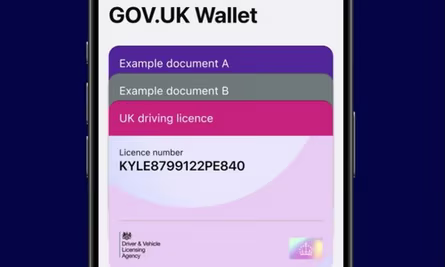
Source: GOV.UK
To support this move, the government introduced the Digital Identity and Attributes Trust Framework (DIATF) in 2021. It was designed to ensure that digital identity solutions are secure, trusted, and aligned with international standards. Since then, the framework has been steadily refined and is already playing a key role in areas like right to work, right to rent, and criminal record checks.
Providers can choose to become accredited under the framework, making it easier for citizens to identify trusted services. Although accreditation isn’t compulsory, it acts as a valuable mark of quality. Many providers are also securing extra certifications for areas like DBS checks to strengthen their offer.
Tension Between the Public and Private Sectors
Not everyone is convinced by how these plans are shaping up. In a joint letter to the Secretary of State for Science, Innovation and Technology, three major associations – the Age Verification Providers Association, the Association of Digital Verification Professionals, and the Online Safety Tech Industry Association – raised serious concerns.
Their warning was clear: the GOV.UK Wallet and One Login systems should only be used for public sector authentication. Expanding them into private sector areas, such as age verification for commercial transactions, would put more than 50 certified private providers at risk. The letter described “shock waves” running through the sector, with rising uncertainty among suppliers and investors.
The associations cautioned that the government could inadvertently create a monopoly in digital identity services. This would risk stifling innovation, reducing consumer choice, and driving up taxpayer costs by duplicating services that the private sector already delivers efficiently.
To avoid this, they called for three key actions:
- Legally limit the GOV.UK Wallet and One Login to accessing public services only.
- Ensure that digital IDs from private providers, if compliant with the DIATF, are accepted for government authentication.
- Allow government-issued credentials, like digital driving licences, to work with any certified identity wallet; not just the GOV.UK Wallet.
They also proposed a joint technical working group to improve collaboration between government and industry. Their message was clear: protecting competition now is critical to the future health of the UK's digital identity market.
What We Found
Our latest report on the UK's digital identity and verification market highlights just how quickly the landscape is shifting. We expect 25.5 million UK citizens to have a digital identity app on their smartphones by 2029, with around 45% of adults using a civic identity app.
However, the rise of the GOV.UK app could create challenges for private sector providers. Our research shows that third-party digital ID apps will grow by just 9% between 2025 and 2029. Based on these insights, we believe the concerns raised by industry associations are well founded. Without a clear commitment from the government to support a competitive environment, there is a real risk that innovation could be squeezed out.
Installed Third-party and Civic Digital Identity Apps in the UK, 2025 vs. 2029
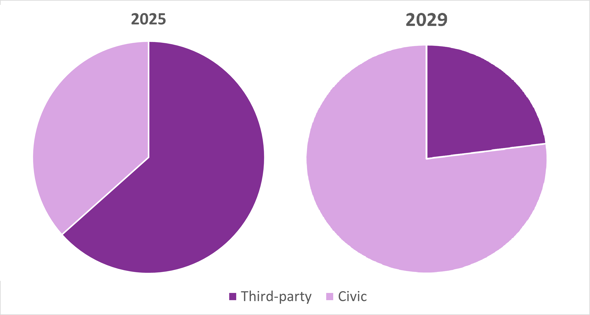
Source: Juniper Research
Why Collaboration Matters
The rollout of the GOV.UK Wallet, digital driving licences, and a unified app marks a major step towards a digital-first approach to government services. It offers clear benefits in terms of convenience and security, and the DIATF provides a strong foundation for quality and trust.
However, the long-term success of the UK’s digital identity strategy will depend on maintaining a fair, competitive market. Working closely with the private sector and giving citizens the choice to use private sector IDs will be essential to sustain investment, consumer trust, and innovation.
The UK is now at a pivotal point. By committing to open collaboration and keeping competition alive, the government can build a digital identity ecosystem that is secure, inclusive, and future-ready — one that works for everyone.
As a Research Analyst at Juniper Research, Thomas provides up-to-date trends analysis, competitive landscape appraisal, and market sizing for industries such as Digital ID & Verification & Merchant Fraud Prevention.
Related Research
-
 ReportApril 2025Identity & Security
 Thomas WilsonDigital ID & Verification in the UK Market, 2025-2029
Our UK-focused Digital ID & Verification Market research suite provides detailed analysis of this emerging market; enabling digital identity service providers to gain an understanding of key trends and challenges, potential growth opportunities, and the competitive environment.
VIEW -
 ReportNovember 2025Digital Wallets
Thomas WilsonDigital Wallets Market, 2025-2030
ReportNovember 2025Digital Wallets
Thomas WilsonDigital Wallets Market, 2025-2030Our digital wallets research suite provides detailed analysis of this rapidly changing market; allowing digital wallet providers to gain an understanding of key payment trends and challenges, potential growth opportunities, and the competitive environment.
VIEW -
 ReportOctober 2025Identity & Security
 Louis AtkinDigital Identity Market, 2025-2030
Juniper Research’s Digital Identity research suite provides a comprehensive and insightful analysis of this market; enabling stakeholders, including digital identity platform providers, digital identity verification providers, government agencies, banks, and many others, to understand future growth, key trends, and the competitive environment.
VIEW
Latest research, whitepapers & press releases
-
 ReportOctober 2026Fintech & Payments
 Jawad JahanCrypto-gaming Market: 2026-2035
Our Crypto-gaming Market research suite provides an insightful analysis of this rapidly growing market; enabling stakeholders - from crypto-gaming and sportsbooks operators, prediction market platforms, business-to-business (B2B) gambling platforms and software providers, to crypto payment processors and regulators - to understand future growth, key trends, and the competitive environment.
VIEW -
 ReportOctober 2026Telecoms & Connectivity
 Alex WebbRetail Roaming Market: 2026-2031
Our Retail Roaming research suite for mobile network operators (MNOs) and mobile virtual network operators (MVNOs) provides detailed analysis and strategic recommendations for the next era of retail roaming.
VIEW -
 ReportSeptember 2026Fintech & Payments
 Dr Manju ChhillarEmbedded Finance Market: 2026-2031
Embedded finance is one of the fastest-growing markets in financial services, and is about to accelerate even further. Our Embedded Finance Market research provides detailed analysis of the key drivers behind this growth, and what these mean for stakeholders in this market.
VIEW -
 ReportSeptember 2026Identity & Security
 Thomas WilsonApplication Security Market: 2026-2031
Our Application Security research suite provides detailed analysis of this emerging market; allowing application security providers to gain an understanding of key security trends and challenges, potential growth opportunities, and the competitive environment.
VIEW -
 ReportSeptember 2026Fintech & Payments
 Shane O'SullivanBanking Fraud Prevention Market: 2026-2031
Our Banking Fraud Prevention research suite provides a comprehensive and in-depth analysis of the types of fraud currently impacting the banking sector, and the evolving methods that can be used to overcome them.
VIEW -
 ReportSeptember 2026Telecoms & Connectivity
 Nick MaynardPrivate LTE & 5G Networks Market: 2026-2031
Our Private LTE & 5G Networks research suite provides detailed and insightful analysis of this evolving market; enabling stakeholders - from private LTE & 5G network platform specialists, mobile network operators, and diversified technology companies - to understand future growth, key trends, and the competitive environment.
VIEW


-
 WhitepaperOctober 2026Fintech & Payments
Jawad Jahan
WhitepaperOctober 2026Fintech & Payments
Jawad JahanCompliance or Anonymity - The Crypto-gaming Operator’s Dilemma
Our complimentary whitepaper, Compliance or Anonymity - The Crypto-gaming Operator’s Dilemma, analyses the current regulatory landscape of the crypto-gaming market.
VIEW -
 WhitepaperOctober 2026Telecoms & Connectivity
Alex Webb
WhitepaperOctober 2026Telecoms & Connectivity
Alex WebbReimagining the Future of Retail Roaming – How Mobile Network Operators Must Adapt
Our complimentary whitepaper, Reimagining the Future of Retail Roaming – How Mobile Network Operators Must Adapt, explores the emerging opportunities for MNOs within retail roaming.
VIEW -
 WhitepaperSeptember 2026Fintech & Payments
Dr Manju Chhillar
WhitepaperSeptember 2026Fintech & Payments
Dr Manju ChhillarEmerging Markets: The Next Opportunity for Embedded Finance
This free whitepaper examines how a combination of multiple factors is driving North America towards saturation for embedded finance.
VIEW -
 WhitepaperSeptember 2026Emerging Technology
Thomas Wilson
WhitepaperSeptember 2026Emerging Technology
Thomas WilsonVibe Coding: The Fastest-growing Threat to Application Security Today
Our complimentary whitepaper, Vibe Coding: The Fastest-growing Threat to Application Security Today, examines the state of the application security market; considering its impact on different verticals, and how it is being employed in these verticals to best combat malicious attackers and keep sensitive data safe.
VIEW -
 WhitepaperSeptember 2026Fintech & Payments
Shane O'Sullivan
WhitepaperSeptember 2026Fintech & Payments
Shane O'SullivanThe Fraud Frontier: Securing Banking in an AI-driven Era
Our complimentary whitepaper, The Fraud Frontier: Securing Banking in an AI-driven Era, examines the rapidly evolving state of the banking fraud prevention market.
VIEW -
 WhitepaperSeptember 2026Telecoms & Connectivity
Nick Maynard
WhitepaperSeptember 2026Telecoms & Connectivity
Nick MaynardHow Private Cellular Networks Are Unlocking Industry 4.0
Our complimentary whitepaper, How Private Cellular Networks Are Unlocking Industry 4.0, examines how private LTE & 5G networks are reshaping the way industry works.
VIEW


-
Fintech & Payments
Crypto Gaming: Wagers to Reach $1.3 Trillion by 2035, as Crypto Rails Widen Global Access Despite Regulatory Challenges
October 2026 -
Fintech & Payments
Juniper Research Unveils Identity & Security Award Winners for 2026
October 2026 -
Retail Roaming Revenue to Fall $4 Billion By 2031, as Regulatory Restrictions and Competition Bite
October 2026 -
Fintech & Payments
Soft POS to Surpass 100 Million Installations in 2030
September 2026 -
Fintech & Payments
The NextGen Payments & RegTech Forum Arrives in Dubai
September 2026 -
Fintech & Payments
The Global Trade Finance Expo Arrives in Dubai, UAE
September 2026