BYD vs. Zeekr: The High-Speed Battle for EV Charging Dominance

On 17th March 2025, Chinese electric vehicle (EV) manufacturer BYD announced it was launching high-capacity EV chargers that are capable of charging capacities up to 1,000 kW. This means that EV drivers could find charging session times reduced to a mere five minutes long; gaining upwards of 400km of range. This illustrates a tremendous leap in terms of technological advancement, with BYD’s primary rival, Tesla, only providing charging capacities of 500kW from its Supercharger network.
This announcement aligned with the unveiling of pre-sales of two new EV models that will utilise this high-performance EV charging platform. The Han L saloon vehicle and the Tang L SUV will be able to mirror charging times that are akin to the time spent at a service station refueling a traditional ICE vehicle. These models will have a battery C rating of 10C; essentially meaning that they are capable of charging to full capacity in a tenth of an hour, or six minutes. This means that for every second of charging, a range of approximately 2km will be added.
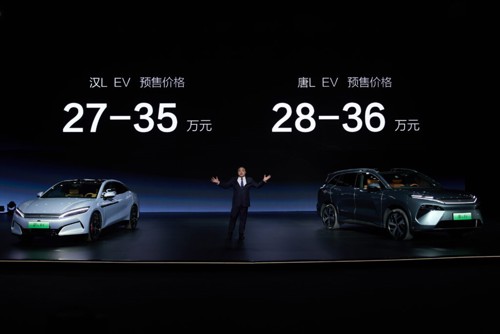
Source: Inside China Auto
BYD has further announced that its ultra-fast charging stations will start to become available across China in April 2025, with a total of more than 4,000 stations planned to be installed.
Zeekr Puts the Pressure On
Zeekr, an EV manufacturer owned by Geely, revealed on 30th March 2025 that it had developed a fully liquid-cooled EV charging station that is capable of a charging capacity of up to 1,200kW; exceeding BYD’s recent innovation.
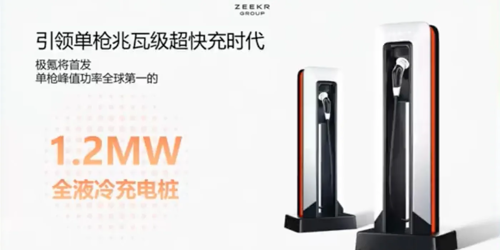 Source: Zeekr
Due to be officially unveiled on 23rd April 2025 at the Shanghai Auto Show, Zeekr announced that it plans to launch its new charging station in Q2 of 2025. It has been a longstanding goal of Zeekr to improve its EV charging infrastructure, as is evident with the consistent updates it has made to its charging stations. In the past three years, the company has gone from 360kW charging capacity to 600kW, and from there up to 800kW.
Zeekr has made it clear that these chargers are designed specifically to support the charging needs of passenger EVs, even though there does not exist a passenger EV model that currently supports this rate of charging. It is important that EV manufacturers take their time to get things right, as opposed to getting caught up in a technological advancement race which could ultimately end up costing the consumer.
Zeekr's announcement of its 1,200kW ultra-fast EV charger is set to intensify the charging race in China; further solidifying the country's dominance in electric vehicle technology. With the ability to charge EV batteries at the fastest rate as of April 2025, Zeekr's innovation not only challenges global competitors like Tesla, but also raises the bar for domestic rivals such as BYD and CATL. This development aligns with China's industrial strategy, which includes substantial government subsidies and a highly developed charging infrastructure; enabling rapid adoption of cutting-edge technologies.
As Chinese manufacturers continue to compete fiercely for leadership in ultra-fast charging, Juniper Research anticipates that these breakthroughs from BYD and Zeekr will likely accelerate advancements across the sector; driving the country closer to achieving widespread ultra-fast EV charging and reshaping consumer expectations for electric mobility. It may also force EV manufacturers outside of China to rethink their strategies and focus more on charging capabilities, rather than streamlining production and bringing manufacturing costs down.
How Does This Affect the Future of EV Charging?
In our latest research in this area, we identified that one of the primary barriers to further EV adoption was cumbersome charging sessions. The majority of EVs that are, firstly, available to most developed markets, and secondly, affordable for consumers, typically come with charging times of less than 30 minutes to charge from 20% to 80% battery capacity. This, when compared to the time it takes to refuel an ICE vehicle, is extremely slow and can cause major disruptions for long haul journeys.
The report found that a total of 395 million charging sessions will take place in China in 2025, as can be seen in the graph below. This figure is projected to rise to a total of slightly fewer than 1.4 billion in 2029; representing a significant growth of 246% over the four-year period. It is evident from these findings that EV adoption is anticipated to rise drastically in China in the near future, and so providing adequate charging solutions will prove to be imperative to keeping EV owners satisfied.
Total EV Charging Sessions in China (m), 2025-2029
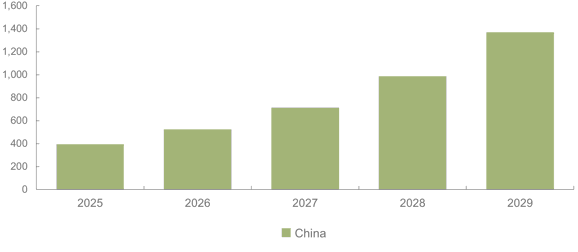 Source: Juniper Research
However, these ultra-fast chargers will only support EV models that are equipped with the necessary battery equipment that is designed to safely handle such charging, which are few and far between. BYD’s newest models are due to officially launch in early April of 2025, which has led to the EV giant discounting the prices of some of its more established models. This will likely see adoption rates grow higher, however consumers that purchase these models will not be able to utilise the ultra-fast charging stations.
Furthermore, accessibility to these specific charging stations may prove to be an issue if their implementation is not handled correctly. BYD has stated that it will install 4,000 ultra-fast chargers across China, with 500 of them ready to installed instantly. However, BYD has stated it must also erect energy storage facilities close by to these chargers so that all drivers can achieve as close to 1,000kW charging speeds as possible; raising some concerns over the availability of such energy, especially in peak times.
In summary, the recent announcements from BYD and Zeekr will not only force other EV manufacturers from around the globe to pour more resources into research and development in order to hold pace with them, but will also begin breaking down a significant barrier that has plagued wider EV adoption up until now. Whilst Tesla has gained significant traction in Europe and North America, BYD is hot on their heels and close to overtaking them as the global EV powerhouse. Although it is expected that many manufacturers will shift their emphasis towards charging solutions, we anticipate that many outside of China must still work on decreasing construction costs in order to compete with BYD in terms of upfront cost, and encourage further adoption outside of Far East & China.
Another key consideration is scalability and charging network fragmentation outside of China. In the UK for example, the roll-out of EV chargers of even much slower speeds has been hampered by many issues, such as a lack of consumer demand, strain on the energy network and planning permission rules. Whilst rolling out current generation EV chargers has been a challenge, rolling out drastically faster chargers will not be an easy process, and will require fundamental changes to numerous processes in the UK. Also, given the risk of tariffs on Chinese vehicles, international roll-outs will need to be carefully considered.
As a Research Analyst at Juniper Research, Thomas provides up-to-date trends analysis, competitive landscape appraisal, and market sizing for industries such as Heat Pumps, Renewable Energy Technologies, and EV Charging & Batteries.
Related Research
-
 ReportMay 2024Emerging Technology
 Thomas WilsonEV Charging & Batteries Market, 2024-2029
Our EV (Electric Vehicle) Charging & Batteries research provides detailed analysis of the EV market; allowing EV battery pack manufacturers, charging hardware and service providers, and EV OEMs (Original Equipment Manufacturers) to gain an understanding of key trends, potential growth opportunities, and the competitive environment.
VIEW
Latest research, whitepapers & press releases
-
 ReportNovember 2026Telecoms & Connectivity
 Peter BoylandCPaaS Market: 2026-2031
Our CPaaS Market 2026-2031 research suite delivers insightful analysis of a market that will experience significant growth in the next five years. It provides an analysis of CPaaS vendors, key partnerships and client relationships, alongside intelligence on how to capitalise on changing market dynamics within the rapidly expanding CPaaS market.
VIEW -
 ReportOctober 2026Fintech & Payments
 Michael GreenwoodAccounts Payable Automation Market: 2026-2031
Our Accounts Payable (AP) Automation research suite provides an insightful analysis of this rapidly growing market; enabling stakeholders to understand future growth, key trends and the competitive environment.
VIEW -
 ReportOctober 2026Fintech & Payments
 Jawad JahanCrypto-gaming Market: 2026-2035
Our Crypto-gaming Market research suite provides an insightful analysis of this rapidly growing market; enabling stakeholders - from crypto-gaming and sportsbooks operators, prediction market platforms, business-to-business (B2B) gambling platforms and software providers, to crypto payment processors and regulators - to understand future growth, key trends, and the competitive environment.
VIEW -
 ReportOctober 2026Telecoms & Connectivity
 Alex WebbRetail Roaming Market: 2026-2031
Our Retail Roaming research suite for mobile network operators (MNOs) and mobile virtual network operators (MVNOs) provides detailed analysis and strategic recommendations for the next era of retail roaming.
VIEW -
 ReportSeptember 2026Fintech & Payments
 Dr Manju ChhillarEmbedded Finance Market: 2026-2031
Embedded finance is one of the fastest-growing markets in financial services, and is about to accelerate even further. Our Embedded Finance Market research provides detailed analysis of the key drivers behind this growth, and what these mean for stakeholders in this market.
VIEW -
 ReportSeptember 2026Identity & Security
 Thomas WilsonApplication Security Market: 2026-2031
Our Application Security research suite provides detailed analysis of this emerging market; allowing application security providers to gain an understanding of key security trends and challenges, potential growth opportunities, and the competitive environment.
VIEW


-
 WhitepaperOctober 2026Fintech & Payments
Michael Greenwood
WhitepaperOctober 2026Fintech & Payments
Michael GreenwoodAccounts Payable Automation ~ How Businesses Are Reducing Operational Costs
Our complimentary whitepaper, Accounts Payable Automation ~ How Businesses Are Reducing Operational Costs, analyses how AP automation is combatting costs by decreasing the need for manual processes, and provides strategic insight into a number of key trends in the AP automation space.
VIEW -
 WhitepaperOctober 2026Fintech & Payments
Jawad Jahan
WhitepaperOctober 2026Fintech & Payments
Jawad JahanCompliance or Anonymity - The Crypto-gaming Operator’s Dilemma
Our complimentary whitepaper, Compliance or Anonymity - The Crypto-gaming Operator’s Dilemma, analyses the current regulatory landscape of the crypto-gaming market.
VIEW -
 WhitepaperOctober 2026Telecoms & Connectivity
Alex Webb
WhitepaperOctober 2026Telecoms & Connectivity
Alex WebbReimagining the Future of Retail Roaming – How Mobile Network Operators Must Adapt
Our complimentary whitepaper, Reimagining the Future of Retail Roaming – How Mobile Network Operators Must Adapt, explores the emerging opportunities for MNOs within retail roaming.
VIEW -
 WhitepaperSeptember 2026Fintech & Payments
Dr Manju Chhillar
WhitepaperSeptember 2026Fintech & Payments
Dr Manju ChhillarEmerging Markets: The Next Opportunity for Embedded Finance
This free whitepaper examines how a combination of multiple factors is driving North America towards saturation for embedded finance.
VIEW -
 WhitepaperSeptember 2026Emerging Technology
Thomas Wilson
WhitepaperSeptember 2026Emerging Technology
Thomas WilsonVibe Coding: The Fastest-growing Threat to Application Security Today
Our complimentary whitepaper, Vibe Coding: The Fastest-growing Threat to Application Security Today, examines the state of the application security market; considering its impact on different verticals, and how it is being employed in these verticals to best combat malicious attackers and keep sensitive data safe.
VIEW -
 WhitepaperSeptember 2026Fintech & Payments
 Shane O'Sullivan
The Fraud Frontier: Securing Banking in an AI-driven Era
Our complimentary whitepaper, The Fraud Frontier: Securing Banking in an AI-driven Era, examines the rapidly evolving state of the banking fraud prevention market.
VIEW


-
Fintech & Payments
26th NextGen Payments & RegTech Forum Arrives in Austin, Texas
October 2026 -
Fintech & Payments
Financial Institutions to Spend Over $66.2 Billion Globally on Fraud Prevention by 2031, Driven by Growing Demand for Cross-industry Fraud Intelligence
October 2026 -
Fintech & Payments
Omnichannel Payment Platforms to See a Dramatic 172% Growth in the Value of Transactions Processed Globally by 2031, as Merchants Capitalise on Payment Data
October 2026 -
Fintech & Payments
Accounts Payable Automation to Save Global Businesses 6.2 Billion Hours by 2031, Accelerated by Business System Integration
October 2026 -
Fintech & Payments
The 25th NextGen Payments & RegTech Forum Arrives in Athens, Greece
October 2026 -
Fintech & Payments
Crypto Gaming: Wagers to Reach $1.3 Trillion by 2035, as Crypto Rails Widen Global Access Despite Regulatory Challenges
October 2026