Building a Successful Superapp: Lessons from Careem

Superapps have been a major point of discussion in the fintech space for several years, with many payment apps and digital wallets having ambitions to become one. The primary motivation for becoming a superapp is the expansion of revenue streams, which can increase an app’s profitability and diversify its sources of revenue, protecting the business from a downturn in any one area.
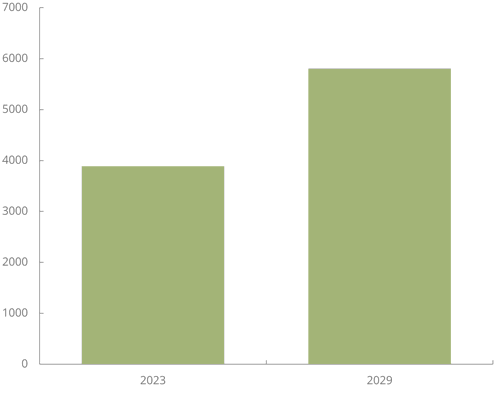
Given this advantage, it is easy to understand why a digital wallet would want to become a fully fledged super app. There is clearly growing potential for this, with our latest forecasts showing that the number of people using digital wallets will grow by 46% between 2024 and 2029.
Number of People Using Digital Wallets (m), 2024 and 2029
Source: Juniper Research
For businesses looking to adopt the superapp model, it is important to understand how other successful superapps have gained their position in their respective markets.
Let's look at Careem.
Careem was founded in 2012 in the UAE as a ride-hailing app. Since its launch, it has expanded its geographic coverage, and is now available in cities in Qatar, Saudi Arabia, Egypt, Morocco, Pakistan, Jordan, Iraq, Bahrain, and Kuwait. It has also expanded into groceries, deliveries, and payments. By 2024, Careem had more than 48 million customers across 80 cities in the 10 countries in which it operates.
Almost all superapps start off as specialised apps; in Careem’s case this was as a ride-hailing app. The advantage of starting off in this way is that it requires less development to get a working app ready to deploy compared with a more broadly focused one; allowing for lower costs and faster time to market. Another strength of this method is that it allows the app to target a specific gap in the market to build up a user base.

Source: Careem
It is important that, if a brand is launching a specialised app, with the intention of it becoming a superapp, the app is designed with modularity in mind. This will make it easier to integrate new features into the app as it grows. One effective way to go about this would be to build the app using a third-party platform. This is cheaper than hiring a development team to build it, and it allows the new app to benefit from the experience of the platform provider. It is crucial that a business selects the right platform for their app as, once one is selected, the vendor is limited by the platform’s capabilities. This means that selecting the wrong platform can prevent a vendor from expanding its capabilities into new areas as opportunities present themselves.
Once an app is established, the next step is to grow it. This is in terms of user base, geographic coverage, and range of services offered. In Careem’s case, it took the approach of focusing on expanding geographically. Between 2012 and 2017, it expanded to cover the 10 countries it covers today, but the only added features were ones which strengthened its ride-sharing business. This strategy grows the user base, building trust and familiarity with users. Due to this, as services expand, existing customers are more likely to adopt a new service from a provider with which they are already familiar.
A payment feature is a consistent part of most superapps. This allows the app to facilitate payments for its own services internally, as well as to tap into revenue from different types of money transfers. Careem first entered into the digital payment space with Careem Pay, a closed-loop P2P money transfer system. This was expanded into a full open-loop payment wallet in 2020, which allowed it to make payments and withdraw funds from the ecosystem. In 2023, Careem added remittances, starting off with the UAE-Pakistan corridor. This was to take advantage of the fact many of its drivers were Pakistani citizens who already transferred their income back to Pakistan. This was sufficiently successful that it has since expanded to include remittance corridors to the UK, India, and the Philippines.
This shows two important trends to making a successful superapp: understanding users and integrating suitable new services with existing ones. Careem understood that many its users were migrant workers who would be sending money to their home country. As these workers were earning money as drivers on the Careem app, this meant it already stored the money the user wished to transfer. This combined the ride-hailing element of the app with the remittance feature; creating an overall stronger offering. When adding new features, particularly payment ones, a brand must look at who its customer base is and what services it already offers. By offering services that synergise with existing offerings, and targeting existing customers, an app can maximise the chances of a new feature’s success. The downside to this is it focuses on an existing user base; potentially limiting its ability to grow the total customer base.
Source: infinum
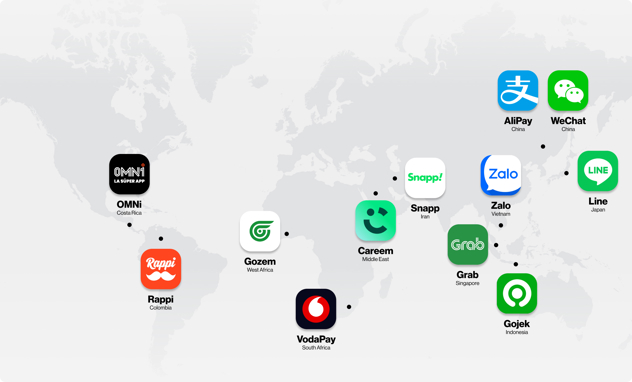
Careem sets a clear example of how to grow a specialised app into a superapp, with others such as Grab and Gojek following similar paths. Vendors looking to launch an app or expand an existing one must understand what these success stories did to get to where they are, and draw relevant lessons for themselves. Key considerations are modularity from the beginning to simplify the process of expanding the wallet as it grows, targeting features to a specific audience or a gap in the market, and using inbuilt payments and funds to provide a seamless checkout experience and keep a user’s money within the superapp ecosystem.
Michael is a Senior Research Analyst at Juniper Research, and primarily conducts research on digital identity and payments markets. His recent reports include Digital Wallets, Digital Identity, and Instant Payments.
Related Research
-
 ReportNovember 2025Digital Wallets
 Thomas WilsonDigital Wallets Market, 2025-2030
Our digital wallets research suite provides detailed analysis of this rapidly changing market; allowing digital wallet providers to gain an understanding of key payment trends and challenges, potential growth opportunities, and the competitive environment.
VIEW
Latest research, whitepapers & press releases
-
 ReportOctober 2026Fintech & Payments
 Michael GreenwoodAccounts Payable Automation Market: 2026-2031
Our Accounts Payable (AP) Automation research suite provides an insightful analysis of this rapidly growing market; enabling stakeholders to understand future growth, key trends and the competitive environment.
VIEW -
 ReportOctober 2026Fintech & Payments
 Jawad JahanCrypto-gaming Market: 2026-2035
Our Crypto-gaming Market research suite provides an insightful analysis of this rapidly growing market; enabling stakeholders - from crypto-gaming and sportsbooks operators, prediction market platforms, business-to-business (B2B) gambling platforms and software providers, to crypto payment processors and regulators - to understand future growth, key trends, and the competitive environment.
VIEW -
 ReportOctober 2026Telecoms & Connectivity
 Alex WebbRetail Roaming Market: 2026-2031
Our Retail Roaming research suite for mobile network operators (MNOs) and mobile virtual network operators (MVNOs) provides detailed analysis and strategic recommendations for the next era of retail roaming.
VIEW -
 ReportSeptember 2026Fintech & Payments
 Dr Manju ChhillarEmbedded Finance Market: 2026-2031
Embedded finance is one of the fastest-growing markets in financial services, and is about to accelerate even further. Our Embedded Finance Market research provides detailed analysis of the key drivers behind this growth, and what these mean for stakeholders in this market.
VIEW -
 ReportSeptember 2026Identity & Security
 Thomas WilsonApplication Security Market: 2026-2031
Our Application Security research suite provides detailed analysis of this emerging market; allowing application security providers to gain an understanding of key security trends and challenges, potential growth opportunities, and the competitive environment.
VIEW -
 ReportSeptember 2026Fintech & Payments
 Shane O'SullivanBanking Fraud Prevention Market: 2026-2031
Our Banking Fraud Prevention research suite provides a comprehensive and in-depth analysis of the types of fraud currently impacting the banking sector, and the evolving methods that can be used to overcome them.
VIEW


-
 WhitepaperOctober 2026Fintech & Payments
Michael Greenwood
WhitepaperOctober 2026Fintech & Payments
Michael GreenwoodAccounts Payable Automation ~ How Businesses Are Reducing Operational Costs
Our complimentary whitepaper, Accounts Payable Automation ~ How Businesses Are Reducing Operational Costs, analyses how AP automation is combatting costs by decreasing the need for manual processes, and provides strategic insight into a number of key trends in the AP automation space.
VIEW -
 WhitepaperOctober 2026Fintech & Payments
Jawad Jahan
WhitepaperOctober 2026Fintech & Payments
Jawad JahanCompliance or Anonymity - The Crypto-gaming Operator’s Dilemma
Our complimentary whitepaper, Compliance or Anonymity - The Crypto-gaming Operator’s Dilemma, analyses the current regulatory landscape of the crypto-gaming market.
VIEW -
 WhitepaperOctober 2026Telecoms & Connectivity
Alex Webb
WhitepaperOctober 2026Telecoms & Connectivity
Alex WebbReimagining the Future of Retail Roaming – How Mobile Network Operators Must Adapt
Our complimentary whitepaper, Reimagining the Future of Retail Roaming – How Mobile Network Operators Must Adapt, explores the emerging opportunities for MNOs within retail roaming.
VIEW -
 WhitepaperSeptember 2026Fintech & Payments
Dr Manju Chhillar
WhitepaperSeptember 2026Fintech & Payments
Dr Manju ChhillarEmerging Markets: The Next Opportunity for Embedded Finance
This free whitepaper examines how a combination of multiple factors is driving North America towards saturation for embedded finance.
VIEW -
 WhitepaperSeptember 2026Emerging Technology
Thomas Wilson
WhitepaperSeptember 2026Emerging Technology
Thomas WilsonVibe Coding: The Fastest-growing Threat to Application Security Today
Our complimentary whitepaper, Vibe Coding: The Fastest-growing Threat to Application Security Today, examines the state of the application security market; considering its impact on different verticals, and how it is being employed in these verticals to best combat malicious attackers and keep sensitive data safe.
VIEW -
 WhitepaperSeptember 2026Fintech & Payments
Shane O'Sullivan
WhitepaperSeptember 2026Fintech & Payments
Shane O'SullivanThe Fraud Frontier: Securing Banking in an AI-driven Era
Our complimentary whitepaper, The Fraud Frontier: Securing Banking in an AI-driven Era, examines the rapidly evolving state of the banking fraud prevention market.
VIEW


-
Fintech & Payments
26th NextGen Payments & RegTech Forum Arrives in Austin, Texas
October 2026 -
Fintech & Payments
Financial Institutions to Spend Over $66.2 Billion Globally on Fraud Prevention by 2031, Driven by Growing Demand for Cross-industry Fraud Intelligence
October 2026 -
Fintech & Payments
Omnichannel Payment Platforms to See a Dramatic 172% Growth in the Value of Transactions Processed Globally by 2031, as Merchants Capitalise on Payment Data
October 2026 -
Fintech & Payments
Accounts Payable Automation to Save Global Businesses 6.2 Billion Hours by 2031, Accelerated by Business System Integration
October 2026 -
Fintech & Payments
The 25th NextGen Payments & RegTech Forum Arrives in Athens, Greece
October 2026 -
Fintech & Payments
Crypto Gaming: Wagers to Reach $1.3 Trillion by 2035, as Crypto Rails Widen Global Access Despite Regulatory Challenges
October 2026