Barclays’ Outage Exposes the Hidden Risks of a Cashless UK

Barclays’ system outage on Friday, 31st January, caused major disruptions for UK customers, affecting mobile and online banking. Many struggled to make payments or saw transactions fail to appear in the app. The timing made the situation even worse - falling on a common UK pay cycle day and the final deadline for self-assessment tax payments to HMRC.
Services were restored by Sunday, 2nd February, and Barclays pledged compensation for affected users. However, the outage raises important questions about the risks of a cashless society, vulnerabilities in the UK payments system, and the need for change. A recent banking app outage at Lloyds Banking Group further highlights these concerns.
Cashless Society – Creating Risks
It has been clear for some time that the UK is headed towards an increasingly cashless society, according to the latest figures from UK Finance. The use of cash is now in freefall, accounting for only 12% of transactions in 2023 (compared to 60% in 2008), while Faster Payments are becoming increasingly popular, alongside cards and other methods.
Payment Volumes (m), 2013-2023
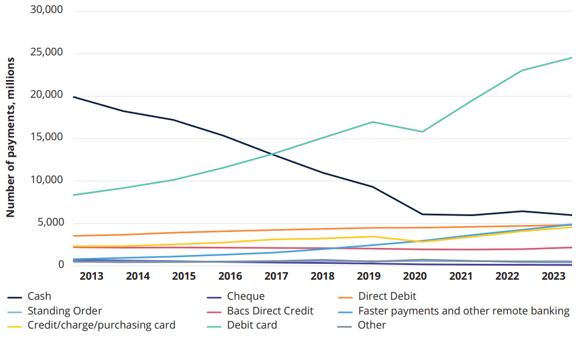
Source: UK Finance – UK Payments Markets Summary July 2024
While there is an increased use of cashless payments, there are major benefits, such as increased convenience, security and the ability to access credit and other financial services. However, this also opens up key vulnerabilities. If digital payment methods are unavailable for any amount of time, this can cause chaos as consumers are used to digital methods. Indeed, we saw this with the Barclays outage, with users unable to pay their tax bills, being unable to transfer money to cover grocery shopping, or being made homeless by being unable to complete a house purchase.
What Can Banks Do to Mitigate Risk?
So, what can be done to mitigate the risks of over relying on digital payment methods? Firstly, banks must take all measures to ensure that outages do not occur in the first place. While the causes for this outage are not as yet clear, banks have extremely complicated IT systems. In particular, banks have often heavily outdated core banking systems, which by themselves are unable to be updated to the latest standards. As such, banking software systems often become complex combinations of different systems; increasing the risk of technical issues striking.
While banks can update their core banking systems to be more modern, overhauling their existing systems also comes with risks, such as the upgrade failing and causing an outage of its own. As such, we recommend that banks should upgrade their core systems’ architecture, but should do so in a way that is measured, incremental and carefully planned to avoid risk.
Expanding Payments Choice for Resilience
Another key strategy that the wider industry, as well as government, should embrace is having more payment system choice. Card has a dominant role in the UK, and this role is even more prevalent when you consider that digital wallets are also gaining traction, and operate mainly as card proxies in the UK. As such, the UK payment system is highly vulnerable to an interruption in card payments, and outages of card payments have previously caused major issues, even when linked to only one major retailer.
As such, providing an alternative payments system that is not reliant on card rails has major potential to reduce risks in the UK market. Account to account (A2A) payments are a major opportunity here, which has been recognised in the UK Government’s National Payments Vision, published in late 2024. Similarly, work towards a retail Central Bank Digital Currency (CBDC) in the UK is also continuing, again boosting the potential for further payment options.
We recommend that the UK Government explores all potential options to boost payments choice in the UK, which will have many benefits, such as reducing cost, but will also create redundancy in the payments systems, which is badly needed.
Conclusion
Fundamentally, banks are critically important to how society operates on a day-to-day basis – any downtime is a major issue, so banks are under intense scrutiny. Given the scale of the challenge in ensuring continued reliability, banks understandably face a difficult task. Banks must ensure that they follow technological strategies that minimise risk, and act quickly when outages occur. However, it is not all on banks. Regulators must ensure that regulatory frameworks enforce a strong level of redundancy in banking and payments, particularly as we shift to an increasingly cashless society.
Nick Maynard is VP of Fintech Market Research at Juniper Research, enabling clients to size new market opportunities, set priorities for future growth, and understand their customers through survey projects. He also enjoys helping clients promote their expertise and vision of markets with compelling thought‑leadership whitepapers, webinars, and other media. Nick has been interviewed by major news outlets such as CNBC, Coindesk, and the BBC, and has spoken at key industry events including Money 20/20 Europe.
Related Research
-
 ReportSeptember 2025Fintech & Payments
 Thomas WilsonA2A Payments Market, 2025-2030
Our A2A Payments research suite provides detailed analysis of this rapidly changing market; enabling A2A payments service providers to gain an understanding of key payment trends and challenges, potential growth opportunities, and the competitive environment.
VIEW -
 ReportApril 2026Fintech & Payments
 Jawad JahanStablecoins Market, 2026-2035
Our Stablecoins market research suite provides detailed and insightful analysis of this evolving market; enabling stakeholders such as central banks, commercial banks, stablecoin issuers, and payment service providers to understand future growth, key trends, and the competitive environment.
VIEW
Latest research, whitepapers & press releases
-
 ReportOctober 2026Fintech & Payments
 Michael GreenwoodAccounts Payable Automation Market: 2026-2031
Our Accounts Payable (AP) Automation research suite provides an insightful analysis of this rapidly growing market; enabling stakeholders to understand future growth, key trends and the competitive environment.
VIEW -
 ReportOctober 2026Fintech & Payments
 Jawad JahanCrypto-gaming Market: 2026-2035
Our Crypto-gaming Market research suite provides an insightful analysis of this rapidly growing market; enabling stakeholders - from crypto-gaming and sportsbooks operators, prediction market platforms, business-to-business (B2B) gambling platforms and software providers, to crypto payment processors and regulators - to understand future growth, key trends, and the competitive environment.
VIEW -
 ReportOctober 2026Telecoms & Connectivity
 Alex WebbRetail Roaming Market: 2026-2031
Our Retail Roaming research suite for mobile network operators (MNOs) and mobile virtual network operators (MVNOs) provides detailed analysis and strategic recommendations for the next era of retail roaming.
VIEW -
 ReportSeptember 2026Fintech & Payments
 Dr Manju ChhillarEmbedded Finance Market: 2026-2031
Embedded finance is one of the fastest-growing markets in financial services, and is about to accelerate even further. Our Embedded Finance Market research provides detailed analysis of the key drivers behind this growth, and what these mean for stakeholders in this market.
VIEW -
 ReportSeptember 2026Identity & Security
 Thomas WilsonApplication Security Market: 2026-2031
Our Application Security research suite provides detailed analysis of this emerging market; allowing application security providers to gain an understanding of key security trends and challenges, potential growth opportunities, and the competitive environment.
VIEW -
 ReportSeptember 2026Fintech & Payments
 Shane O'SullivanBanking Fraud Prevention Market: 2026-2031
Our Banking Fraud Prevention research suite provides a comprehensive and in-depth analysis of the types of fraud currently impacting the banking sector, and the evolving methods that can be used to overcome them.
VIEW


-
 WhitepaperOctober 2026Fintech & Payments
Michael Greenwood
WhitepaperOctober 2026Fintech & Payments
Michael GreenwoodAccounts Payable Automation ~ How Businesses Are Reducing Operational Costs
Our complimentary whitepaper, Accounts Payable Automation ~ How Businesses Are Reducing Operational Costs, analyses how AP automation is combatting costs by decreasing the need for manual processes, and provides strategic insight into a number of key trends in the AP automation space.
VIEW -
 WhitepaperOctober 2026Fintech & Payments
Jawad Jahan
WhitepaperOctober 2026Fintech & Payments
Jawad JahanCompliance or Anonymity - The Crypto-gaming Operator’s Dilemma
Our complimentary whitepaper, Compliance or Anonymity - The Crypto-gaming Operator’s Dilemma, analyses the current regulatory landscape of the crypto-gaming market.
VIEW -
 WhitepaperOctober 2026Telecoms & Connectivity
Alex Webb
WhitepaperOctober 2026Telecoms & Connectivity
Alex WebbReimagining the Future of Retail Roaming – How Mobile Network Operators Must Adapt
Our complimentary whitepaper, Reimagining the Future of Retail Roaming – How Mobile Network Operators Must Adapt, explores the emerging opportunities for MNOs within retail roaming.
VIEW -
 WhitepaperSeptember 2026Fintech & Payments
Dr Manju Chhillar
WhitepaperSeptember 2026Fintech & Payments
Dr Manju ChhillarEmerging Markets: The Next Opportunity for Embedded Finance
This free whitepaper examines how a combination of multiple factors is driving North America towards saturation for embedded finance.
VIEW -
 WhitepaperSeptember 2026Emerging Technology
Thomas Wilson
WhitepaperSeptember 2026Emerging Technology
Thomas WilsonVibe Coding: The Fastest-growing Threat to Application Security Today
Our complimentary whitepaper, Vibe Coding: The Fastest-growing Threat to Application Security Today, examines the state of the application security market; considering its impact on different verticals, and how it is being employed in these verticals to best combat malicious attackers and keep sensitive data safe.
VIEW -
 WhitepaperSeptember 2026Fintech & Payments
Shane O'Sullivan
WhitepaperSeptember 2026Fintech & Payments
Shane O'SullivanThe Fraud Frontier: Securing Banking in an AI-driven Era
Our complimentary whitepaper, The Fraud Frontier: Securing Banking in an AI-driven Era, examines the rapidly evolving state of the banking fraud prevention market.
VIEW


-
Fintech & Payments
Accounts Payable Automation to Save Global Businesses 6.2 Billion Hours by 2031, Accelerated by Business System Integration
October 2026 -
Fintech & Payments
The 25th NextGen Payments & RegTech Forum Arrives in Athens, Greece
October 2026 -
Fintech & Payments
Crypto Gaming: Wagers to Reach $1.3 Trillion by 2035, as Crypto Rails Widen Global Access Despite Regulatory Challenges
October 2026 -
Fintech & Payments
Juniper Research Unveils Identity & Security Award Winners for 2026
October 2026 -
Retail Roaming Revenue to Fall $4 Billion By 2031, as Regulatory Restrictions and Competition Bite
October 2026 -
Fintech & Payments
Soft POS to Surpass 100 Million Installations in 2030
September 2026