AWS Outage: Are Enterprises Overestimating Cloud Reliability?

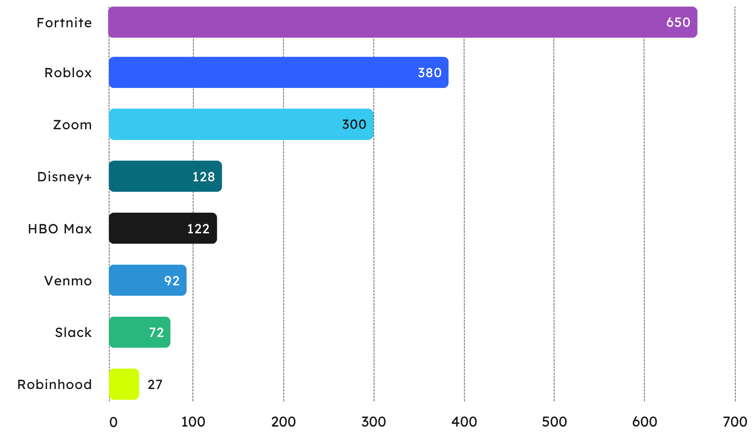
On October 20th, 2025, Amazon Web Services (AWS) experienced a substantial outage of its services in the US, with global impacts. The outage, caused by a domain name system (DNS) resolution failure that impacted a key database service, resulted in a cascading effect on AWS services. In turn, this led to many services that rely on AWS to also suffer outages; impacting consumers of various services including Disney+, Fortnite, HBO Max, Robinhood, Roblox, Slack, Venmo, and Zoom.
Estimated User Base for Select Service Providers Impacted by AWS Outage (m)
Source: Juniper Research
While AWS resolved the root cause of the issue within three hours, there were substantial impacts on various enterprises that leverage AWS. Despite the disruption, Amazon’s stock remained relatively stable; suggesting continued investor confidence in the company’s long-term market leadership. However, the incident could accelerate demand for multi-cloud orchestration tools, edge computing, and services that increase the overall resilience of cloud services. Overall, we expect the outage to initiate enterprises to explore new solutions or business models to increase the uptime of their services.
Is There an Overreliance on One Provider for Cloud Services?
The short answer is yes, we believe that there is an overreliance on many cloud services, notably AWS — which Juniper Research estimates to have a global market share of over 30%. As a company that has such a noteworthy presence in the market, it attracts the highest spending enterprises through significant degrees of redundancy within their operations to avoid scenarios like this. However, as is evident, no service is perfectly redundant, especially as the geographical reach of cloud services offered increases the complexity of network architectures. The larger the cloud service becomes, there is more within the service to fail, and a larger chance for cascading failures.
While AWS offers service credits for downtime, it does not cover the full operational and reputational costs. The event serves as a reminder that even leading cloud providers are not immune to large-scale disruptions.
Lessons are to be learned from this outage. Enterprises must not believe that services from AWS, and other leading providers such as Google and Microsoft, can be wholly relied upon, especially for enterprises that operate across multiple regions. The impacts of a failed DNS resolution must lead enterprises to explore multi-cloud strategies to increase redundancy and avoid vendor lock-in. Additionally, we recommend that enterprises implement their own monitoring software and not rely on the services provided by cloud providers.
The Financial Impact of AWS’s Outage
The financial impact of the outage is difficult to quantify at this stage, but we believe it will be significant. Many fintech services, such as Robinhood and Venmo, suffered downtime on their own platforms, which will likely lead to time spent on chargeback and dispute resolution, plus indirect costs of the outage. Similarly, digital platforms providers such as Disney+ and HBO Max suffered service interruptions; albeit for a small amount of downtime.
Aside from direct revenue loss from downtime, such as missed transactions and halted services, several indirect losses have resulted from this outage:
- Lost productivity for users of services such as Zoom or Slack. Many other enterprises rely on this for internal and external communication. This causes delays to AWS clients.
- Disrupted operations caused by the outage can also cause indirect costs through lost time. Key examples of this are enterprises in the healthcare or aviation industries that must be considered time-sensitive industries, where efficiency is key to maintaining profit; notably as profit margins can be small.
- Loss to brand reputation if services are down for substantial periods; leading to high levels of customer dissatisfaction. Essentially, this loss is unquantifiable, given the subjectivity and changes to opinion over time.
- Customer compensation, particularly in sectors like finance, travel, and telecoms, can add further costs through required refunds and service credits — as well as the unexpected time and resource needed to complete them.
How Must the Market Respond to this Outage?
It is reported that AWS’s service level agreements (SLAs) include 99.99% uptime for virtual servers, with discounts or credits to future services if AWS fails to meet these requirements. However, it's unlikely that these agreements cover lost enterprise revenue, productivity or reputational damage. Therefore, an enterprise’s choice of cloud service provider, or providers, must consider the impacts of this kind of outage. We believe that outages of any service are inevitable at some point.
Adopting a multi-cloud strategy will increase resilience and allow enterprises to mitigate the risks, direct costs, and indirect costs associated with these outages. A multi-cloud strategy will increase resilience and minimise the risk of extended periods of service downtime by enabling fallback onto a secondary service provider.
However, a key hurdle to enterprise adoption of multi-cloud strategies is the increased cost and complexity of implementation. For example, cloud service vendors will use a different suite of APIs, and security processes and functions are not interoperable between different platforms. Not only does this strategy lead to increased spend on cloud platforms, but additional training on the additional cloud service.
Outages such as this are a clear reminder that no service provider, regardless of reputation, scale or reach, can guarantee 100% uptime or provide complete protection against service downtime. While multi-vendor strategies will increase resilience, the high cost and interoperability challenges involved will likely exclude most cloud service users from adopting this strategy.
Indeed, we believe that cloud providers should embrace this challenge; providing solutions that are interoperable with other cloud platforms, including network APIs, to maximise the value of their solutions to enterprise users. After this outage, Juniper Research expects increased interest in a multi-cloud strategy, and platforms that can reduce spend and investment into integrating with additional systems will increase their value proposition to enterprises.
As VP of Telecoms Market Research at Juniper Research, Sam produces high-quality research on telecommunications technologies and the future of digital content. His recent reports include CPaaS, Direct-to-Cell, and 5G Future Strategies. Sam has been interviewed by leading media outlets, including the BBC and Wall Street Journal, and is a regular contributor to messaging conferences and telecommunications industry events.
Related Research
-
 ReportAugust 2025Telecoms & Connectivity
 Alex WebbNetwork APIs Market, 2025-2030
Our Network API research suite provides operators, CPaaS providers, and other GSMA channel partners with extensive analysis and actionable insights into the rapidly growing network API market. It contains data that allows stakeholders in the market to make informed decisions on their product development and business strategies in the network API market.
VIEW -
 ReportMay 2024Telecoms & Connectivity
Alex WebbTelecommunications Cloud Strategies Market, 2024-2028
ReportMay 2024Telecoms & Connectivity
Alex WebbTelecommunications Cloud Strategies Market, 2024-2028Our Telecommunications Cloud research suite provides actionable insights and analysis into this rapidly growing and competitive market; enabling stakeholders, such as operators, cloud providers, network equipment providers, and hyperscalers to navigate and capitalise on the development of cloud infrastructure in telecommunications networks.
VIEW -
 ReportMay 2025Telecoms & Connectivity
 Fred SavageOperator Revenue Strategies Market, 2025-2029
Discover invaluable insights into trends and strategies for network operator revenue in our latest report, Network Operator Revenue Strategies. With data split across 60 countries, this extensive forecast analyses the dynamic and competitive network operator market and the current market challenges posed by slowing revenue, high market saturation in the consumer market, rising network ownership costs, and challenges in 5G monetisation.
VIEW
Latest research, whitepapers & press releases
-
 ReportOctober 2026Fintech & Payments
 Michael GreenwoodAccounts Payable Automation Market: 2026-2031
Our Accounts Payable (AP) Automation research suite provides an insightful analysis of this rapidly growing market; enabling stakeholders to understand future growth, key trends and the competitive environment.
VIEW -
 ReportOctober 2026Fintech & Payments
 Jawad JahanCrypto-gaming Market: 2026-2035
Our Crypto-gaming Market research suite provides an insightful analysis of this rapidly growing market; enabling stakeholders - from crypto-gaming and sportsbooks operators, prediction market platforms, business-to-business (B2B) gambling platforms and software providers, to crypto payment processors and regulators - to understand future growth, key trends, and the competitive environment.
VIEW -
 ReportOctober 2026Telecoms & Connectivity
 Alex WebbRetail Roaming Market: 2026-2031
Our Retail Roaming research suite for mobile network operators (MNOs) and mobile virtual network operators (MVNOs) provides detailed analysis and strategic recommendations for the next era of retail roaming.
VIEW -
 ReportSeptember 2026Fintech & Payments
 Dr Manju ChhillarEmbedded Finance Market: 2026-2031
Embedded finance is one of the fastest-growing markets in financial services, and is about to accelerate even further. Our Embedded Finance Market research provides detailed analysis of the key drivers behind this growth, and what these mean for stakeholders in this market.
VIEW -
 ReportSeptember 2026Identity & Security
 Thomas WilsonApplication Security Market: 2026-2031
Our Application Security research suite provides detailed analysis of this emerging market; allowing application security providers to gain an understanding of key security trends and challenges, potential growth opportunities, and the competitive environment.
VIEW -
 ReportSeptember 2026Fintech & Payments
 Shane O'SullivanBanking Fraud Prevention Market: 2026-2031
Our Banking Fraud Prevention research suite provides a comprehensive and in-depth analysis of the types of fraud currently impacting the banking sector, and the evolving methods that can be used to overcome them.
VIEW


-
 WhitepaperOctober 2026Fintech & Payments
Jawad Jahan
WhitepaperOctober 2026Fintech & Payments
Jawad JahanCompliance or Anonymity - The Crypto-gaming Operator’s Dilemma
Our complimentary whitepaper, Compliance or Anonymity - The Crypto-gaming Operator’s Dilemma, analyses the current regulatory landscape of the crypto-gaming market.
VIEW -
 WhitepaperOctober 2026Telecoms & Connectivity
Alex Webb
WhitepaperOctober 2026Telecoms & Connectivity
Alex WebbReimagining the Future of Retail Roaming – How Mobile Network Operators Must Adapt
Our complimentary whitepaper, Reimagining the Future of Retail Roaming – How Mobile Network Operators Must Adapt, explores the emerging opportunities for MNOs within retail roaming.
VIEW -
 WhitepaperSeptember 2026Fintech & Payments
Dr Manju Chhillar
WhitepaperSeptember 2026Fintech & Payments
Dr Manju ChhillarEmerging Markets: The Next Opportunity for Embedded Finance
This free whitepaper examines how a combination of multiple factors is driving North America towards saturation for embedded finance.
VIEW -
 WhitepaperSeptember 2026Emerging Technology
Thomas Wilson
WhitepaperSeptember 2026Emerging Technology
Thomas WilsonVibe Coding: The Fastest-growing Threat to Application Security Today
Our complimentary whitepaper, Vibe Coding: The Fastest-growing Threat to Application Security Today, examines the state of the application security market; considering its impact on different verticals, and how it is being employed in these verticals to best combat malicious attackers and keep sensitive data safe.
VIEW -
 WhitepaperSeptember 2026Fintech & Payments
Shane O'Sullivan
WhitepaperSeptember 2026Fintech & Payments
Shane O'SullivanThe Fraud Frontier: Securing Banking in an AI-driven Era
Our complimentary whitepaper, The Fraud Frontier: Securing Banking in an AI-driven Era, examines the rapidly evolving state of the banking fraud prevention market.
VIEW -
 WhitepaperSeptember 2026Telecoms & Connectivity
 Nick Maynard
How Private Cellular Networks Are Unlocking Industry 4.0
Our complimentary whitepaper, How Private Cellular Networks Are Unlocking Industry 4.0, examines how private LTE & 5G networks are reshaping the way industry works.
VIEW


-
Fintech & Payments
The 25th NextGen Payments & RegTech Forum Arrives in Athens, Greece
October 2026 -
Fintech & Payments
Crypto Gaming: Wagers to Reach $1.3 Trillion by 2035, as Crypto Rails Widen Global Access Despite Regulatory Challenges
October 2026 -
Fintech & Payments
Juniper Research Unveils Identity & Security Award Winners for 2026
October 2026 -
Retail Roaming Revenue to Fall $4 Billion By 2031, as Regulatory Restrictions and Competition Bite
October 2026 -
Fintech & Payments
Soft POS to Surpass 100 Million Installations in 2030
September 2026 -
Fintech & Payments
The NextGen Payments & RegTech Forum Arrives in Dubai
September 2026