Are Stablecoins Still Riding the Wave of the Future?

Over the past few years, digital currencies, and stablecoins more specifically, have been a high-profile topic within fintech & payments - being touted as the future of money on a regular basis.
As with any new development, there has been a significant amount of hype and noise around this, but until recently, little evidence of what impact stablecoins are actually having on the ground. However, the picture is now clearing up, with stablecoins having high potential across numerous areas. Indeed, stablecoins have hit a market cap of almost $280 billion as of August 2025; an increase of over $100 billion since the same point last year.
So what does this growth mean for the fintech and payments market? Stablecoins have broad potential, but examining use cases is important to understanding what this potential will look like on the ground.
Cross-border Payments
Cross-border transactions are the biggest potential area for stablecoin adoption, fundamentally because cross-border transactions are complex, costly and difficult to track under current models. Cross-border payments typically involve multiple layers of correspondent banks, meaning that to send money requires multiple stages, multiple parties receiving fees, and a costly FX conversion.
While newer players such as Wise and Revolut have been improving this by building more efficient networks, with Nium and Thunes targeting this market from an infrastructure angle, the market is still a complex one.
Stablecoins can have a major impact on this. As their value is set to a linked fiat currency, they have a set value, and critically can be sent and received across borders to different wallet addresses, regardless of physical location. This has the potential to unlock far cheaper and faster cross-border payments, and we expect this to have a major impact in markets such as remittances.
Programmable Money
One of the ideal scenarios for digital transformation of money is that it can become fully programmable. Under this scenario, a digital currency could be tied to whatever scenario is required using a smart contract. This would enable financial transactions to become a seamless, programmable layer, in the same way that many other components and APIs act.
While this has been attempted with some payment methods such as virtual cards, these have their limitations as they rely on card acceptance rails. Stablecoins can be seen as the future of programmable money – they have a set and predictable value, and can be integrated easily into digital processes. As such, they have strong potential for transformation.
Storing Value in Unstable Economies
Central to stablecoins is their stability and predictable value; particularly given the overwhelming majority of stablecoins in circulation are USD denominated. This creates opportunities for the use of stablecoins in economies where the currency is unstable.
For example, recent months have seen economic instability in Venezuela, where economic sanctions have contributed to a major economic issue, with the Venezuelan Bolivar declining by 73% versus the US dollar in the past year. As such, demand for US dollars in Venezuela has been high, but restrictions by the government have limited the ability for Venezuelans to access foreign currencies. As such, Venezuelan interest in stablecoins has spiked.
In scenarios such as this, broad access to stablecoins will allow users in disrupted economies to preserve their wealth when hyperinflation and economic issues emerge.
Why Stablecoins Aren't the Whole Solution
While as we have seen stablecoins are high impact, particularly across those three use cases, they are not the whole solution by themselves.
Stablecoins, similar to any other payment method, still need on and off ramps. As stablecoins are not ubiquitous and cannot be used for everyday transactions, there has to be a way for money to be added and withdrawn from stablecoin wallets. This creates the same network challenge as other payment methods, and means that institutions using stablecoins will need to partner to enable pay ins and pay outs. In the remittance example, it is no problem to send money to a relative in another country, but if they cannot access that money, it is useless to them.
Conclusion
It is clear that stablecoins have strong potential to transform the way payments work, however while great progress is being made, we are still in the early stages of that transformation. What we need to see is greater support and involvement from financial institutions in terms of providing access to and operationalising stablecoins, which will help to bridge the cryptocurrency and everyday finance worlds.
This is a process that is already starting to happen. Major financial institutions are starting to invest in stablecoin services, and indeed have already begun to use this for areas such as cross-border payments. This can be seen our latest data on the subject, which shows that financial institution savings are set to hit $26 billion in 2028 alone from stablecoin use.
Global Savings to Financial Institutions from Stablecoin Use ($bn), 2025 vs. 2028
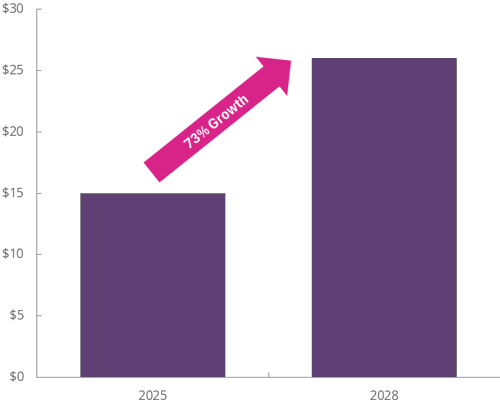
Source: Juniper Research
As such, we expect financial institutions to increasingly engage with stablecoins. It will take time for stablecoins to touch different use cases, but we expect cross-border payments in particular to see strong disruption; transforming the way money is sent and received.
Nick Maynard is VP of Fintech Market Research at Juniper Research, where he leads analysis on key trends shaping the future of finance. With deep expertise across digital payments and commerce, his recent work includes reports on Chargeback Management, Digital Commerce, and Payment Card Technologies; helping stakeholders stay ahead in a rapidly evolving market.
Related Research
-
 ReportApril 2026Fintech & Payments
 Jawad JahanStablecoins Market, 2026-2035
Our Stablecoins market research suite provides detailed and insightful analysis of this evolving market; enabling stakeholders such as central banks, commercial banks, stablecoin issuers, and payment service providers to understand future growth, key trends, and the competitive environment.
VIEW
Latest research, whitepapers & press releases
-
 ReportOctober 2026Fintech & Payments
 Jawad JahanCrypto-gaming Market: 2026-2035
Our Crypto-gaming Market research suite provides an insightful analysis of this rapidly growing market; enabling stakeholders - from crypto-gaming and sportsbooks operators, prediction market platforms, business-to-business (B2B) gambling platforms and software providers, to crypto payment processors and regulators - to understand future growth, key trends, and the competitive environment.
VIEW -
 ReportOctober 2026Telecoms & Connectivity
 Alex WebbRetail Roaming Market: 2026-2031
Our Retail Roaming research suite for mobile network operators (MNOs) and mobile virtual network operators (MVNOs) provides detailed analysis and strategic recommendations for the next era of retail roaming.
VIEW -
 ReportSeptember 2026Fintech & Payments
 Dr Manju ChhillarEmbedded Finance Market: 2026-2031
Embedded finance is one of the fastest-growing markets in financial services, and is about to accelerate even further. Our Embedded Finance Market research provides detailed analysis of the key drivers behind this growth, and what these mean for stakeholders in this market.
VIEW -
 ReportSeptember 2026Identity & Security
 Thomas WilsonApplication Security Market: 2026-2031
Our Application Security research suite provides detailed analysis of this emerging market; allowing application security providers to gain an understanding of key security trends and challenges, potential growth opportunities, and the competitive environment.
VIEW -
 ReportSeptember 2026Fintech & Payments
 Shane O'SullivanBanking Fraud Prevention Market: 2026-2031
Our Banking Fraud Prevention research suite provides a comprehensive and in-depth analysis of the types of fraud currently impacting the banking sector, and the evolving methods that can be used to overcome them.
VIEW -
 ReportSeptember 2026Telecoms & Connectivity
 Nick MaynardPrivate LTE & 5G Networks Market: 2026-2031
Our Private LTE & 5G Networks research suite provides detailed and insightful analysis of this evolving market; enabling stakeholders - from private LTE & 5G network platform specialists, mobile network operators, and diversified technology companies - to understand future growth, key trends, and the competitive environment.
VIEW


-
 WhitepaperOctober 2026Fintech & Payments
Jawad Jahan
WhitepaperOctober 2026Fintech & Payments
Jawad JahanCompliance or Anonymity - The Crypto-gaming Operator’s Dilemma
Our complimentary whitepaper, Compliance or Anonymity - The Crypto-gaming Operator’s Dilemma, analyses the current regulatory landscape of the crypto-gaming market.
VIEW -
 WhitepaperOctober 2026Telecoms & Connectivity
Alex Webb
WhitepaperOctober 2026Telecoms & Connectivity
Alex WebbReimagining the Future of Retail Roaming – How Mobile Network Operators Must Adapt
Our complimentary whitepaper, Reimagining the Future of Retail Roaming – How Mobile Network Operators Must Adapt, explores the emerging opportunities for MNOs within retail roaming.
VIEW -
 WhitepaperSeptember 2026Fintech & Payments
Dr Manju Chhillar
WhitepaperSeptember 2026Fintech & Payments
Dr Manju ChhillarEmerging Markets: The Next Opportunity for Embedded Finance
This free whitepaper examines how a combination of multiple factors is driving North America towards saturation for embedded finance.
VIEW -
 WhitepaperSeptember 2026Emerging Technology
Thomas Wilson
WhitepaperSeptember 2026Emerging Technology
Thomas WilsonVibe Coding: The Fastest-growing Threat to Application Security Today
Our complimentary whitepaper, Vibe Coding: The Fastest-growing Threat to Application Security Today, examines the state of the application security market; considering its impact on different verticals, and how it is being employed in these verticals to best combat malicious attackers and keep sensitive data safe.
VIEW -
 WhitepaperSeptember 2026Fintech & Payments
Shane O'Sullivan
WhitepaperSeptember 2026Fintech & Payments
Shane O'SullivanThe Fraud Frontier: Securing Banking in an AI-driven Era
Our complimentary whitepaper, The Fraud Frontier: Securing Banking in an AI-driven Era, examines the rapidly evolving state of the banking fraud prevention market.
VIEW -
 WhitepaperSeptember 2026Telecoms & Connectivity
Nick Maynard
WhitepaperSeptember 2026Telecoms & Connectivity
Nick MaynardHow Private Cellular Networks Are Unlocking Industry 4.0
Our complimentary whitepaper, How Private Cellular Networks Are Unlocking Industry 4.0, examines how private LTE & 5G networks are reshaping the way industry works.
VIEW


-
Fintech & Payments
Crypto Gaming: Wagers to Reach $1.3 Trillion by 2035, as Crypto Rails Widen Global Access Despite Regulatory Challenges
October 2026 -
Fintech & Payments
Juniper Research Unveils Identity & Security Award Winners for 2026
October 2026 -
Retail Roaming Revenue to Fall $4 Billion By 2031, as Regulatory Restrictions and Competition Bite
October 2026 -
Fintech & Payments
Soft POS to Surpass 100 Million Installations in 2030
September 2026 -
Fintech & Payments
The NextGen Payments & RegTech Forum Arrives in Dubai
September 2026 -
Fintech & Payments
The Global Trade Finance Expo Arrives in Dubai, UAE
September 2026