What Roles Is AI Playing in Customer Service Interactions?

When we talk about AI handling customer interactions, we’re very often not talking about a single use case. In practice, AI is being deployed across multiple points in the customer journey; taking on a range of clearly defined functions rather than acting as a catch-all replacement for human agents.
Some of these roles are already well established. Others are becoming more prominent as platforms mature and businesses gain confidence in automation.
Initial Support
AI is most commonly used as the initial point of contact. This includes answering FAQs, guiding users through basic troubleshooting, and helping customers navigate menus or self-service portals. By handling high-volume, low-complexity queries, AI reduces queue times and frees up human agents for more complex issues.
Intent Detection & Routing
Beyond answering questions directly, AI plays a critical role behind the scenes. Natural language processing allows systems to understand why a customer is getting in touch and route them to the right department, channel, or agent. In many cases, this happens before a human ever sees the interaction, improving first-contact resolution rates.
Transactional Support
AI is increasingly trusted with transactional tasks. This includes changing account details, processing refunds, tracking orders, resetting passwords, or managing subscriptions. These interactions are structured, repeatable, and ideal for automation, especially at scale.
Proactive Engagement
Rather than waiting for customers to get in touch, AI is now used to initiate interactions. This might involve sending delivery updates, flagging potential service issues, or prompting customers when an action is required. Proactive engagement reduces inbound contact volumes while improving the overall customer experience.
Agent Assistance
Not all AI-handled interactions are customer-facing. AI is also embedded within contact centre workflows to support human agents. This includes real-time response suggestions, knowledge base surfacing, call summarisation, and post-interaction analytics. In these cases, AI improves efficiency without removing the human element.
Personalisation at Scale
AI enables platforms to tailor interactions based on customer history, behaviour, and preferences. This allows businesses to deliver more relevant responses and recommendations without increasing agent workloads, something that becomes increasingly important as interaction volumes grow.
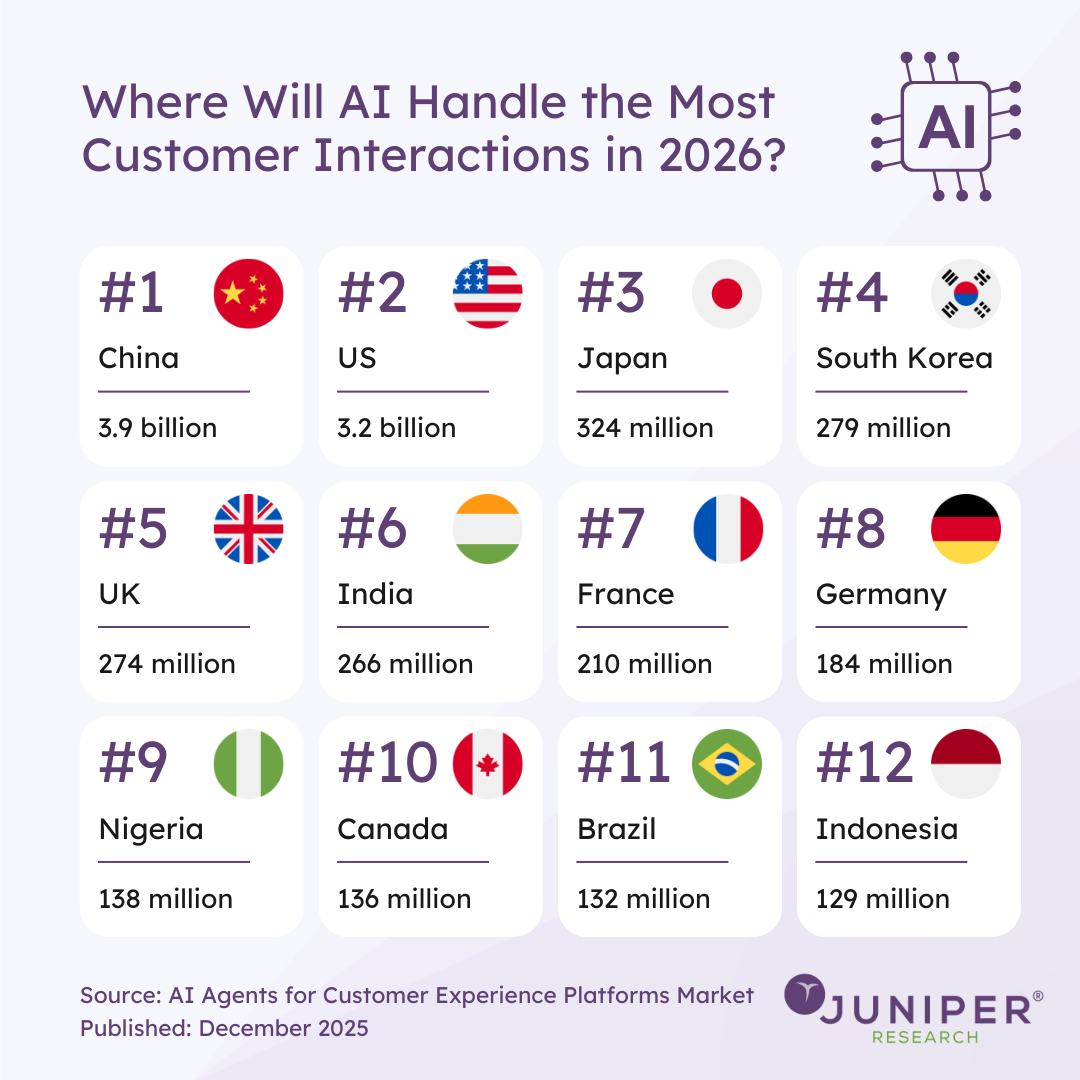
As our latest research demonstrates, the number of AI-handled customer interactions is set to rise sharply across multiple markets in 2026. The key takeaway isn’t just who is adopting AI fastest, but how strategically it’s being deployed. The most effective implementations focus on clearly defined roles for AI, using it to augment customer experience rather than simply automate it.
Source: AI Agents for Customer Experience Platforms Market 2025-2030
Read the Press Release: AI Agents to Power 1,000% More Customer Interactions for Enterprises Globally by 2027
Download the Whitepaper: Human + AI: Drivers of Customer Experience AI Agents in 2026

Latest research, whitepapers & press releases
-
 ReportApril 2026IoT & Emerging Technology
 Molly GatfordPhysical AI in Manufacturing & Logistics Market: 2026-2030
Our Physical AI in Manufacturing and Logistics research suite provides in-depth analysis of the key economic, operational, and technological factors driving growth in this fast-growing market.
VIEW -
 ReportApril 2026Fintech & Payments
 Nick MaynardAgentic Commerce Market: 2026-2031
Juniper Research’s Agentic Commerce research suite provides an insightful analysis of this rapidly emerging market; enabling stakeholders, including AI developers, payment infrastructure providers, eCommerce marketplaces, merchants and many others, to understand future growth, key trends, and the competitive environment.
VIEW -
 ReportMarch 2026Fintech & Payments
 Michael GreenwoodB2B Payment Cards Market: 2026-2030
Our B2B card payments research suite provides detailed analysis of this rapidly changing market; allowing B2B card providers to gain an understanding of key payment trends and challenges, potential growth opportunities, and the competitive environment.
VIEW -
 ReportMarch 2026Telecoms & Connectivity
 Alex WebbDirect Carrier Billing Market: 2026-2030
Our Direct Carrier Billing research suite for mobile network operators provides detailed analysis and strategic recommendations for the direct carrier billing market over the next four years.
VIEW -
 ReportMarch 2026Fintech & Payments
 Lorien CarterCross-border Payments Market: 2026-2030
Our Cross-border Payments research suite provides a comprehensive and in-depth analysis of the evolving cross-border payments landscape; enabling stakeholders such as businesses, financial institutions, payment service providers, card networks, regulators, and technology infrastructure providers to understand future growth, key trends, and the competitive environment.
VIEW -
 ReportFebruary 2026Telecoms & Connectivity
 Ardit BallhysaMobile Messaging Market: 2026-2030
Juniper Research’s Mobile Messaging research suite provides mobile messaging vendors, mobile network operators, and enterprises with intelligence on how to capitalise on changing market dynamics within the mobile messaging market.
VIEW


-
 WhitepaperApril 2026Fintech & Payments
Nick Maynard
WhitepaperApril 2026Fintech & Payments
Nick MaynardAgentic Commerce - Revolution or False Dawn?
Our complimentary whitepaper assesses the trends that are increasing agentic commerce adoption, and challenges to agentic commerce usage. Additionally, it includes a forecast summary of the global spend on agentic commerce by 2030.
VIEW -
 WhitepaperMarch 2026Fintech & Payments
Michael Greenwood
WhitepaperMarch 2026Fintech & Payments
Michael GreenwoodHow B2B Payment Cards Are Streamlining Corporate Expenses
Our complimentary whitepaper, How B2B Payment Cards Are Streamlining Corporate Expenses, examines the state of the B2B payment cards market; considering its impact on different geographies and how it is shaping the modern B2B payments landscape through card controls, payment data analysis tools, and fully integrated spend management solutions.
VIEW -
 WhitepaperMarch 2026Telecoms & Connectivity
Alex Webb
WhitepaperMarch 2026Telecoms & Connectivity
Alex WebbDirect Carrier Billing: Unlocking Emerging Revenue Streams for Operators
Our complimentary whitepaper, Direct Carrier Billing: Unlocking Emerging Revenue Streams for Operators, explores the emerging opportunities for mobile network operators to monetise direct carrier billing.
VIEW -
 WhitepaperMarch 2026Telecoms & Connectivity
Molly Gatford
WhitepaperMarch 2026Telecoms & Connectivity
Molly GatfordMWC 2026: What's Next for Mobile?
Our latest whitepaper distils the most important announcements from MWC Barcelona 2026 and examines what they mean for the telecoms market over the year ahead. From network APIs and 5G monetisation to AI-RAN, direct-to-cell connectivity, and 5G-Advanced, it explains where the biggest opportunities — and challenges — will emerge next.
VIEW -
 WhitepaperMarch 2026Fintech & Payments
Lorien Carter
WhitepaperMarch 2026Fintech & Payments
Lorien CarterThe Transformation of Cross-border Payment Infrastructure
Our complimentary whitepaper, The Transformation of Cross-border Payment Infrastructure, examines the state of the cross-border payments market; explaining the role of key actors in transforming the cross-border payment experience, as well as the current landscape and recent developments within the cross-border payments industry.
VIEW -
 WhitepaperFebruary 2026Telecoms & Connectivity
Ardit Ballhysa
WhitepaperFebruary 2026Telecoms & Connectivity
Ardit BallhysaHow Social Media Will Disrupt Mobile Messaging Channels in 2026
Our complimentary whitepaper, How Social Media Will Disrupt Mobile Messaging Channels in 2026, explores the challenges and opportunities for operators and enterprises as social media traffic continues to increase.
VIEW


-
Fintech & Payments
Agentic Commerce Set to Generate $1.5 Trillion Globally by 2030, as Payments Infrastructure Leaders Revealed
April 2026 -
Fintech & Payments
B2B Card Payments to Reach $11 Trillion Globally in 2030, Accelerated by Increased Corporate Use
March 2026 -
Telecoms & Connectivity
Direct Carrier Billing to Grow by $35 Billion Globally Over the Next Four Years, as Anti-fraud Capabilities Are Enhanced by Network APIs
March 2026 -
Fintech & Payments
Sophisticated Microfinance Services Spend to Surpass $22 billion By 2030, as Mobile Money Services in Emerging Markets Mature
March 2026 -
Fintech & Payments
Top Three Global Leaders in Cross-border Payment Infrastructure Revealed
March 2026 -
Telecoms & Connectivity
MVNO Subscriber Revenue to Exceed $50 Billion Globally in 2030
March 2026