What Makes Travel eSIMs So Much Cheaper Than Roaming?

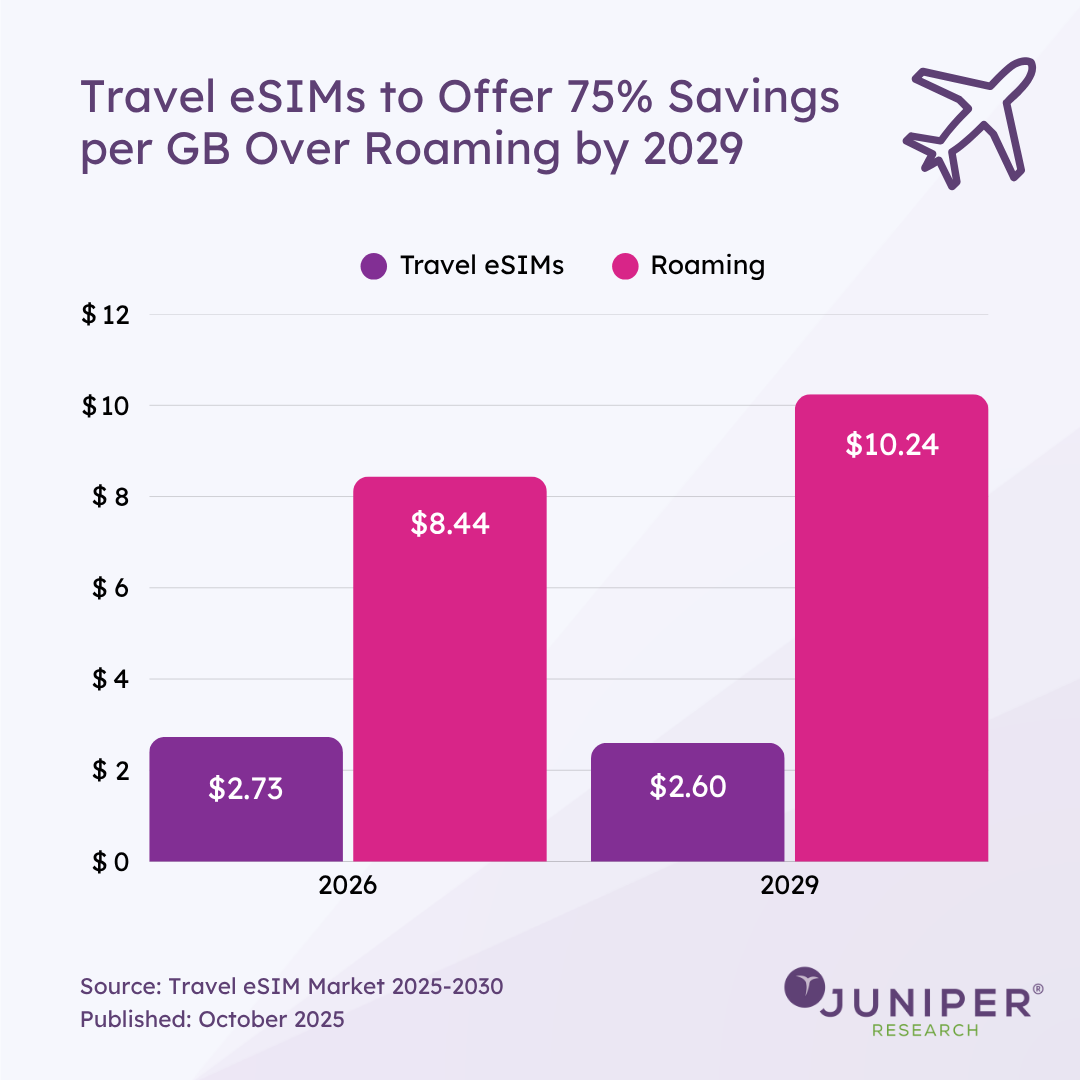
The cost of staying connected abroad has long been a pain point for travellers. But that’s changing fast. Travel eSIMs — digital SIM cards that can be downloaded in seconds — are rapidly transforming how people access data overseas. According to our latest research on the matter, travellers are set to save around 75% per GB of data compared to traditional roaming services by 2029. So, what’s behind these dramatic savings?
Direct Local Partnerships
Traditional roaming relies on complex, often outdated agreements between operators. When you travel abroad, your home operator effectively “borrows” network access from a local provider, adding layers of wholesale fees and markups along the way. Travel eSIM providers skip that middleman model entirely. Instead, they partner directly with local operators — or aggregate access across multiple regional partners — securing wholesale rates that are far cheaper than retail roaming charges.
Digital-first Operations
Travel eSIM providers don’t rely on physical infrastructure, plastic SIM cards, or in-country retail networks. Everything — from plan selection and payment to activation — happens within an app or website. This digital-first model keeps operational costs low, enabling providers to offer competitive pricing while maintaining profitability.
Transparency & Competition
The traditional roaming market has long benefited from inertia: travellers often stick with their existing operator, even if costs are high. In contrast, the travel eSIM market is open, transparent, and highly competitive. Users can easily compare plans, regions, and data allowances before purchase. This competition drives prices down, particularly as more players enter the market and seek to differentiate through affordability and flexibility.
Local Data Routing
One of the biggest hidden costs in roaming comes from how data is routed. Many roaming connections are sent back through the traveller’s home network — a costly and inefficient process. Travel eSIMs, however, connect directly to local networks, keeping data traffic local. This reduces latency, improves speed, and most importantly, eliminates the expensive routing costs that inflate roaming prices.
The Bottom Line
Travel eSIMs are redefining international connectivity. They’re digital, efficient, and built for transparency — everything traditional roaming isn’t. As adoption grows and more consumers become aware of their advantages, the balance of power in the global mobile market is shifting. For travellers, that means one thing: lower costs, greater flexibility, and seamless connectivity wherever they go.
Source: Travel eSIM Market 2025-2030
Read the Press Release: Travel eSIMs Surge as Roaming Alternative - Up 85% in 2025
Download the Whitepaper: Why Operators Are Launching Travel eSIMs in 2026
Latest research, whitepapers & press releases
-
 ReportSeptember 2026IoT & Emerging Technology
 Thomas WilsonApplication Security Market: 2026-2031
Our Application Security research suite provides detailed analysis of this emerging market; allowing application security providers to gain an understanding of key security trends and challenges, potential growth opportunities, and the competitive environment.
VIEW -
 ReportSeptember 2026Fintech & Payments
 Shane O'SullivanBanking Fraud Prevention Market: 2026-2031
Our Banking Fraud Prevention research suite provides a comprehensive and in-depth analysis of the types of fraud currently impacting the banking sector, and the evolving methods that can be used to overcome them.
VIEW -
 ReportSeptember 2026Telecoms & Connectivity
 Nick MaynardPrivate LTE & 5G Networks Market: 2026-2031
Our Private LTE & 5G Networks research suite provides detailed and insightful analysis of this evolving market; enabling stakeholders - from private LTE & 5G network platform specialists, mobile network operators, and diversified technology companies - to understand future growth, key trends, and the competitive environment.
VIEW -
 ReportSeptember 2026Fintech & Payments
 Michael GreenwoodOmnichannel Payment Platform Market: 2026-2031
Our Omnichannel Payment Platform research provides detailed analysis of this rapidly emerging market; allowing omnichannel payment platform providers to gain an understanding of key payment trends and challenges, potential growth opportunities, and the competitive environment.
VIEW -
 ReportSeptember 2026IoT & Emerging Technology
Nick MaynardIdentity & Access Management Market: 2026-2031
ReportSeptember 2026IoT & Emerging Technology
Nick MaynardIdentity & Access Management Market: 2026-2031Our Identity & Access Management research suite provides detailed and insightful analysis of this evolving market; enabling stakeholders - from Identity & Access Management platform specialists, cybersecurity vendors, and diversified technology companies - to understand future growth, key trends, and the competitive environment.
VIEW -
 ReportAugust 2026Fintech & Payments
Nick MaynardContactless Payments Market Data: 2026-2031
ReportAugust 2026Fintech & Payments
Nick MaynardContactless Payments Market Data: 2026-2031Our Contactless Payments market analysis provides exhaustive data coverage of the market in its entirety, including the adoption of mobile wallets featuring contactless payment technology, the growth of contactless transactions, and the market’s associated values.
VIEW


-
 WhitepaperSeptember 2026IoT & Emerging Technology
Thomas Wilson
WhitepaperSeptember 2026IoT & Emerging Technology
Thomas WilsonVibe Coding: The Fastest-growing Threat to Application Security Today
Our complimentary whitepaper, Vibe Coding: The Fastest-growing Threat to Application Security Today, examines the state of the application security market; considering its impact on different verticals, and how it is being employed in these verticals to best combat malicious attackers and keep sensitive data safe.
VIEW -
 WhitepaperSeptember 2026Fintech & Payments
Shane O'Sullivan
WhitepaperSeptember 2026Fintech & Payments
Shane O'SullivanThe Fraud Frontier: Securing Banking in an AI-driven Era
Our complimentary whitepaper, The Fraud Frontier: Securing Banking in an AI-driven Era, examines the rapidly evolving state of the banking fraud prevention market.
VIEW -
 WhitepaperSeptember 2026Telecoms & Connectivity
Nick Maynard
WhitepaperSeptember 2026Telecoms & Connectivity
Nick MaynardHow Private Cellular Networks Are Unlocking Industry 4.0
Our complimentary whitepaper, How Private Cellular Networks Are Unlocking Industry 4.0, examines how private LTE & 5G networks are reshaping the way industry works.
VIEW -
 WhitepaperSeptember 2026Fintech & Payments
Michael Greenwood
WhitepaperSeptember 2026Fintech & Payments
Michael GreenwoodHow Omnichannel Payment Platforms Are Streamlining Merchant Operations
Our complimentary whitepaper, How Omnichannel Payment Platforms Are Streamlining Merchant Operations, examines how merchants are utilising omnichannel payment platforms to capitalise on customer data and integration with other business management software in order to minimise inefficiency.
VIEW -
 WhitepaperSeptember 2026Telecoms & Connectivity
 Jawad Jahan
Beyond the Headlines: What the 'AI Bubble' Really Means
Our complimentary whitepaper, Beyond the Headlines – What the 'AI Bubble' Really Means, analyses the scale and structure of AI infrastructure investment in the West, and the channels through which it could transmit stress to the wider financial system.
VIEW -
 WhitepaperSeptember 2026IoT & Emerging Technology
Nick Maynard
WhitepaperSeptember 2026IoT & Emerging Technology
Nick MaynardNon-human Identities ~ Transforming Identity & Access Management
Our complimentary whitepaper, Non-human Identities ~ Transforming Identity & Access Management, examines how non-human identities are revolutionising the Identity & Access Management market.
VIEW


-
IoT & Emerging Technology
AppSec Enterprise Spend to Approach $13 Billion Globally by 2031, as Market Leaders Revealed in New Competitor Leaderboard
September 2026 -
Banking Fraud to Reach 2.2 billion Transactions by 2031, Fuelled by Growing AI-enabled Attacks
September 2026 -
Telecoms & Connectivity
Private Network Spend to Exceed $84 Billion Globally by 2031, as Market Leaders Set to Capitalise
September 2026 -
Fintech & Payments
The 6th Financial Innovation Forum – Payments & RegTech Arrives in London
September 2026 -
Fintech & Payments
Omnichannel Payment Platform Revenue to Exceed $100 Billion Globally by 2031, as Leading Platforms Set to Capitalise Are Revealed
September 2026 -
Telecoms & Connectivity
Calling the Game-changers in Telco: 2027 Future Digital Awards are Now Open for Entries
September 2026