The Value of Revenue Lost to Chargeback Fraud Will Exceed $38 Billion in 2031

Chargebacks are now an established part of the payments industry. Initially introduced to help customers resolve issues related to unauthorised purchases, faulty goods, or unfulfilled services, the idea behind them was also to provide consumers with greater protection against vendor malpractice. However, chargebacks have provided an opportunity for fraud to take place; abusing their original intent.
There are primarily three key situations in which an individual will issue a chargeback:
- Legitimate Chargebacks: Legitimate chargebacks are when a customer has been defrauded by a third-party fraudster.
- Erroneous Chargebacks: This is when a customer does not understand their transaction history, or does not remember a particular transaction, and requests a chargeback on a transaction they mistakenly think is fraudulent.
- Chargeback/Friendly Fraud: This is when a customer requests a chargeback on a transaction that they know is legitimate or was made in accordance with terms and conditions to which they agreed.
About the Infographic
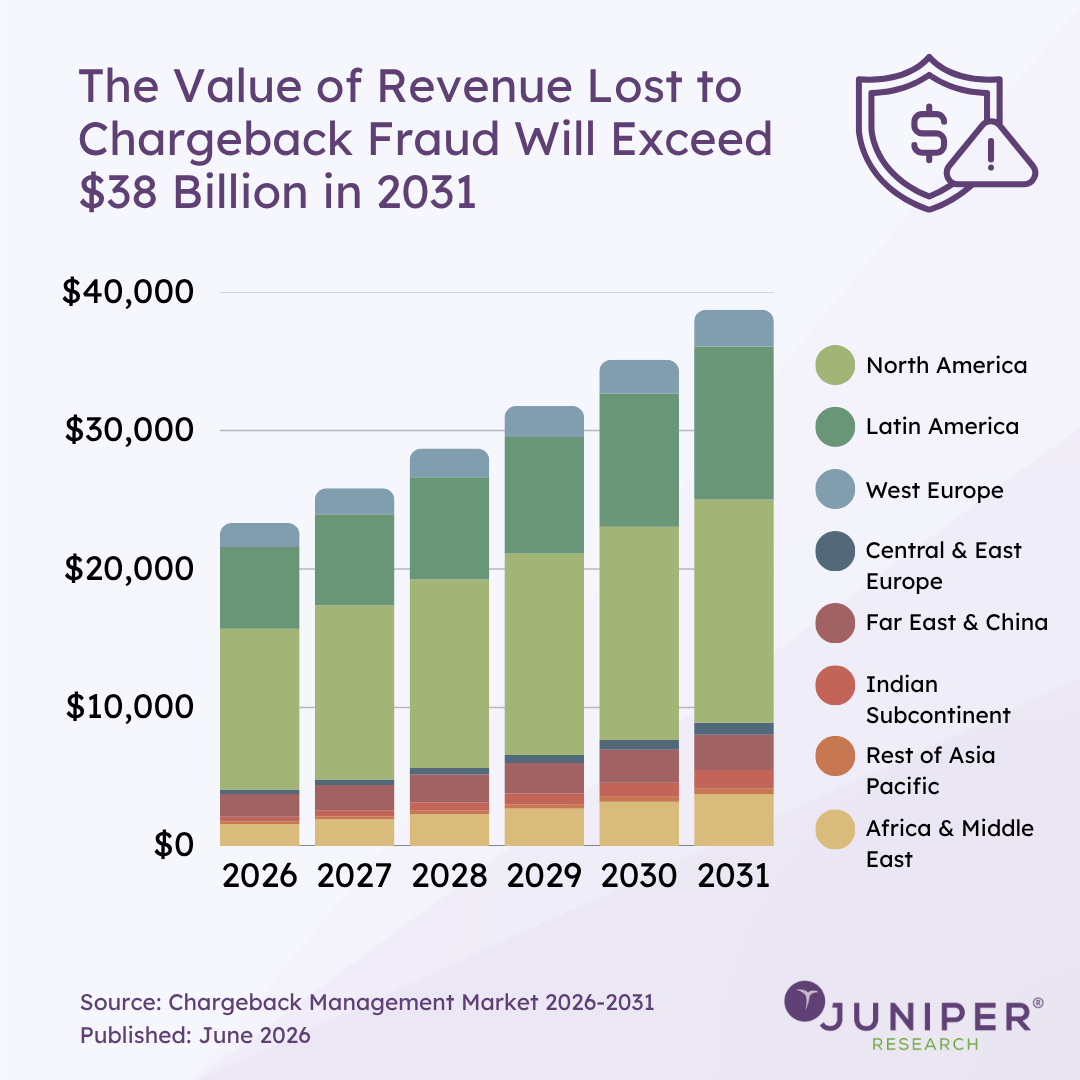
The infographic illustrates the value of revenue projected to be lost globally to friendly/chargeback fraud; providing a continent-wide breakdown of the total revenue forecast to be lost due to this type of fraud over the next five years.
Juniper Research estimates that the global total value of revenue lost to chargeback fraud will grow from $23.33 billion in 2026 to $38.73 billion in 2031. This includes direct transaction losses and associated chargeback fees.
Contrary to the perception often promoted on social media, chargeback fraud is not a victimless crime. Merchants bear the financial liability for fraudulent chargebacks; making dispute abuse a significant commercial risk. The substantial financial impact of chargeback fraud highlights the growing complexity of dispute management in digital commerce. Beyond direct revenue losses, merchants also incur higher payment processing costs, suffer reputational damage, and risk losing payment processing privileges if their chargeback ratios exceed card network thresholds.
Small and medium-sized merchants are expected to be disproportionately affected by rising chargeback fraud losses, as they often lack the advanced fraud prevention capabilities available to larger enterprises. Consequently, demand for managed fraud prevention services and automated dispute resolution platforms is expected to grow throughout the forecast period, as these businesses seek more effective ways to mitigate fraud and manage disputes.
Source: Chargeback Management Market 2026-2031
Read the Press Release: Friendly Fraud to Make Up 28% of Chargebacks Globally by 2031, Driven by Changing Consumer Attitudes Towards Merchants
Download the Whitepaper: Chargeback Management: The Fightback Against Friendly Fraud
Latest research, whitepapers & press releases
-
 ReportSeptember 2026IoT & Emerging Technology
 Thomas WilsonApplication Security Market: 2026-2031
Our Application Security research suite provides detailed analysis of this emerging market; allowing application security providers to gain an understanding of key security trends and challenges, potential growth opportunities, and the competitive environment.
VIEW -
 ReportSeptember 2026Fintech & Payments
 Shane O'SullivanBanking Fraud Prevention Market: 2026-2031
Our Banking Fraud Prevention research suite provides a comprehensive and in-depth analysis of the types of fraud currently impacting the banking sector, and the evolving methods that can be used to overcome them.
VIEW -
 ReportSeptember 2026Telecoms & Connectivity
 Nick MaynardPrivate LTE & 5G Networks Market: 2026-2031
Our Private LTE & 5G Networks research suite provides detailed and insightful analysis of this evolving market; enabling stakeholders - from private LTE & 5G network platform specialists, mobile network operators, and diversified technology companies - to understand future growth, key trends, and the competitive environment.
VIEW -
 ReportSeptember 2026Fintech & Payments
 Michael GreenwoodOmnichannel Payment Platform Market: 2026-2031
Our Omnichannel Payment Platform research provides detailed analysis of this rapidly emerging market; allowing omnichannel payment platform providers to gain an understanding of key payment trends and challenges, potential growth opportunities, and the competitive environment.
VIEW -
 ReportSeptember 2026IoT & Emerging Technology
Nick MaynardIdentity & Access Management Market: 2026-2031
ReportSeptember 2026IoT & Emerging Technology
Nick MaynardIdentity & Access Management Market: 2026-2031Our Identity & Access Management research suite provides detailed and insightful analysis of this evolving market; enabling stakeholders - from Identity & Access Management platform specialists, cybersecurity vendors, and diversified technology companies - to understand future growth, key trends, and the competitive environment.
VIEW -
 ReportAugust 2026Fintech & Payments
Nick MaynardContactless Payments Market Data: 2026-2031
ReportAugust 2026Fintech & Payments
Nick MaynardContactless Payments Market Data: 2026-2031Our Contactless Payments market analysis provides exhaustive data coverage of the market in its entirety, including the adoption of mobile wallets featuring contactless payment technology, the growth of contactless transactions, and the market’s associated values.
VIEW


-
 WhitepaperSeptember 2026IoT & Emerging Technology
Thomas Wilson
WhitepaperSeptember 2026IoT & Emerging Technology
Thomas WilsonVibe Coding: The Fastest-growing Threat to Application Security Today
Our complimentary whitepaper, Vibe Coding: The Fastest-growing Threat to Application Security Today, examines the state of the application security market; considering its impact on different verticals, and how it is being employed in these verticals to best combat malicious attackers and keep sensitive data safe.
VIEW -
 WhitepaperSeptember 2026Fintech & Payments
Shane O'Sullivan
WhitepaperSeptember 2026Fintech & Payments
Shane O'SullivanThe Fraud Frontier: Securing Banking in an AI-driven Era
Our complimentary whitepaper, The Fraud Frontier: Securing Banking in an AI-driven Era, examines the rapidly evolving state of the banking fraud prevention market.
VIEW -
 WhitepaperSeptember 2026Telecoms & Connectivity
Nick Maynard
WhitepaperSeptember 2026Telecoms & Connectivity
Nick MaynardHow Private Cellular Networks Are Unlocking Industry 4.0
Our complimentary whitepaper, How Private Cellular Networks Are Unlocking Industry 4.0, examines how private LTE & 5G networks are reshaping the way industry works.
VIEW -
 WhitepaperSeptember 2026Fintech & Payments
Michael Greenwood
WhitepaperSeptember 2026Fintech & Payments
Michael GreenwoodHow Omnichannel Payment Platforms Are Streamlining Merchant Operations
Our complimentary whitepaper, How Omnichannel Payment Platforms Are Streamlining Merchant Operations, examines how merchants are utilising omnichannel payment platforms to capitalise on customer data and integration with other business management software in order to minimise inefficiency.
VIEW -
 WhitepaperSeptember 2026Telecoms & Connectivity
 Jawad Jahan
Beyond the Headlines: What the 'AI Bubble' Really Means
Our complimentary whitepaper, Beyond the Headlines – What the 'AI Bubble' Really Means, analyses the scale and structure of AI infrastructure investment in the West, and the channels through which it could transmit stress to the wider financial system.
VIEW -
 WhitepaperSeptember 2026IoT & Emerging Technology
Nick Maynard
WhitepaperSeptember 2026IoT & Emerging Technology
Nick MaynardNon-human Identities ~ Transforming Identity & Access Management
Our complimentary whitepaper, Non-human Identities ~ Transforming Identity & Access Management, examines how non-human identities are revolutionising the Identity & Access Management market.
VIEW


-
IoT & Emerging Technology
AppSec Enterprise Spend to Approach $13 Billion Globally by 2031, as Market Leaders Revealed in New Competitor Leaderboard
September 2026 -
Banking Fraud to Reach 2.2 billion Transactions by 2031, Fuelled by Growing AI-enabled Attacks
September 2026 -
Telecoms & Connectivity
Private Network Spend to Exceed $84 Billion Globally by 2031, as Market Leaders Set to Capitalise
September 2026 -
Fintech & Payments
The 6th Financial Innovation Forum – Payments & RegTech Arrives in London
September 2026 -
Fintech & Payments
Omnichannel Payment Platform Revenue to Exceed $100 Billion Globally by 2031, as Leading Platforms Set to Capitalise Are Revealed
September 2026 -
Telecoms & Connectivity
Calling the Game-changers in Telco: 2027 Future Digital Awards are Now Open for Entries
September 2026