How Do Different Virtual Cards Cater to Evolving Payment Needs?

As digital payment methods now represent the majority of payments for most countries worldwide, the reliance on physical payment cards is increasingly complemented by virtual alternatives. Digital wallets are now a staple of the everyday payments landscape across the globe, and users are increasingly integrating virtual cards into digital wallets to make secure and convenient payments.
Virtual cards differ from digital cards. A digital card consists of a digitised version of a physical card, with the same card details as the original physical card, whereas a virtual card has its own set of credentials, which reduces the amount of sensitive card data that is exposed if the data is stolen.
Virtual cards are versatile and can be used within digital wallets to pay both in store and online. They offer different functionalities depending on their intended use cases, with each type providing distinct benefits in terms of payment control, security and spending management.
The main types of virtual cards include:
- Disposable virtual cards
- Merchant-linked cards
- Dynamic CVV cards
- Timed-use cards
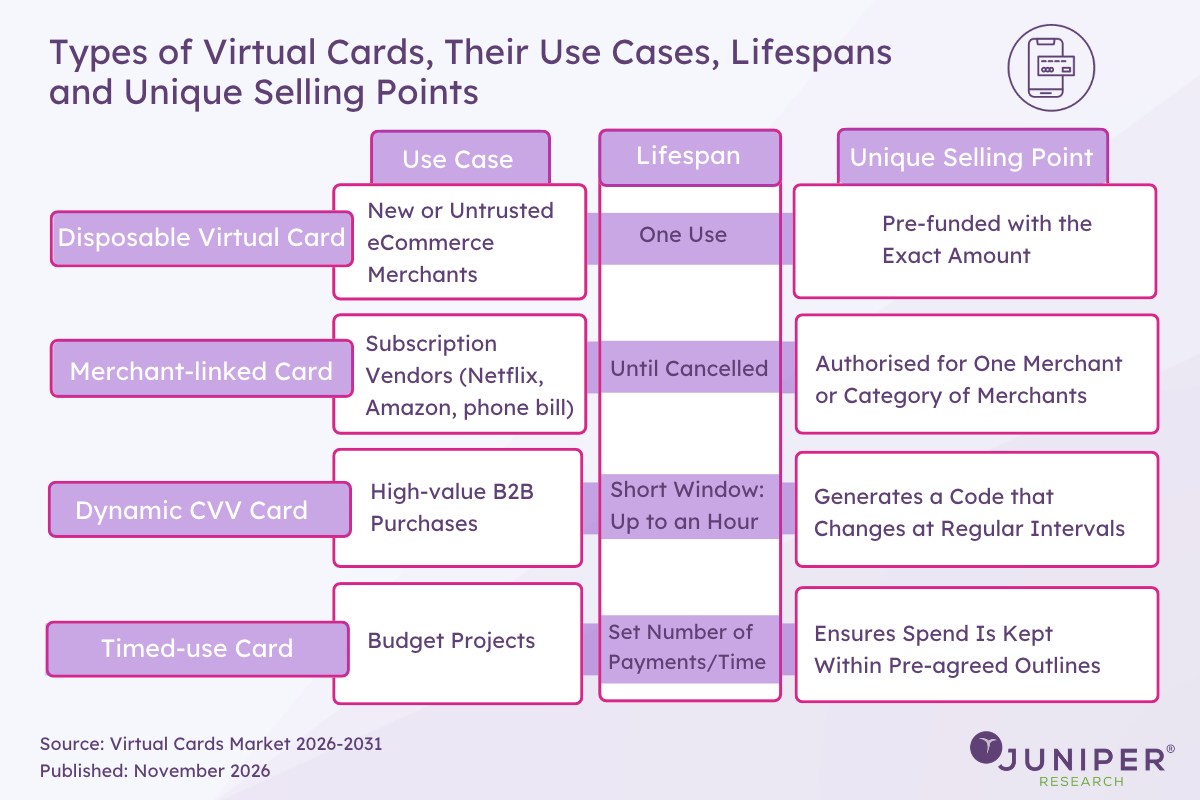
About the Infographic
The infographic provides an overview of different types of virtual cards; highlighting their respective use cases, lifespans and unique selling points. Each type of virtual card is designed to address different payment requirements, through different validity periods and security features. The comparison demonstrates how virtual cards offer varying levels of payment flexibility, security and spending control, depending on their intended application.
Disposable virtual cards are primarily intended for transactions with new or untrusted eCommerce merchants. These cards are designed for one-time use, reducing the risk of unauthorised transactions or subsequent misuse. Their key selling point is that they are pre-funded with an exact amount, which allows users to maintain greater control over the funds allocated to individual purchases.
Merchant-linked cards are suited to recurring payments and subscriptions, including services such as Netflix, Amazon, and phone bills. Unlike disposable cards, these remain active until cancelled, making them suitable for ongoing transactions. Their primary security advantage is that they are authorised for use with only one specific merchant or a defined category of merchants, which helps restrict unauthorised spending elsewhere.
Dynamic CVV cards are designed to support high-value, business-to-business (B2B) purchases where additional payment security is required. These cards operate within a short validity window of up to one hour. Their distinguishing feature is the generation of a security code that changes at regular intervals, making it more difficult for compromised payment details to be reused for fraudulent transactions.
Timed-use cards are particularly useful for managing expenditure on budget-controlled projects. These cards allow organisations to establish a predetermined number of payments or a specific period during which the card can be used. This helps ensure that spending remains within pre-agreed limits; providing greater oversight of project-related expenses and reducing the risk of budget overruns.
The different types of virtual cards demonstrate how payment solutions can be tailored to specific spending requirements. From securing individual online purchases and managing recurring subscriptions to protecting high-value transactions and controlling project budgets, virtual cards provide businesses with greater flexibility, security and oversight of their payments.
Source: Virtual Cards Market: 2026-2031
Read the Press Release: Virtual Cards Market Leaders Revealed by Juniper Research, as Revenue Forecast to Hit $148 Billion by 2031
Download the Whitepaper: Is Agentic Commerce on the (Virtual) Cards?
Latest research, whitepapers & press releases
-
 ReportDecember 2026Telecoms & Connectivity
 Fred Savage
Operator Revenue Strategies Market: 2026-2031
Discover invaluable insights into trends and strategies for network operator revenue in our latest report, Network Operator Revenue Strategies. With data split across 60 countries, this extensive forecast analyses the dynamic and competitive network operator market and the current market challenges posed by slowing revenue, high market saturation in the consumer market, rising network ownership costs, and challenges in 5G monetisation.
VIEW -
 ReportDecember 2026Fintech & Payments
 Dr Manju Chhillar
eCommerce Payments Market: 2026-2031
Our eCommerce Payments Market 2026-2031 report offers an in-depth assessment of this fast-changing market. It provides stakeholders - from eCommerce payment platform providers to merchants and payment service providers - the insight they need to anticipate growth, respond to emerging trends, and benchmark themselves against the competition.
VIEW -
 ReportNovember 2026Telecoms & Connectivity
 Thomas Wilson
Network APIs Market: 2026-2031
Our Network APIs Market research suite provides operators, Communications Platform-as-a-Service (CPaaS) providers, and other GSMA channel partners with extensive analysis and actionable insights into the rapidly growing network API market.
VIEW -
 ReportNovember 2026Fintech & Payments
 Lorien Carter
Virtual Cards Market: 2026-2031
Our Virtual Cards research suite provides a comprehensive and in-depth analysis of the role of virtual cards in the digital payments landscape
VIEW -
 ReportNovember 2026Fintech & Payments
 Shane O'Sullivan
B2B Payments Market: 2026-2031
Our B2B Payments research suite provides a wide-ranging and rigorous analysis of this massive market; enabling stakeholders from B2B payment platform providers to regulators and banks, to understand future growth, key trends and the competitive environment.
VIEW -
 ReportNovember 2026Telecoms & Connectivity
 Ardit Ballhysa
Robocalling & Branded Calling Market: 2026-2031
Our Robocalling & Branded Calling Market research suite provides insightful analysis of a market that is becoming increasingly dynamic and complex.
VIEW


-
 WhitepaperNovember 2026Telecoms & Connectivity
Thomas Wilson
How Operators Can Monetise Network APIs without Compromising Trust
Our complimentary whitepaper, How Operators Can Monetise Network APIs without Compromising Trust, explores how operators can capitalise on the opportunities in the network API market, both now and in the future.
VIEW -
 WhitepaperNovember 2026Fintech & Payments
Lorien Carter
Is Agentic Commerce on the (Virtual) Cards?
Our complimentary whitepaper, Is Agentic Commerce on the (Virtual) Cards?, examines the state of the virtual cards market; explaining the role of key actors in the virtual cards landscape and recent developments within the virtual cards industry.
VIEW -
 WhitepaperNovember 2026Fintech & Payments
Shane O'Sullivan
The End of Wire Transfer – the Battle for B2B Payments
Our complimentary whitepaper, The End of Wire Transfer – the Battle for B2B Payments, examines the rapidly evolving state of the B2B payments market.
VIEW -
 WhitepaperNovember 2026Telecoms & Connectivity
Ardit Ballhysa
Deepfakes in Robocalling Fraud – the Need for Advanced Solutions and Frameworks in 2027 and Beyond
Our complimentary whitepaper, Deepfakes in Robocalling Fraud – the Need for Advanced Solutions and Frameworks in 2027 and Beyond, explores the challenges and opportunities for fraud prevention.
VIEW -
 WhitepaperNovember 2026Telecoms & Connectivity
 Peter Boyland
Rich Messaging, Real Growth: the Rise of RCS and OTT in CPaaS
Our complimentary whitepaper, Rich Messaging, Real Growth: the Rise of RCS and OTT in CPaaS, explores the challenges and opportunities for operators and enterprises as CPaaS becomes more embedded in the consumer experience.
VIEW -
 WhitepaperOctober 2026Fintech & Payments
 Michael Greenwood
Accounts Payable Automation ~ How Businesses Are Reducing Operational Costs
Our complimentary whitepaper, Accounts Payable Automation ~ How Businesses Are Reducing Operational Costs, analyses how AP automation is combatting costs by decreasing the need for manual processes, and provides strategic insight into a number of key trends in the AP automation space.
VIEW


-
Telecoms & Connectivity
Fraud & Authentication Network API Revenue to Pass $6 Billion Globally by 2031, Thanks to New KYC Opportunities
November 2026 -
Telecoms & Connectivity
Private Networks in Service to Exceed 47,000 Globally by 2031, as Industry Specialisation & 5G Drive Expands
November 2026 -
Fintech & Payments
Virtual Cards Market Leaders Revealed by Juniper Research, as Revenue Forecast to Hit $148 Billion by 2031
November 2026 -
Fintech & Payments
B2B Payment Transactions to Exceed 612 Billion by 2031, as Fintechs Challenge Banks for Business Payment Relationships
November 2026 -
Fintech & Payments
27th NextGen Payments & RegTech Forum Returns to Limassol, Cyprus
November 2026 -
Telecoms & Connectivity
North American Consumer Losses from Fraudulent Robocalls to Fall by a Third by 2031; Driven by Robust Solutions and Branded Calling
November 2026