How Could Investment in Post-quantum Cryptography Technology Evolve?

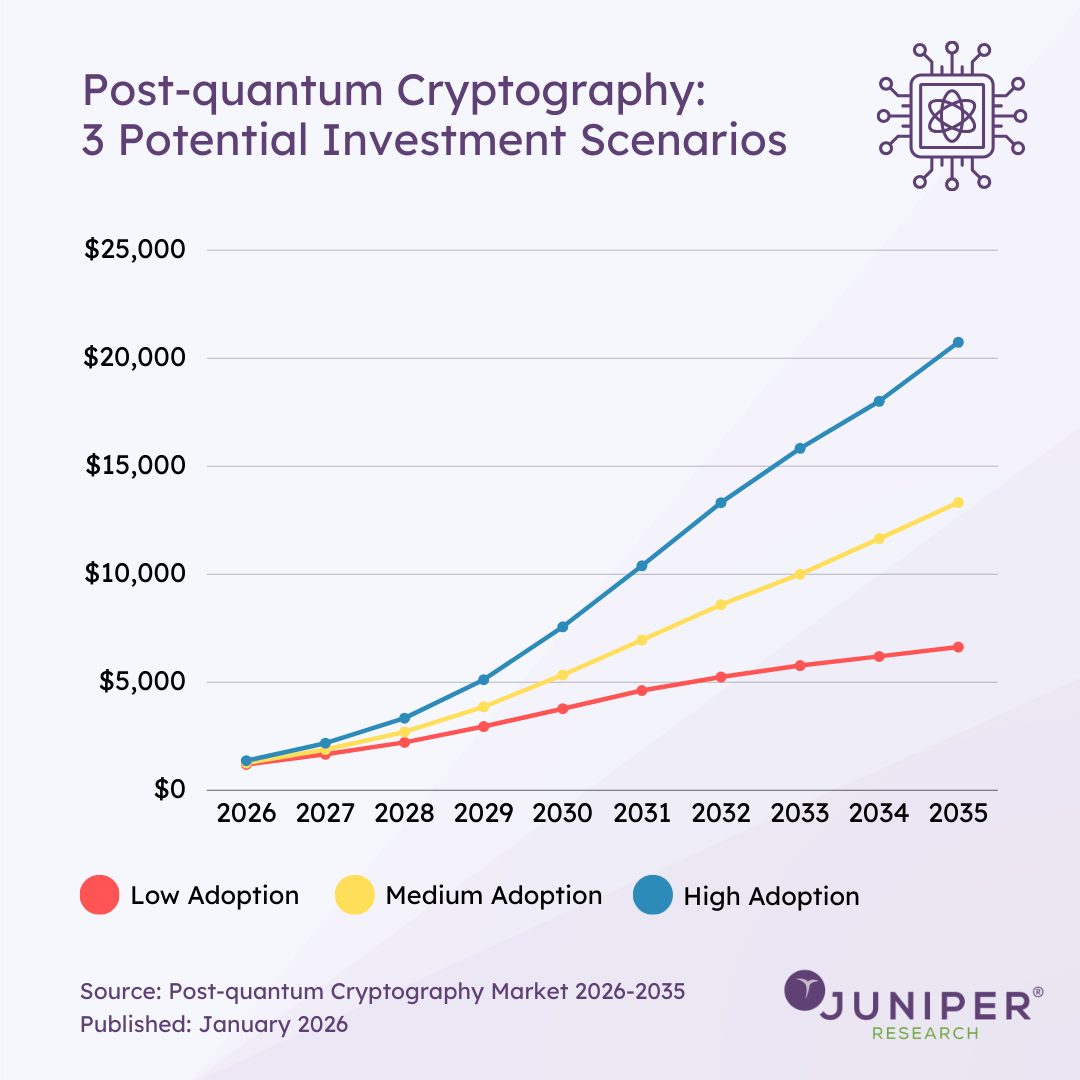
Post-quantum cryptography (PQC) sits in an unusual position in the cybersecurity landscape. Its importance is widely acknowledged, yet the timeline that will ultimately drive large-scale deployment remains uncertain. Unlike most security technologies, PQC adoption is not being pulled forward by an active threat, but by the expectation of a future one: the point at which quantum computers are capable of breaking today’s public-key cryptography.
This moment - often referred to as Q-Day - is impossible to date with confidence. Progress in quantum computing continues, but commercial, fault-tolerant systems capable of breaking widely used encryption standards are still years away. That uncertainty makes PQC investment difficult to forecast using traditional market models, as adoption will not follow a smooth, linear curve. Instead, it is likely to accelerate in phases, shaped by regulation, government readiness programmes, and enterprise risk tolerance.
The publication of quantum-resistant algorithms by National Institute of Standards and Technology has removed one major barrier to adoption: cryptographic uncertainty.
However, algorithm availability does not equate to deployment readiness. Enterprises still face complex challenges around implementation, system migration, performance trade-offs, and long-term compliance. As a result, much of the commercial opportunity in PQC lies not in the algorithms themselves, but in the tools, integrations, SDKs, APIs, and advisory services that enable organisations to adopt them safely and at scale.
This is why mapping multiple investment scenarios is essential. PQC adoption will be influenced by several external variables - including breakthroughs in quantum hardware, regulatory mandates, national security priorities, and high-profile cryptographic failures - none of which can be predicted with precision.
Scenario-based forecasting allows us to model how investment could evolve under different adoption speeds, rather than presenting a single, misleading trajectory. In doing so, it provides enterprises, vendors, and policymakers with a more realistic framework for planning investment, prioritising readiness, and managing cryptographic risk over the long term.
Source: Post-quantum Cryptography Market 2026-2035
Read the Press Release: Post-quantum Cryptography Market to Exceed $13 Billion by 2035 as Q-Day Awareness Accelerates
Download the Whitepaper: Preparing for Q-Day: Post-quantum Security Shift

Latest research, whitepapers & press releases
-
 ReportMarch 2026Fintech & Payments
 Lorien CarterCross-border Payments Market: 2026-2030
Our Cross-border Payments research suite provides a comprehensive and in-depth analysis of the evolving cross-border payments landscape; enabling stakeholders such as businesses, financial institutions, payment service providers, card networks, regulators, and technology infrastructure providers to understand future growth, key trends, and the competitive environment.
VIEW -
 ReportFebruary 2026Telecoms & Connectivity
 Ardit BallhysaMobile Messaging Market: 2026-2030
Juniper Research’s Mobile Messaging research suite provides mobile messaging vendors, mobile network operators, and enterprises with intelligence on how to capitalise on changing market dynamics within the mobile messaging market.
VIEW -
 ReportFebruary 2026Fintech & Payments
 Shane O'SullivanKYC/KYB Systems Market: 2026-2030
Our KYC/KYB Systems research suite provides a detailed and insightful analysis of an evolving market; enabling stakeholders such as financial institutions, eCommerce platforms, regulatory agencies and technology vendors to understand future growth, key trends and the competitive environment.
VIEW -
 ReportFebruary 2026Telecoms & Connectivity
 Molly GatfordRCS for Business Market: 2026-2030
Our comprehensive RCS for Business research suite provides an in‑depth evaluation of a market poised for rapid expansion over the next five years. It equips stakeholders with clear insight into the most significant opportunities emerging over the next two years.
VIEW -
 ReportFebruary 2026Fintech & Payments
 Jawad JahanMobile Money in Emerging Markets: 2026-2030
Our Mobile Money in Emerging Markets research report provides detailed evaluation and analysis of the ways in which the mobile financial services space is evolving and developing.
VIEW -
 ReportJanuary 2026IoT & Emerging Technology
 Louis AtkinPost-quantum Cryptography Market: 2026-2035
Juniper Research’s Post-quantum Cryptography (PQC) research suite provides a comprehensive and insightful analysis of this market; enabling stakeholders, including PQC-enabled platform providers, specialists, cybersecurity consultancies, and many others, to understand future growth, key trends, and the competitive environment.
VIEW


-
 WhitepaperMarch 2026Telecoms & Connectivity
Molly Gatford
WhitepaperMarch 2026Telecoms & Connectivity
Molly GatfordMWC 2026: What's Next for Mobile?
Our latest whitepaper distils the most important announcements from MWC Barcelona 2026 and examines what they mean for the telecoms market over the year ahead. From network APIs and 5G monetisation to AI-RAN, direct-to-cell connectivity, and 5G-Advanced, it explains where the biggest opportunities — and challenges — will emerge next.
VIEW -
 WhitepaperMarch 2026Fintech & Payments
Lorien Carter
WhitepaperMarch 2026Fintech & Payments
Lorien CarterThe Transformation of Cross-border Payment Infrastructure
Our complimentary whitepaper, The Transformation of Cross-border Payment Infrastructure, examines the state of the cross-border payments market; explaining the role of key actors in transforming the cross-border payment experience, as well as the current landscape and recent developments within the cross-border payments industry.
VIEW -
 WhitepaperFebruary 2026Telecoms & Connectivity
Ardit Ballhysa
WhitepaperFebruary 2026Telecoms & Connectivity
Ardit BallhysaHow Social Media Will Disrupt Mobile Messaging Channels in 2026
Our complimentary whitepaper, How Social Media Will Disrupt Mobile Messaging Channels in 2026, explores the challenges and opportunities for operators and enterprises as social media traffic continues to increase.
VIEW -
 WhitepaperFebruary 2026Telecoms & Connectivity
 Sam Barker
Protecting Users from Scam Ads: A Call for Social Media Platform Accountability
In this new whitepaper commissioned by Revolut, Juniper Research examines how scam advertising has become embedded across major social media platforms, quantifies the scale of user exposure and financial harm, and explains why current detection and enforcement measures are failing to keep pace.
VIEW -
 WhitepaperFebruary 2026Fintech & Payments
Shane O'Sullivan
WhitepaperFebruary 2026Fintech & Payments
Shane O'SullivanKnow Your Agents (KYA): The Next Frontier in KYC/KYB Systems
Our complimentary whitepaper, Know Your Agents (KYA): The Next Frontier in KYC/KYB Systems, examines the state of the KYC/KYB systems market; considering the impact of regulatory development, emerging risk factors such as identity enabled fraud, and how identity and business verification is evolving beyond traditional customer and merchant onboarding toward agent-level governance.
VIEW -
 WhitepaperFebruary 2026Telecoms & Connectivity
Molly Gatford
WhitepaperFebruary 2026Telecoms & Connectivity
Molly Gatford3 Key Strategies for Capitalising on RCS Growth in 2026
Our complimentary whitepaper, 3 Key Strategies for Capitalising on RCS Growth in 2026, explores key trends shaping the RCS for Business market and outlines how mobile operators and platforms can accelerate adoption and maximise revenue over the next 12 months.
VIEW


-
Fintech & Payments
Sophisticated Microfinance Services Spend to Surpass $22 billion By 2030, as Mobile Money Services in Emerging Markets Mature
March 2026 -
Fintech & Payments
Top Three Global Leaders in Cross-border Payment Infrastructure Revealed
March 2026 -
Telecoms & Connectivity
MVNO Subscriber Revenue to Exceed $50 Billion Globally in 2030
March 2026 -
Fintech & Payments
QUBE Events is excited to bring back the 24th NextGen Payments & RegTech Forum - Switzerland
February 2026 -
Telecoms & Connectivity
OTT Messaging Apps to Exceed 5 Billion Users Globally by 2028; Driving Shift in Enterprise Communication Strategies
February 2026 -
Fintech & Payments
Calling All Fintech & Payment Innovators: Future Digital Awards Now Open for 2026
February 2026