Why Apple’s iPhone Air Marks a New Era for eSIM

It was only a matter of time before Apple announced an embedded SIM (eSIM)-only iPhone worldwide, following its announcement of the US-exclusive eSIM-only iPhone 14 line-up in September 2022. Apple announced the iPhone Air during its annual September event, named “Awe Dropping." This event introduced the latest iPhone line-up, alongside the new iPhone Air, the next iteration of AirPods Pro, and the next series of Apple Watch.
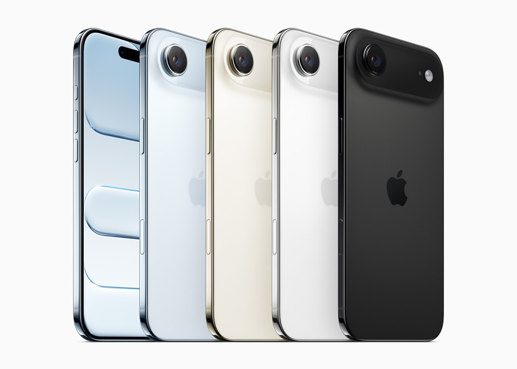 Source: Apple
The iPhone Air adds a new form factor into Apple’s iPhone line-up; adding some much-needed differentiation after almost a decade of minimal changes to the iPhone’s design. Apple’s decision to make only its new iPhone Air model eSIM-only, however, calls into question carrier readiness for eSIM-only smartphones. It also raises the question of Apple’s motives behind releasing the iPhone Air.
During its keynote, Apple noted that eSIM is easier to use, has better security, and saves space inside the device - all of which are true. eSIM achieves this as, unlike a physical SIM card, it is digitally built directly onto a device’s hardware. eSIM offers protection against lost or stolen physical SIMs, which can then be used by fraudsters to receive important One-Time Passwords (OTPs) to gain unauthorised access to sensitive data and accounts; protecting, against Account Takeover (ATO) fraud.
Considering the advantages eSIM poses over a physical SIM, why wouldn’t Apple make the entirety of its iPhone line-up eSIM-only worldwide, too? Juniper Research believes there are two key reasons; firstly, not all carriers offer eSIM capabilities at present. According to Apple, over 500 networks offer support for eSIM worldwide, with the GSMA expecting most operators globally to support eSIM by 2028. According to our data, less than a third of all smartphones shipped in 2024 offer eSIM support and there is currently no strong incentive for many carriers around the world to make eSIM an available offering to their customers.
Secondly, many consumers do not know what eSIM is; this being particularly true for older consumers and smartphone users in less developed countries.
With the iPhone Air, however, Apple is hoping to change this by encouraging carrier adoption of eSIM, with carriers subsequently left with the responsibility of educating their consumer base. Apple will stand to benefit from more carriers offering eSIM; as consumers will be likely to upgrade their iPhones more frequently owing to the convenience offered by this technology. eSIMs provide consumers with instant access to a carrier’s network upon taking out a plan, without the need to physically pick up a SIM card or wait for one in the post.
An eSIM-only iPhone also benefits from freed up physical space within the device. This additional space can be used for larger batteries, as with the Apple iPhone Air. The extra space can also be used to incorporate additional components, which Apple may look to do in future iterations of its Pro line-up once this line-up is standardised globally. Larger batteries can provide better battery life to enable more power-hungry chipsets, whereas additional components could potentially fuel new use cases for Apple’s smartphones to further differentiate Apple from other smartphone OEMs.
There is a possibility that Apple’s plan to push eSIM support globally may not work. If it doesn’t, then the iPhone Air underperforming due to low sales becomes a real risk. Apple strategically chose not to use its lower-end iPhones for eSIM-only, as they often have larger sales volumes. This is primarily due to their lower price point, with previous generation base iPhone models still available to consumers at a discounted price. Apple also made the right decision to not make its two Pro models eSIM-only, as they are the top two selling iPhones. Doing so could potentially have lost them sales revenue, should consumers around the world reject an eSIM-only iPhone.
Apple’s ulterior motives aside, trying to push the industry forward by establishing eSIM as the default in smartphones is commendable. Not only do physical SIM cards adversely affect the climate by contributing to plastic waste and landfills, they can also pose a security risk for individuals who lose their SIM cards or have them stolen.
Proportion of Smartphones That Are eSIM-capable, 2020-2025
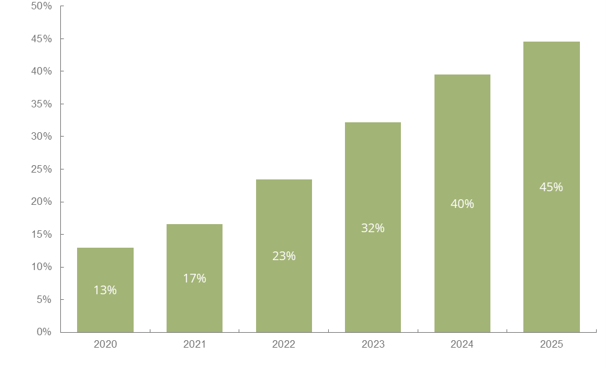
Source: Juniper Research
Juniper Research forecasts that the proportion of cellular smartphones that are eSIM-capable will grow from 45% in 2025 to 58% in 2028. A successful iPhone Air may push this growth even further, especially as other OEMs follow suit to gain the advantages eSIM offers on their own smartphones. Further, Apple could standardise eSIM across all its iPhones when carrier adoption of eSIM reaches maturation in most parts of the world; bolstering the eSIM market even more.
Ardit works within the Telecoms & Connectivity team; providing insights and strategic recommendations on current and future markets within the telecoms industry. His primary area of focus is on operator and CSP strategies. He previously worked at GlobalData for four years where he covered the technology and telecommunications industries, and prior to that, worked at Gartner for two years.
Related Research
-
 ReportOctober 2025Telecoms & Connectivity
 Molly GatfordTravel eSIM Market, 2025-2030
Our comprehensive Travel eSIMs research suite comprises detailed assessment of a market undergoing rapid growth. It provides insight into how travel eSIM providers can differentiate their services to maximise success in the market over the next two years.
VIEW -
 ReportSeptember 2025Telecoms & Connectivity
 Ardit BallhysaMobile Messaging Fraud Prevention Market, 2025-2030
Our Mobile Messaging Fraud Prevention research suite provides a detailed and insightful analysis of a market set for significant disruption over the next five years. It enables stakeholders from mobile operators, enterprises, and mobile messaging fraud prevention vendors to understand how the market for mobile messaging fraud will evolve, as well as the impact of AI, RCS, and the evolving competitive environment.
VIEW
Latest research, whitepapers & press releases
-
 ReportOctober 2026Fintech & Payments
 Michael GreenwoodAccounts Payable Automation Market: 2026-2031
Our Accounts Payable (AP) Automation research suite provides an insightful analysis of this rapidly growing market; enabling stakeholders to understand future growth, key trends and the competitive environment.
VIEW -
 ReportOctober 2026Fintech & Payments
 Jawad JahanCrypto-gaming Market: 2026-2035
Our Crypto-gaming Market research suite provides an insightful analysis of this rapidly growing market; enabling stakeholders - from crypto-gaming and sportsbooks operators, prediction market platforms, business-to-business (B2B) gambling platforms and software providers, to crypto payment processors and regulators - to understand future growth, key trends, and the competitive environment.
VIEW -
 ReportOctober 2026Telecoms & Connectivity
 Alex WebbRetail Roaming Market: 2026-2031
Our Retail Roaming research suite for mobile network operators (MNOs) and mobile virtual network operators (MVNOs) provides detailed analysis and strategic recommendations for the next era of retail roaming.
VIEW -
 ReportSeptember 2026Fintech & Payments
 Dr Manju ChhillarEmbedded Finance Market: 2026-2031
Embedded finance is one of the fastest-growing markets in financial services, and is about to accelerate even further. Our Embedded Finance Market research provides detailed analysis of the key drivers behind this growth, and what these mean for stakeholders in this market.
VIEW -
 ReportSeptember 2026Identity & Security
 Thomas WilsonApplication Security Market: 2026-2031
Our Application Security research suite provides detailed analysis of this emerging market; allowing application security providers to gain an understanding of key security trends and challenges, potential growth opportunities, and the competitive environment.
VIEW -
 ReportSeptember 2026Fintech & Payments
 Shane O'SullivanBanking Fraud Prevention Market: 2026-2031
Our Banking Fraud Prevention research suite provides a comprehensive and in-depth analysis of the types of fraud currently impacting the banking sector, and the evolving methods that can be used to overcome them.
VIEW


-
 WhitepaperOctober 2026Fintech & Payments
Michael Greenwood
WhitepaperOctober 2026Fintech & Payments
Michael GreenwoodAccounts Payable Automation ~ How Businesses Are Reducing Operational Costs
Our complimentary whitepaper, Accounts Payable Automation ~ How Businesses Are Reducing Operational Costs, analyses how AP automation is combatting costs by decreasing the need for manual processes, and provides strategic insight into a number of key trends in the AP automation space.
VIEW -
 WhitepaperOctober 2026Fintech & Payments
Jawad Jahan
WhitepaperOctober 2026Fintech & Payments
Jawad JahanCompliance or Anonymity - The Crypto-gaming Operator’s Dilemma
Our complimentary whitepaper, Compliance or Anonymity - The Crypto-gaming Operator’s Dilemma, analyses the current regulatory landscape of the crypto-gaming market.
VIEW -
 WhitepaperOctober 2026Telecoms & Connectivity
Alex Webb
WhitepaperOctober 2026Telecoms & Connectivity
Alex WebbReimagining the Future of Retail Roaming – How Mobile Network Operators Must Adapt
Our complimentary whitepaper, Reimagining the Future of Retail Roaming – How Mobile Network Operators Must Adapt, explores the emerging opportunities for MNOs within retail roaming.
VIEW -
 WhitepaperSeptember 2026Fintech & Payments
Dr Manju Chhillar
WhitepaperSeptember 2026Fintech & Payments
Dr Manju ChhillarEmerging Markets: The Next Opportunity for Embedded Finance
This free whitepaper examines how a combination of multiple factors is driving North America towards saturation for embedded finance.
VIEW -
 WhitepaperSeptember 2026Emerging Technology
Thomas Wilson
WhitepaperSeptember 2026Emerging Technology
Thomas WilsonVibe Coding: The Fastest-growing Threat to Application Security Today
Our complimentary whitepaper, Vibe Coding: The Fastest-growing Threat to Application Security Today, examines the state of the application security market; considering its impact on different verticals, and how it is being employed in these verticals to best combat malicious attackers and keep sensitive data safe.
VIEW -
 WhitepaperSeptember 2026Fintech & Payments
Shane O'Sullivan
WhitepaperSeptember 2026Fintech & Payments
Shane O'SullivanThe Fraud Frontier: Securing Banking in an AI-driven Era
Our complimentary whitepaper, The Fraud Frontier: Securing Banking in an AI-driven Era, examines the rapidly evolving state of the banking fraud prevention market.
VIEW


-
Fintech & Payments
Accounts Payable Automation to Save Global Businesses 6.2 Billion Hours by 2031, Accelerated by Business System Integration
October 2026 -
Fintech & Payments
The 25th NextGen Payments & RegTech Forum Arrives in Athens, Greece
October 2026 -
Fintech & Payments
Crypto Gaming: Wagers to Reach $1.3 Trillion by 2035, as Crypto Rails Widen Global Access Despite Regulatory Challenges
October 2026 -
Fintech & Payments
Juniper Research Unveils Identity & Security Award Winners for 2026
October 2026 -
Retail Roaming Revenue to Fall $4 Billion By 2031, as Regulatory Restrictions and Competition Bite
October 2026 -
Fintech & Payments
Soft POS to Surpass 100 Million Installations in 2030
September 2026