What Will the New Year Bring for Payments?

2025 was an eventful year for payments. Whether it was stablecoin hype taking payments by storm, Pay by Bank scaling up across different markets, or A2A payments growing with the launch of Wero, 2025 saw big shifts in the world of payments.
The important question is, what will the new year bring?
In our Top 10 Fintech & Payments Trends 2026 whitepaper, we highlighted several key trends that will have a major impact on payments this year. Let’s explore three of the most important.
Stablecoins to Rival Existing Interbank Settlement Layer
Cross-border payments are seeing significant change; given their challenges around speed, cost, and transparency. As part of this transformation, we predict that stablecoins will take an important role as a way for banks to settle cross-border payments; bypassing much of the legacy infrastructure in place. This will reduce reliance on traditional rails, and reduce costs and time to send payments.
Agentic Commerce to Reshape B2B & Consumer Purchasing
AI is having a major impact on all walks of life. eCommerce will be no different, with AI agents set to transform the way we buy goods and services online. Payments companies were preparing for this in 2025, and we will see much more progress on building the infrastructure this year.
AI Agent Authorisation Flow
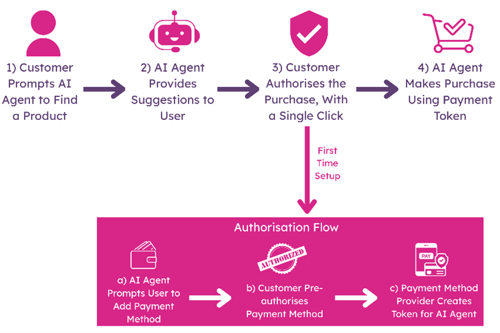
Source: Juniper Research
Pay by Bank to Scale in the UK Via Commercial VRPs (cVRPs)
Late 2025 saw clear signs of intent made by the PSR and FCA, in terms of building the foundations to push this alternative payment option into the mainstream. As such, we predict cVRPs will cement themselves as a practical payment option beyond 2026; thereby fuelling Pay by Bank payment options throughout the UK.
Not only will cVRPs become available on a more widespread basis, but international examples show that recurring payments have an important accelerative effect on A2A payment schemes. Recurring payment features such as Pix Automάtico are enabling A2A payments to scale rapidly, and we anticipate that a similar impact will be seen with cVRPs.
What Is Driving These Shifts?
Taken together, these three trends represent a major shift in payments, towards a more programmable, alternative payments-focused future. However, in a payments market many had traditionally seen as slow moving, what is driving this shift?
Clearly, the payments market is moving faster than it has for some time – many changes outside of these trends are also occurring. Fundamentally, there are several reasons why the payments market is changing quickly:
- AI & the Need for Programmability - With the rise of AI, and agentic AI in particular, traditional payment systems designed for humans are not optimised for AI use. Methods such as payment cards are older, and while they have been redesigned to feature elements such as network tokenisation, they are still designed around usage by humans. As such, the need to optimise payments for AI is a major trend, and is driving transformation.
- Sovereignty of Payment Systems - With international events showing no signs of slowing down, governments around the world are increasingly concerned with reducing their reliance on international and US payment systems by having more direct control over which payment systems are used in country. This means that different countries and bodies are focusing on how they can stimulate local payment system growth, which is boosting alternative payment methods.
- Intense Market Competition - Payments and the broader fintech ecosystem are highly competitive, with many large international fintechs, as well as vibrant startup ecosystems and country-level providers in nearly every country. As such, the payments market is saturated in many ways, so there is intense competition to innovate and create new solutions as a way to differentiate. This is a major force in driving the market forwards.
These are not the only factors driving shifts in payments, but they are major forces; powering many of the trends we have predicted for 2026.
What Will We See Longer Term?
In the longer term, we expect to see a continuation of these trends – more payment innovation, more payment methods launching, and more investment. Critically, this will not directly translate into end user adoption. Indeed, we anticipate that the payments market will consolidate as alternative payment methods mature. Having a key reason why users should adopt a service, rather than innovation for innovation’s sake, will be vital to success.
Nick Maynard is VP of Fintech Market Research at Juniper Research, where he leads analysis on key trends shaping the future of finance. With deep expertise across digital payments and commerce, his recent work includes reports on Instant Payments, eCommerce Payments, and Chargeback Management; helping stakeholders stay ahead in a rapidly evolving market.
Latest research, whitepapers & press releases
-
 ReportApril 2026IoT & Emerging Technology
 Molly GatfordPhysical AI in Manufacturing & Logistics Market: 2026-2030
Our Physical AI in Manufacturing and Logistics research suite provides in-depth analysis of the key economic, operational, and technological factors driving growth in this fast-growing market.
VIEW -
 ReportApril 2026Fintech & Payments
 Nick MaynardAgentic Commerce Market: 2026-2031
Juniper Research’s Agentic Commerce research suite provides an insightful analysis of this rapidly emerging market; enabling stakeholders, including AI developers, payment infrastructure providers, eCommerce marketplaces, merchants and many others, to understand future growth, key trends, and the competitive environment.
VIEW -
 ReportMarch 2026Fintech & Payments
 Michael GreenwoodB2B Payment Cards Market: 2026-2030
Our B2B card payments research suite provides detailed analysis of this rapidly changing market; allowing B2B card providers to gain an understanding of key payment trends and challenges, potential growth opportunities, and the competitive environment.
VIEW -
 ReportMarch 2026Telecoms & Connectivity
 Alex WebbDirect Carrier Billing Market: 2026-2030
Our Direct Carrier Billing research suite for mobile network operators provides detailed analysis and strategic recommendations for the direct carrier billing market over the next four years.
VIEW -
 ReportMarch 2026Fintech & Payments
 Lorien CarterCross-border Payments Market: 2026-2030
Our Cross-border Payments research suite provides a comprehensive and in-depth analysis of the evolving cross-border payments landscape; enabling stakeholders such as businesses, financial institutions, payment service providers, card networks, regulators, and technology infrastructure providers to understand future growth, key trends, and the competitive environment.
VIEW -
 ReportFebruary 2026Telecoms & Connectivity
 Ardit BallhysaMobile Messaging Market: 2026-2030
Juniper Research’s Mobile Messaging research suite provides mobile messaging vendors, mobile network operators, and enterprises with intelligence on how to capitalise on changing market dynamics within the mobile messaging market.
VIEW


-
 WhitepaperApril 2026IoT & Emerging Technology
Molly Gatford
WhitepaperApril 2026IoT & Emerging Technology
Molly GatfordKey Growth Opportunities for Physical AI in 2026
Our complimentary whitepaper, Key Growth Opportunities for Physical AI in 2026, provides insight into the rapidly evolving physical AI in manufacturing and logistics market; highlighting the countries in which high demand for automation in these industries is anticipated over the next five years.
VIEW -
 WhitepaperApril 2026Fintech & Payments
Nick Maynard
WhitepaperApril 2026Fintech & Payments
Nick MaynardAgentic Commerce - Revolution or False Dawn?
Our complimentary whitepaper assesses the trends that are increasing agentic commerce adoption, and challenges to agentic commerce usage. Additionally, it includes a forecast summary of the global spend on agentic commerce by 2030.
VIEW -
 WhitepaperMarch 2026Fintech & Payments
Michael Greenwood
WhitepaperMarch 2026Fintech & Payments
Michael GreenwoodHow B2B Payment Cards Are Streamlining Corporate Expenses
Our complimentary whitepaper, How B2B Payment Cards Are Streamlining Corporate Expenses, examines the state of the B2B payment cards market; considering its impact on different geographies and how it is shaping the modern B2B payments landscape through card controls, payment data analysis tools, and fully integrated spend management solutions.
VIEW -
 WhitepaperMarch 2026Telecoms & Connectivity
Alex Webb
WhitepaperMarch 2026Telecoms & Connectivity
Alex WebbDirect Carrier Billing: Unlocking Emerging Revenue Streams for Operators
Our complimentary whitepaper, Direct Carrier Billing: Unlocking Emerging Revenue Streams for Operators, explores the emerging opportunities for mobile network operators to monetise direct carrier billing.
VIEW -
 WhitepaperMarch 2026Telecoms & Connectivity
Molly Gatford
WhitepaperMarch 2026Telecoms & Connectivity
Molly GatfordMWC 2026: What's Next for Mobile?
Our latest whitepaper distils the most important announcements from MWC Barcelona 2026 and examines what they mean for the telecoms market over the year ahead. From network APIs and 5G monetisation to AI-RAN, direct-to-cell connectivity, and 5G-Advanced, it explains where the biggest opportunities — and challenges — will emerge next.
VIEW -
 WhitepaperMarch 2026Fintech & Payments
Lorien Carter
WhitepaperMarch 2026Fintech & Payments
Lorien CarterThe Transformation of Cross-border Payment Infrastructure
Our complimentary whitepaper, The Transformation of Cross-border Payment Infrastructure, examines the state of the cross-border payments market; explaining the role of key actors in transforming the cross-border payment experience, as well as the current landscape and recent developments within the cross-border payments industry.
VIEW


-
IoT & Emerging Technology
Physical AI Deployments in Manufacturing & Logistics to Reach 400,000 Systems by 2030
April 2026 -
Fintech & Payments
Agentic Commerce Set to Generate $1.5 Trillion Globally by 2030, as Payments Infrastructure Leaders Revealed
April 2026 -
Fintech & Payments
B2B Card Payments to Reach $11 Trillion Globally in 2030, Accelerated by Increased Corporate Use
March 2026 -
Telecoms & Connectivity
Direct Carrier Billing to Grow by $35 Billion Globally Over the Next Four Years, as Anti-fraud Capabilities Are Enhanced by Network APIs
March 2026 -
Fintech & Payments
Sophisticated Microfinance Services Spend to Surpass $22 billion By 2030, as Mobile Money Services in Emerging Markets Mature
March 2026 -
Fintech & Payments
Top Three Global Leaders in Cross-border Payment Infrastructure Revealed
March 2026