What the Arrival of VodafoneThree Means for UK Telecoms

Vodafone UK and Three UK have officially merged, forming a new joint venture: VodafoneThree. The new entity is 51% owned by Vodafone and 49% by CK Hutchison Group Telecom Holdings, and will be fully consolidated into Vodafone’s financial reporting. This marks a key milestone in Vodafone’s ongoing European restructuring; and adds another chapter to a market already shaped by three major mergers over the past 15 years.
What Does This Mean for UK Telecoms?
The launch of VodafoneThree introduces a fresh challenge to the long-standing dominance of EE/BT and Virgin Media O2. But the timing is critical; like many developed markets, the UK is facing growing pressure to accelerate digitalisation against a backdrop of economic uncertainty.
Although commercial 5G has been available since 2019, operators have yet to unlock its full revenue potential, making it harder to sustain profitability. This has placed renewed focus on operational efficiency and cost control.
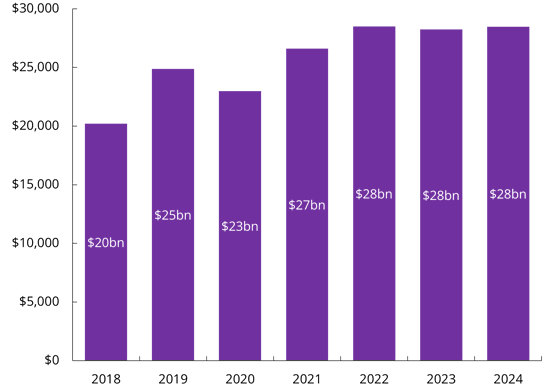
Historical revenue data (taken from our latest research on the subject) is included below, showing a gradual upward trend. However, despite this growth, operators remain heavily focused on reducing the total cost of ownership (TCO) across their networks. Vodafone expects the merger to deliver significant savings, forecasting annual cost reductions of £700 million within five years.
Total Operator-billed Revenue in the UK ($m), 2018-2024
Source: Juniper Research
Juniper Research has identified three key areas where VodafoneThree is likely to achieve cost savings:
- Network Operational Expenditure (OPEX) through Integration: The most significant savings will come from integrating networks—sharing spectrum and base stations will substantially lower ongoing operational costs.
- Network Expansion Costs through Economies of Scale: Combining resources will make it more cost-effective to expand coverage and capacity, reducing capital requirements for future growth.
- Back-Office Efficiencies: Consolidating infrastructure and digital systems will cut costs across support functions and shared services.
Navigating Strategic Differences Post-Merger
Both Vodafone UK and Three UK have long prioritised 5G deployment, and VodafoneThree has reinforced this with a major investment pledge: £11 billion ($14.8 billion) to expand its network footprint, including £1.3 billion ($1.7 billion) earmarked for 2025 alone.
However, despite this shared focus, the two operators entered the merger with notably different market strategies. Vodafone has a broader portfolio and a strong presence in the B2B space, while Three UK has built its brand around competitively priced consumer services. This raises important questions about what the merger means for subscribers.
Juniper Research expects Vodafone’s strategy to lead the direction of the new entity, given its larger size and majority ownership. That said, the competitive pricing that defined Three UK’s consumer offering is likely to remain in place, at least in the near term.
Looking more broadly, the B2B segment cannot be overlooked; it remains one of the fastest-growing revenue streams in telecoms. As such, we anticipate a balanced strategy from VodafoneThree, addressing both consumer and enterprise markets over the next three years.
Vodafone’s recent moves underline this strategic pivot. In addition to its AI and financial services partnership with Microsoft, the company has spun off its IoT division into a standalone business focused on enterprise growth. This development is particularly relevant to the merger, as it signals Vodafone’s long-term ambition in the B2B space; an area where Three UK has had minimal involvement to date.
Vodafone IoT Repositioning as a Connectivity Platform
Vodafone UK’s decision to spin off its IoT business while merging with Three UK highlights a deliberate move to treat the consumer and enterprise segments as distinct priorities. This approach reflects the very different dynamics, demands, and revenue models that define each market.
The consumer mobile market - the primary focus of the merger - is driven by scale, competitive pricing, and brand visibility. It’s a high-volume, low-margin space where success hinges on customer acquisition, retention, and network reliability. Juniper Research views customer experience as one of the most critical factors influencing UK subscriber decisions when choosing a mobile operator.
Yet the rollout of 5G has underscored just how difficult it is to monetise consumer networks. Despite significant investment, operators have struggled to deliver new services that generate meaningful additional revenue from the consumer segment. This has placed growing importance on the enterprise market, where the opportunity to monetise cellular connectivity in new ways is much greater; though it also presents a very different set of challenges.
Unlike the consumer sector, the IoT and enterprise space involves complex, often bespoke deployments; longer sales cycles; higher acquisition costs; and ongoing service and support requirements. By spinning out its IoT business, Vodafone can develop focused strategies tailored to enterprise clients across key sectors such as manufacturing, logistics, healthcare, and smart cities; free from the constraints of the consumer market model.
As VP of Telecoms Market Research at Juniper Research, Sam produces high-quality research on telecommunications technologies and the future of digital content. His recent reports include CPaaS, Direct-to-Cell, and Future Leaders 100: Telco. Sam has been interviewed by leading media outlets, including the BBC and Wall Street Journal, and is a regular contributor to messaging conferences and telecommunications industry events.
Related Research
-
 ReportMay 2025Telecoms & Connectivity
 Fred SavageOperator Revenue Strategies Market, 2025-2029
Discover invaluable insights into trends and strategies for network operator revenue in our latest report, Network Operator Revenue Strategies. With data split across 60 countries, this extensive forecast analyses the dynamic and competitive network operator market and the current market challenges posed by slowing revenue, high market saturation in the consumer market, rising network ownership costs, and challenges in 5G monetisation.
VIEW -
 ReportJune 2025Telecoms & Connectivity
 Alex WebbCellular IoT Market, 2025-2030
Our Cellular IoT research suite provides operators, mobile virtual network operators (MVNOs), and connectivity service providers with extensive analysis and actionable insights into the evolving cellular IoT market.
VIEW
Latest research, whitepapers & press releases
-
 ReportOctober 2026Fintech & Payments
 Michael GreenwoodAccounts Payable Automation Market: 2026-2031
Our Accounts Payable (AP) Automation research suite provides an insightful analysis of this rapidly growing market; enabling stakeholders to understand future growth, key trends and the competitive environment.
VIEW -
 ReportOctober 2026Fintech & Payments
 Jawad JahanCrypto-gaming Market: 2026-2035
Our Crypto-gaming Market research suite provides an insightful analysis of this rapidly growing market; enabling stakeholders - from crypto-gaming and sportsbooks operators, prediction market platforms, business-to-business (B2B) gambling platforms and software providers, to crypto payment processors and regulators - to understand future growth, key trends, and the competitive environment.
VIEW -
 ReportOctober 2026Telecoms & Connectivity
 Alex WebbRetail Roaming Market: 2026-2031
Our Retail Roaming research suite for mobile network operators (MNOs) and mobile virtual network operators (MVNOs) provides detailed analysis and strategic recommendations for the next era of retail roaming.
VIEW -
 ReportSeptember 2026Fintech & Payments
 Dr Manju ChhillarEmbedded Finance Market: 2026-2031
Embedded finance is one of the fastest-growing markets in financial services, and is about to accelerate even further. Our Embedded Finance Market research provides detailed analysis of the key drivers behind this growth, and what these mean for stakeholders in this market.
VIEW -
 ReportSeptember 2026Identity & Security
 Thomas WilsonApplication Security Market: 2026-2031
Our Application Security research suite provides detailed analysis of this emerging market; allowing application security providers to gain an understanding of key security trends and challenges, potential growth opportunities, and the competitive environment.
VIEW -
 ReportSeptember 2026Fintech & Payments
 Shane O'SullivanBanking Fraud Prevention Market: 2026-2031
Our Banking Fraud Prevention research suite provides a comprehensive and in-depth analysis of the types of fraud currently impacting the banking sector, and the evolving methods that can be used to overcome them.
VIEW


-
 WhitepaperOctober 2026Fintech & Payments
Michael Greenwood
WhitepaperOctober 2026Fintech & Payments
Michael GreenwoodAccounts Payable Automation ~ How Businesses Are Reducing Operational Costs
Our complimentary whitepaper, Accounts Payable Automation ~ How Businesses Are Reducing Operational Costs, analyses how AP automation is combatting costs by decreasing the need for manual processes, and provides strategic insight into a number of key trends in the AP automation space.
VIEW -
 WhitepaperOctober 2026Fintech & Payments
Jawad Jahan
WhitepaperOctober 2026Fintech & Payments
Jawad JahanCompliance or Anonymity - The Crypto-gaming Operator’s Dilemma
Our complimentary whitepaper, Compliance or Anonymity - The Crypto-gaming Operator’s Dilemma, analyses the current regulatory landscape of the crypto-gaming market.
VIEW -
 WhitepaperOctober 2026Telecoms & Connectivity
Alex Webb
WhitepaperOctober 2026Telecoms & Connectivity
Alex WebbReimagining the Future of Retail Roaming – How Mobile Network Operators Must Adapt
Our complimentary whitepaper, Reimagining the Future of Retail Roaming – How Mobile Network Operators Must Adapt, explores the emerging opportunities for MNOs within retail roaming.
VIEW -
 WhitepaperSeptember 2026Fintech & Payments
Dr Manju Chhillar
WhitepaperSeptember 2026Fintech & Payments
Dr Manju ChhillarEmerging Markets: The Next Opportunity for Embedded Finance
This free whitepaper examines how a combination of multiple factors is driving North America towards saturation for embedded finance.
VIEW -
 WhitepaperSeptember 2026Emerging Technology
Thomas Wilson
WhitepaperSeptember 2026Emerging Technology
Thomas WilsonVibe Coding: The Fastest-growing Threat to Application Security Today
Our complimentary whitepaper, Vibe Coding: The Fastest-growing Threat to Application Security Today, examines the state of the application security market; considering its impact on different verticals, and how it is being employed in these verticals to best combat malicious attackers and keep sensitive data safe.
VIEW -
 WhitepaperSeptember 2026Fintech & Payments
Shane O'Sullivan
WhitepaperSeptember 2026Fintech & Payments
Shane O'SullivanThe Fraud Frontier: Securing Banking in an AI-driven Era
Our complimentary whitepaper, The Fraud Frontier: Securing Banking in an AI-driven Era, examines the rapidly evolving state of the banking fraud prevention market.
VIEW


-
Fintech & Payments
Accounts Payable Automation to Save Global Businesses 6.2 Billion Hours by 2031, Accelerated by Business System Integration
October 2026 -
Fintech & Payments
The 25th NextGen Payments & RegTech Forum Arrives in Athens, Greece
October 2026 -
Fintech & Payments
Crypto Gaming: Wagers to Reach $1.3 Trillion by 2035, as Crypto Rails Widen Global Access Despite Regulatory Challenges
October 2026 -
Fintech & Payments
Juniper Research Unveils Identity & Security Award Winners for 2026
October 2026 -
Retail Roaming Revenue to Fall $4 Billion By 2031, as Regulatory Restrictions and Competition Bite
October 2026 -
Fintech & Payments
Soft POS to Surpass 100 Million Installations in 2030
September 2026