What It Takes to Lead in Modern Card Issuing: A Conversation with i2c

In our latest Modern Card Issuing Platforms research, we crowned i2c as an Established Leader in this space; on the strength of its unified, highly configurable global platform; its depth of issuing and processing capabilities across credit, debit, and prepaid; and its proven ability to support large-scale, complex deployments without compromising reliability or control.
To mark this recognition, we sat down with Amir Wain, Founder & CEO of i2c, to explore the thinking behind the platform, the challenges facing modern issuers, and how i2c is helping financial institutions and fintechs scale innovation without trade-offs.
 |
i2c is a leading global financial technology provider; enabling financial institutions and fintechs to deliver next-generation banking and payments solutions. Since founding i2c in 2000, Wain has guided the company’s vision to create a flexible, secure, all-in-one platform that empowers clients to launch innovative financial products - ranging from credit, debit, and prepaid to core banking and money movement services - at unprecedented speed and scale. |
What makes i2c an Established Leader among modern card issuing platforms?
For decades, financial institutions have had to compromise - forced to choose between mature, dependable processing platforms that resist change, or modern, flexible platforms that falter under pressure and scale.
i2c was created to end that compromise; giving institutions the power to innovate and evolve without sacrificing stability and trust. That conviction shaped the creation of a single, unified platform engineered to operate globally across products and markets. Instead of layering third-party components or stitching together acquired platforms, we developed a unified foundation of configurable building blocks designed to evolve over time. Financial institutions can launch and expand their business on one consistent platform that continues to perform and adapt to increasing market, regulatory, and customer complexities and demands.
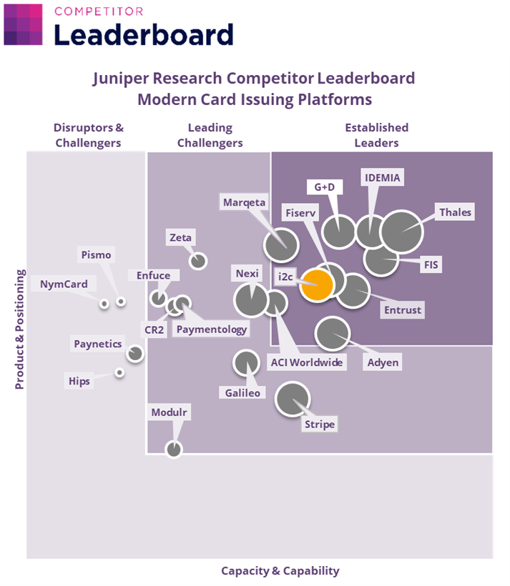
What matters most to financial institutions is trust in execution. They need confidence that issuing, risk, controls, and operations are designed to work together as one system. As a fully integrated platform, i2c empowers them to operate efficiently while maintaining reliability, security, and control at scale.
Equally important to them is control. From consumer and commercial credit to digital-first debit and flexible prepaid programmes, financial institutions can configure exactly what they need - when they need it - without overhauling their infrastructure. They can move at the pace of their customers, while maintaining the resilience required to operate and compete in an ever-evolving industry.
Striking that unique balance between innovation and trust has established i2c as a leader in the industry; enabling financial institutions and fintechs to grow their issuing strategies - without compromise.
What are some of the biggest challenges that your clients face, and how does i2c help solve them?
Financial institutions know how they want to serve their customers - but execution and scale stall when their infrastructure cannot keep up. Product-centric systems slow change, extend timelines, demand constant rework, and make even incremental updates painful. As a result, great ideas die before they reach customers.
The first hurdle is execution. i2c removes execution friction by putting financial institutions in control with self-service tools that let them configure, test, and iterate product development on their terms. The distance from idea to execution shrinks, and their teams move with greater speed and precision.
The next obstacle is scale. i2c’s all-in-one platform and customer-centric (not product-centric) architecture were designed to enable long-term growth across any product, programme, and market. That coordinated scale - where issuing, controls, and risk mitigation advance together - is what enables financial institutions to launch, refine, and grow card programmes without replatforming or creating operational strain as customer expectations, regulations, and market demands evolve in complexity.
With i2c, financial institutions can move at the speed of their ambitions; turning great ideas into scalable realities.
How is i2c aiding its clients in achieving sustainable card issuance strategies?
Sustainability starts with a platform that evolves seamlessly with our clients’ needs. Many institutions spread programmes across multiple systems, products, and regions - introducing complexity and constraining their ability to adapt quickly and cost-effectively to changing market conditions, customer expectations, and regulatory requirements.
Sustainability demands stability. i2c supports any product, segment, and market on a single global platform; creating a consistent and stable operating model across markets. This minimises the risk and technical debt that accumulates across multiple disparate environments by streamlining integration, development, maintenance, and reporting to a single point; reducing an institution’s total cost of ownership to innovate and grow their business without disruption.
Sustainability demands control. i2c’s building block technology enables financial institutions to configure and tailor card programmes and features to market and customer demands. Through self-service applications, they control creation and customisation of any financial use case without rebuilding their infrastructure or languishing in their processor’s development queue.
i2c uses sustainability as a strategic advantage; empowering financial institutions to build the issuing strategies that thrive today and remain resilient for whatever comes next.
What differentiates i2c’s next-generation platform from other processors in the market?
We built i2c to solve a problem that had gone unchallenged for decades: financial institutions were forced to compromise. They could choose reliability or flexibility, stability or speed, global reach or cohesive architecture - but never all at once, never in one platform.
Legacy processors reflected the era in which they were created. Their systems were stable but siloed - designed product by product, region by region. Over time, they expanded through acquisitions and bolt-on technologies; layering third-party systems to keep pace. The result was predictable: fragmentation that slowed innovation, made global expansion costly, and created operational drag just as customer expectations were accelerating.
Meanwhile, a new wave of modern processors offered agility and promise. Their composable, low-code frameworks made iteration faster, at least at the start. But they too relied on third parties for scale and coverage; creating the same patchwork of dependencies as the legacy providers they aimed to replace. Also, their lack of longevity made it difficult for institutions to place long-term trust in them - especially for mission-critical infrastructure where stability is not optional.
Twenty-five years ago, we refused to accept that these trade-offs were inevitable. We asked a simple but provocative question: why can’t financial institutions have both in a processing partner - uncompromising reliability and true flexibility - in one unified platform?
Then we built the answer.
From day one, i2c was architected as a global, integrated, issuer processing platform - customer-centric rather than product-centric; unified rather than stitched together. Instead of assembling a constellation of systems, we created configurable technology building blocks that could support any product, any market, any customer segment; all on a single platform.
That architectural choice changed everything. All products and geographies operate on the same underlying system. Financial institutions integrate once and gain access to a single API framework, a single interface, and a single data model – whether launching in one country or across continents, or offering one product or building an entire portfolio. This consistency gives institutions the ability to scale without reinventing their operating model each time they grow.
The impact is real. We’ve powered fully digital credit launches in Latin America where customers can apply, receive, and begin using a card within minutes. We’ve executed large-scale US migrations under extraordinary time pressure - moving hundreds of thousands of cards in days without service disruption - because issuing, risk, and servicing all operate as one system. Across Asia-Pacific and North America, institutions have launched digital-first prepaid, travel, and small business credit programmes in days rather than months using the same self-service tools, workflows, and global infrastructure. These aren’t isolated successes - they’re the natural outcome of a platform designed to scale seamlessly, consistently, and intelligently.
Ultimately, i2c occupies a truly unique position in the industry as the only nextgeneration processor; proving that legacy reliability and modern flexibility can coexist in one platform to deliver the repeatable model for growth and innovation that financial institutions need - without compromise.
How do you see the card issuing space evolving?
The most important shift is generational. Younger consumers expect digital-first, highly personalised experiences - immediacy, transparency, and control as a baseline.
That expectation is accelerating the move from branch-led scale to infrastructure-led scale. Yesterday, size and physical presence defined success. Today, the platform behind the product is the differentiator - how fast it adapts, how reliably it operates under greater complexity, and how intelligently it manages risk in real time.
As expectations rise, financial products will become more responsive and dynamically configurable. This opens the door for agentic capabilities: systems acting within defined controls to adjust parameters, manage risk, and support customer experiences without waiting for manual intervention.
The institutions that win will invest in flexible, scalable infrastructure - and pair it with intelligent, thoughtful operations. Platforms built for adaptability at their core, like i2c, will be best positioned to enable the next phase of growth and innovation in banking and payments.
Learn more about why i2c was named an Established Leader in modern card issuing, download the report today. You can also connect with Amir on LinkedIn.
Related Research
-
 ReportNovember 2025Modern Card Issuing
 Jawad JahanModern Card Issuing Platforms Market, 2025-2030
Our Modern Card Issuing Platforms Market research suite provides a detailed and insightful analysis of this evolving market; enabling stakeholders from banks, financial institutions, fintech companies, and technology vendors to understand future growth, key trends, and the competitive environment.
VIEW
Latest research, whitepapers & press releases
-
 ReportApril 2026IoT & Emerging Technology
 Molly GatfordPhysical AI in Manufacturing & Logistics Market: 2026-2030
Our Physical AI in Manufacturing and Logistics research suite provides in-depth analysis of the key economic, operational, and technological factors driving growth in this fast-growing market.
VIEW -
 ReportApril 2026Fintech & Payments
 Nick MaynardAgentic Commerce Market: 2026-2031
Juniper Research’s Agentic Commerce research suite provides an insightful analysis of this rapidly emerging market; enabling stakeholders, including AI developers, payment infrastructure providers, eCommerce marketplaces, merchants and many others, to understand future growth, key trends, and the competitive environment.
VIEW -
 ReportMarch 2026Fintech & Payments
 Michael GreenwoodB2B Payment Cards Market: 2026-2030
Our B2B card payments research suite provides detailed analysis of this rapidly changing market; allowing B2B card providers to gain an understanding of key payment trends and challenges, potential growth opportunities, and the competitive environment.
VIEW -
 ReportMarch 2026Telecoms & Connectivity
 Alex WebbDirect Carrier Billing Market: 2026-2030
Our Direct Carrier Billing research suite for mobile network operators provides detailed analysis and strategic recommendations for the direct carrier billing market over the next four years.
VIEW -
 ReportMarch 2026Fintech & Payments
 Lorien CarterCross-border Payments Market: 2026-2030
Our Cross-border Payments research suite provides a comprehensive and in-depth analysis of the evolving cross-border payments landscape; enabling stakeholders such as businesses, financial institutions, payment service providers, card networks, regulators, and technology infrastructure providers to understand future growth, key trends, and the competitive environment.
VIEW -
 ReportFebruary 2026Telecoms & Connectivity
 Ardit BallhysaMobile Messaging Market: 2026-2030
Juniper Research’s Mobile Messaging research suite provides mobile messaging vendors, mobile network operators, and enterprises with intelligence on how to capitalise on changing market dynamics within the mobile messaging market.
VIEW


-
 WhitepaperApril 2026Fintech & Payments
Nick Maynard
WhitepaperApril 2026Fintech & Payments
Nick MaynardAgentic Commerce - Revolution or False Dawn?
Our complimentary whitepaper assesses the trends that are increasing agentic commerce adoption, and challenges to agentic commerce usage. Additionally, it includes a forecast summary of the global spend on agentic commerce by 2030.
VIEW -
 WhitepaperMarch 2026Fintech & Payments
Michael Greenwood
WhitepaperMarch 2026Fintech & Payments
Michael GreenwoodHow B2B Payment Cards Are Streamlining Corporate Expenses
Our complimentary whitepaper, How B2B Payment Cards Are Streamlining Corporate Expenses, examines the state of the B2B payment cards market; considering its impact on different geographies and how it is shaping the modern B2B payments landscape through card controls, payment data analysis tools, and fully integrated spend management solutions.
VIEW -
 WhitepaperMarch 2026Telecoms & Connectivity
Alex Webb
WhitepaperMarch 2026Telecoms & Connectivity
Alex WebbDirect Carrier Billing: Unlocking Emerging Revenue Streams for Operators
Our complimentary whitepaper, Direct Carrier Billing: Unlocking Emerging Revenue Streams for Operators, explores the emerging opportunities for mobile network operators to monetise direct carrier billing.
VIEW -
 WhitepaperMarch 2026Telecoms & Connectivity
Molly Gatford
WhitepaperMarch 2026Telecoms & Connectivity
Molly GatfordMWC 2026: What's Next for Mobile?
Our latest whitepaper distils the most important announcements from MWC Barcelona 2026 and examines what they mean for the telecoms market over the year ahead. From network APIs and 5G monetisation to AI-RAN, direct-to-cell connectivity, and 5G-Advanced, it explains where the biggest opportunities — and challenges — will emerge next.
VIEW -
 WhitepaperMarch 2026Fintech & Payments
Lorien Carter
WhitepaperMarch 2026Fintech & Payments
Lorien CarterThe Transformation of Cross-border Payment Infrastructure
Our complimentary whitepaper, The Transformation of Cross-border Payment Infrastructure, examines the state of the cross-border payments market; explaining the role of key actors in transforming the cross-border payment experience, as well as the current landscape and recent developments within the cross-border payments industry.
VIEW -
 WhitepaperFebruary 2026Telecoms & Connectivity
Ardit Ballhysa
WhitepaperFebruary 2026Telecoms & Connectivity
Ardit BallhysaHow Social Media Will Disrupt Mobile Messaging Channels in 2026
Our complimentary whitepaper, How Social Media Will Disrupt Mobile Messaging Channels in 2026, explores the challenges and opportunities for operators and enterprises as social media traffic continues to increase.
VIEW


-
Fintech & Payments
Agentic Commerce Set to Generate $1.5 Trillion Globally by 2030, as Payments Infrastructure Leaders Revealed
April 2026 -
Fintech & Payments
B2B Card Payments to Reach $11 Trillion Globally in 2030, Accelerated by Increased Corporate Use
March 2026 -
Telecoms & Connectivity
Direct Carrier Billing to Grow by $35 Billion Globally Over the Next Four Years, as Anti-fraud Capabilities Are Enhanced by Network APIs
March 2026 -
Fintech & Payments
Sophisticated Microfinance Services Spend to Surpass $22 billion By 2030, as Mobile Money Services in Emerging Markets Mature
March 2026 -
Fintech & Payments
Top Three Global Leaders in Cross-border Payment Infrastructure Revealed
March 2026 -
Telecoms & Connectivity
MVNO Subscriber Revenue to Exceed $50 Billion Globally in 2030
March 2026