The Iran Ceasefire Might Stabilise the Middle East — But Can the AI Boom Recover?

Tanker traffic through the Strait of Hormuz has effectively ground to a halt, down from an average of 138 vessels per day in peacetime. The impact on oil markets has been immediate and severe; marking the most significant price shock since the 1970s, with further volatility likely as the conflict evolves. Prior to US strikes on Iran on 26 February, oil was trading at $74 per barrel; it has since surged, hitting peaks of $113.
Crude Oil, $ per Barrel (as of 9th April)
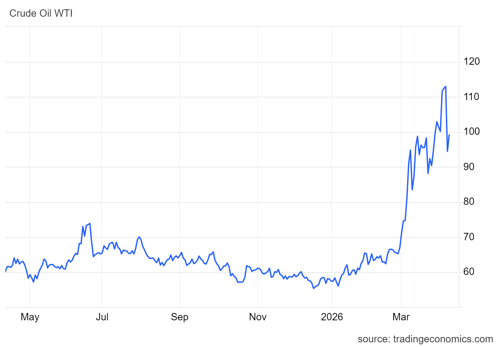
This week’s ceasefire has provided only limited relief. Although prices briefly dipped following the announcement, the truce remains fragile, and shipping through the Strait is still heavily restricted; meaning supply constraints, and elevated prices, are likely to persist in the near term.
This disruption is not confined to oil markets. It feeds directly into the cost and availability of energy inputs that underpin AI infrastructure; particularly natural gas, which remains the primary power source for data centres.
Around 75% of AI data centres run on natural gas as their primary fuel source, as outlined last month by Cleanview. This is because of unavoidable baseline energy demands: local grids cannot provide AI data centres with enough power, and even if they could, connecting to them can take up to five years.
Additionally, solar power and other renewable sources experience fluctuating energy production, while small nuclear reactors are up to a decade away from being realised in a commercial space. The only method deployable today that is capable of generating enough power for AI is natural gas; making it the foundation of the entire AI sector. As a result, any increase in oil prices or limiting of supply represents a material threat to the AI industry — a risk already highlighted by Iran’s attack on Qatar’s Ras Laffan Industrial City, the world’s largest liquefied natural gas facility.
Electricity accounts for around half the expenses of an AI data centre. With the sharp surges in energy prices affecting bottom-line expenses, it will become even harder for AI startups to become profitable. Downstream effects such as increased subscription prices or usage caps might reduce demand for AI subscriptions, as well as causing investors to think twice before supporting the AI industry.
Helium Shortages
At the start of the year, we wrote about the deleterious effects of AI on consumer chip prices. In short, AI hyperscalers were outbidding consumer manufacturers for access to chips; causing prices to soar and smaller AI startups to be locked out of RAM access - now, AI and computer chips are in the headlines again.
Helium is critical to the process of building advanced microchips for AI. A third of all commercial helium is produced in just three helium plants, located in Qatar. The immediate effect of the closing of the Strait of Hormuz is that helium tanks are stuck in Qatar, unable to transit. At the moment, the impact of this on supply is mitigated by the recent 15% surplus of helium compared to global demand. However, if the war continues then these supplies will deplete. Furthermore, as helium is produced from waste products of liquified natural gas (LNG) plants, when these plants have to cease production - when their LNG storage tanks are filled - it will have a knock-on effect on helium production. At worst, this could close a third of helium production; devastating semiconductor manufacturers and, once again, increasing prices.
Threats on AI Data Centres
For the first time ever, commercial data centres have become targets for warfare. Several data centres in the Middle East region have been struck by missiles: Amazon Web Services has had data centres struck in Bahrain and Oracle has had one hit in Dubai. These strikes had the effect of wiping out access to mobile banking services and fintech-based payments for millions in the region.
What’s more, Iran has stated that if the US hits civilian infrastructure such as power plants and water desalination plants, they will retaliate with strikes against the energy and technology infrastructure of US companies - specifically, the Stargate data centre in the UAE, which is jointly owned by OpenAI, SoftBank, and Oracle. This unprecedented move recognises AI infrastructure as a sovereign asset.
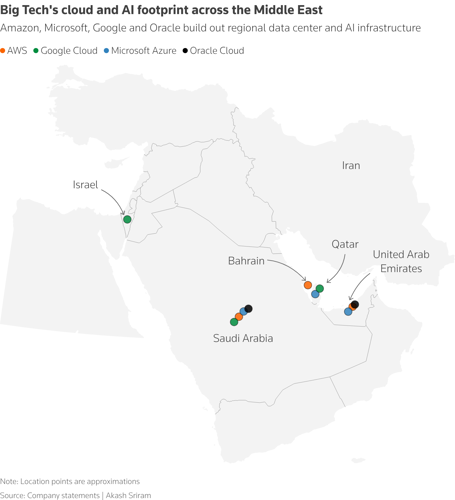
Regardless of how quickly this current war ends, the positioning of data centres as valuable targets will not be forgotten. It costs billions to build one single data centre capable of meeting the requirements needed to power AI, and only seconds to completely wipe it out. This reliance on exposed core infrastructure may cause investors to pull back.
What of the Future?
No matter how quickly the war ends, ongoing shocks to supply will continue. Existing attacks on oil production plants have eliminated production capacity for years to come. For example, attacks on the LNG plant in Ras Laffan has been estimated to wipe out 3.5% of global LNG production for the next three to five years. This will increase energy costs in the long term; impacting AI’s supply chain and operating costs.
One potential long-term effect stems from the geographical divergence in AI growth, which could result in regions such as North America and South Asia racing forward with AI while Europe and the Middle East are held back. Europe is more exposed to oil price shocks than the US - seeing prices rise 40% compared to only 5% in the US - so oil price rises will hit Europe-based AI companies harder. Similarly, the conflict risk to infrastructure may cause Chinese companies such as Alibaba and Huawei to redirect data centre investment away from the Middle East; interrupting the Gulf’s ambition to become an AI frontrunner.
While the US is initially more insulated from oil price rises, the long-term economic impacts of the war may yet put its entire AI industry at risk.
Related Research
-
 ReportApril 2026IoT & Emerging Technology
 Molly GatfordPhysical AI in Manufacturing & Logistics Market, 2026-2030
Our Physical AI in Manufacturing and Logistics research suite provides in-depth analysis of the key economic, operational, and technological factors driving growth in this fast-growing market.
VIEW -
 ReportApril 2026Fintech & Payments
 Nick MaynardAgentic Commerce Market, 2026-2031
Juniper Research’s Agentic Commerce research suite provides an insightful analysis of this rapidly emerging market; enabling stakeholders, including AI developers, payment infrastructure providers, eCommerce marketplaces, merchants and many others, to understand future growth, key trends, and the competitive environment.
VIEW -
 ReportDecember 2025Telecoms & Connectivity
Molly GatfordAI Agents for Customer Experience Platforms Market, 2025-2030
ReportDecember 2025Telecoms & Connectivity
Molly GatfordAI Agents for Customer Experience Platforms Market, 2025-2030Our comprehensive AI Agents for Customer Experience Platforms research suite comprises detailed assessment of a market that is set to disrupt mobile communications. It provides stakeholders with insight into the key opportunities within the AI agents for customer experience platforms market over the next two years.
VIEW
Latest research, whitepapers & press releases
-
 ReportOctober 2026Fintech & Payments
 Jawad JahanCrypto-gaming Market: 2026-2035
Our Crypto-gaming Market research suite provides an insightful analysis of this rapidly growing market; enabling stakeholders - from crypto-gaming and sportsbooks operators, prediction market platforms, business-to-business (B2B) gambling platforms and software providers, to crypto payment processors and regulators - to understand future growth, key trends, and the competitive environment.
VIEW -
 ReportOctober 2026Telecoms & Connectivity
 Alex WebbRetail Roaming Market: 2026-2031
Our Retail Roaming research suite for mobile network operators (MNOs) and mobile virtual network operators (MVNOs) provides detailed analysis and strategic recommendations for the next era of retail roaming.
VIEW -
 ReportSeptember 2026Fintech & Payments
 Dr Manju ChhillarEmbedded Finance Market: 2026-2031
Embedded finance is one of the fastest-growing markets in financial services, and is about to accelerate even further. Our Embedded Finance Market research provides detailed analysis of the key drivers behind this growth, and what these mean for stakeholders in this market.
VIEW -
 ReportSeptember 2026IoT & Emerging Technology
 Thomas WilsonApplication Security Market: 2026-2031
Our Application Security research suite provides detailed analysis of this emerging market; allowing application security providers to gain an understanding of key security trends and challenges, potential growth opportunities, and the competitive environment.
VIEW -
 ReportSeptember 2026Fintech & Payments
 Shane O'SullivanBanking Fraud Prevention Market: 2026-2031
Our Banking Fraud Prevention research suite provides a comprehensive and in-depth analysis of the types of fraud currently impacting the banking sector, and the evolving methods that can be used to overcome them.
VIEW -
 ReportSeptember 2026Telecoms & Connectivity
 Nick MaynardPrivate LTE & 5G Networks Market: 2026-2031
Our Private LTE & 5G Networks research suite provides detailed and insightful analysis of this evolving market; enabling stakeholders - from private LTE & 5G network platform specialists, mobile network operators, and diversified technology companies - to understand future growth, key trends, and the competitive environment.
VIEW


-
 WhitepaperOctober 2026Telecoms & Connectivity
Alex Webb
WhitepaperOctober 2026Telecoms & Connectivity
Alex WebbReimagining the Future of Retail Roaming – How Mobile Network Operators Must Adapt
Our complimentary whitepaper, Reimagining the Future of Retail Roaming – How Mobile Network Operators Must Adapt, explores the emerging opportunities for MNOs within retail roaming.
VIEW -
 WhitepaperSeptember 2026Fintech & Payments
Dr Manju Chhillar
WhitepaperSeptember 2026Fintech & Payments
Dr Manju ChhillarEmerging Markets: The Next Opportunity for Embedded Finance
This free whitepaper examines how a combination of multiple factors is driving North America towards saturation for embedded finance.
VIEW -
 WhitepaperSeptember 2026IoT & Emerging Technology
Thomas Wilson
WhitepaperSeptember 2026IoT & Emerging Technology
Thomas WilsonVibe Coding: The Fastest-growing Threat to Application Security Today
Our complimentary whitepaper, Vibe Coding: The Fastest-growing Threat to Application Security Today, examines the state of the application security market; considering its impact on different verticals, and how it is being employed in these verticals to best combat malicious attackers and keep sensitive data safe.
VIEW -
 WhitepaperSeptember 2026Fintech & Payments
Shane O'Sullivan
WhitepaperSeptember 2026Fintech & Payments
Shane O'SullivanThe Fraud Frontier: Securing Banking in an AI-driven Era
Our complimentary whitepaper, The Fraud Frontier: Securing Banking in an AI-driven Era, examines the rapidly evolving state of the banking fraud prevention market.
VIEW -
 WhitepaperSeptember 2026Telecoms & Connectivity
Nick Maynard
WhitepaperSeptember 2026Telecoms & Connectivity
Nick MaynardHow Private Cellular Networks Are Unlocking Industry 4.0
Our complimentary whitepaper, How Private Cellular Networks Are Unlocking Industry 4.0, examines how private LTE & 5G networks are reshaping the way industry works.
VIEW -
 WhitepaperSeptember 2026Fintech & Payments
 Michael Greenwood
How Omnichannel Payment Platforms Are Streamlining Merchant Operations
Our complimentary whitepaper, How Omnichannel Payment Platforms Are Streamlining Merchant Operations, examines how merchants are utilising omnichannel payment platforms to capitalise on customer data and integration with other business management software in order to minimise inefficiency.
VIEW


-
Fintech & Payments
Juniper Research Unveils Identity & Security Award Winners for 2026
October 2026 -
Retail Roaming Revenue to Fall $4 Billion By 2031, as Regulatory Restrictions and Competition Bite
October 2026 -
Fintech & Payments
Soft POS to Surpass 100 Million Installations in 2030
September 2026 -
Fintech & Payments
The NextGen Payments & RegTech Forum Arrives in Dubai
September 2026 -
Fintech & Payments
The Global Trade Finance Expo Arrives in Dubai, UAE
September 2026 -
Fintech & Payments
The Vision Forex Forum Arrives in Dubai, UAE
September 2026