Stripe Expands Pay by Bank to France & Germany – But Can It Dethrone the Card?

Stripe, a global provider of payments software to businesses, has expanded its offering of account-to-account (A2A) payments to Germany and France through a continued partnership with TrueLayer, an Open Banking platform.
Stripe’s A2A product, called Pay by Bank, uses TrueLayer’s Open Banking infrastructure which connects bank accounts across Europe; enabling merchants to accept transactions directly from a customer’s bank account. This expansion follows the success of Stripe and TrueLayer partnering to offer the same service in the UK in September 2024. There is reason for Stripe to be optimistic about this expansion, with TrueLayer already processing €2 billion ($2.4 billion) of Pay by Bank transactions in France and €1.4 billion ($1.6 billion) in Germany.
Advantages of Pay by Bank
There are several advantages for merchants accepting payments by Pay by Bank over traditional payment methods.
One of the primary advantages is the lower transaction fees, especially when compared to card networks. The cost of card transaction fees is significant to businesses, as it is the most common form of consumer payments in the markets in which Stripe has so far launched Pay by Bank.
Another important advantage for merchants is the lack of chargebacks on Pay by Bank.
Chargebacks, both legitimate and fraudulent, represent a significant cost for many merchants. The large increase in fraudulent chargebacks in recent years has only increased the burden. Even when a fraudulent claim is beaten by a merchant, it takes time. This is a time when the merchant does not have access to the payments; interrupting cashflow which can push businesses to rely on financing, further increasing costs. Chargebacks also require a merchant to allocate resources to fight the chargeback, whether that is staff spending time putting together evidence, or the merchant spending money on a chargeback management platform to undertake this task.
Another benefit of Pay by Bank is its increased security. In the markets Stripe is targeting, there are clear Open Banking regulations, as well as the requirement for strong customer authentication from the Second Payment Services Directive (PSD2). These, together with the fact banks employ their own strong anti-fraud systems, mean that Pay by Bank is relatively resistant to fraud.
These advantages are more attractive to small and medium-sized enterprises (SMEs), as these costs represent a larger proportion of costs for merchants of this size, compared to large enterprises and multinationals who are more able to absorb the additional costs. As Stripe’s primary customer base are SMEs, this makes Pay by Bank a particularly valuable addition to its payments acceptance offering.
Another advantage for merchants is customer satisfaction, given the convenience that Pay by Bank provides. To pay using Pay by Bank online, the consumer simply has to select the Pay by Bank option at checkout and then verify their identity. This is quicker than manually entering payment card details and can be more secure as it can be verified using biometric verification. Likewise, refunded monies can be back in the customer’s bank account within seconds, minimising a too-often significant cause of frustration for consumers.
Juniper Research expects that these advantages will drive an 80% growth in the number of online A2A payments users between 2025 and 2029.
Total Global Online A2A Payment Users (m), 2025 vs. 2029
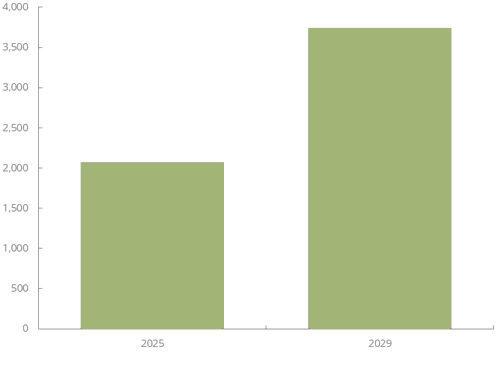
Source: Juniper Research
Challenges of Pay by Bank
Despite these advantages, Pay by Bank is not without its challenges.
The most significant challenge is consumer attitude. Many consumers are simply not aware of Pay by Bank as a payments option. Those who are aware of it may not fully understand what exactly it is or understand the advantages it offers over traditional payment methods. This compounds with consumers’ existing preference for card payments. Consumers are familiar with cards and trust them to be secure. There is also consumer protection in place, in markets such as the UK; ensuring that consumers get their money back if they are a victim of fraud that was not their fault. This makes any security advantages of Pay by Bank less of a concern for consumers.
Another disadvantage of Pay by Bank, compared to credit cards, is its inability to extend lines of credit or offer rewards for its use. This means those who use credit cards are very unlikely to give up these benefits for the additional convenience of using Pay by Bank.
A limitation of the payment method is its reliance on Open Banking regulation to enable it, without needing to partner with the consumer’s bank. Without Open Banking, the process of enabling Pay by Bank is significantly complicated, and banks’ unwillingness to partner to allow this can significantly restrict coverage. This means Pay by Bank is unlikely to gain much traction in any market that does not have Open Banking regulations to support this payment method.
Another challenge is facilitating cross-border transactions using Pay by Bank. Due to Pay by Bank’s reliance on regulations facilitating the payment method, there are markets, such as the US, where merchants are less likely to accept it. Equally, for merchants that have many international customers, a proportion of these customers will not have Pay by Bank supported in their country. This contrasts with the major card networks, where merchants will have customers in nearly every market and facilitate cross-border transactions between them regularly. This is not an issue within the EU, as all countries have the same Open Banking regulation, as do other countries which have signed up for regulatory alignment.
Pay by Bank is gaining traction in markets where the regulatory framework is in place. Partnerships, such as the one between Stripe and TrueLayer, will further boost this payment method, with it becoming easier for merchants to accept these payments. Juniper Research expects that Pay by Bank will continue to grow over the coming years, especially if Pay by Bank providers focus on raising awareness among consumers. However, it will be quite some time before it becomes a true competitor to the major card networks.
As a Senior Research Analyst, Michael delivers in-depth insights into the fast-evolving worlds of digital identity and payments. His recent work spans critical topics such as Digital Wallets, Digital Identity, and Instant Payments; helping industry leaders navigate change and identify new opportunities.
Related Research
-
 ReportSeptember 2025Fintech & Payments
 Thomas WilsonA2A Payments Market, 2025-2030
Our A2A Payments research suite provides detailed analysis of this rapidly changing market; enabling A2A payments service providers to gain an understanding of key payment trends and challenges, potential growth opportunities, and the competitive environment.
VIEW -
 ReportFebruary 2025Open Banking APIs
 Matthew PurnellOpen Banking APIs Market, 2025-2029
Our Global Open Banking APIs research suite provides detailed and perceptive analysis of this evolving market; enabling stakeholders such as Open Banking infrastructure and payment service providers, banks and other financial institutions, and eCommerce platforms and merchants to understand future growth, key trends, and the competitive environment.
VIEW
Latest research, whitepapers & press releases
-
 ReportOctober 2026Fintech & Payments
 Michael GreenwoodAccounts Payable Automation Market: 2026-2031
Our Accounts Payable (AP) Automation research suite provides an insightful analysis of this rapidly growing market; enabling stakeholders to understand future growth, key trends and the competitive environment.
VIEW -
 ReportOctober 2026Fintech & Payments
 Jawad JahanCrypto-gaming Market: 2026-2035
Our Crypto-gaming Market research suite provides an insightful analysis of this rapidly growing market; enabling stakeholders - from crypto-gaming and sportsbooks operators, prediction market platforms, business-to-business (B2B) gambling platforms and software providers, to crypto payment processors and regulators - to understand future growth, key trends, and the competitive environment.
VIEW -
 ReportOctober 2026Telecoms & Connectivity
 Alex WebbRetail Roaming Market: 2026-2031
Our Retail Roaming research suite for mobile network operators (MNOs) and mobile virtual network operators (MVNOs) provides detailed analysis and strategic recommendations for the next era of retail roaming.
VIEW -
 ReportSeptember 2026Fintech & Payments
 Dr Manju ChhillarEmbedded Finance Market: 2026-2031
Embedded finance is one of the fastest-growing markets in financial services, and is about to accelerate even further. Our Embedded Finance Market research provides detailed analysis of the key drivers behind this growth, and what these mean for stakeholders in this market.
VIEW -
 ReportSeptember 2026Identity & Security
 Thomas WilsonApplication Security Market: 2026-2031
Our Application Security research suite provides detailed analysis of this emerging market; allowing application security providers to gain an understanding of key security trends and challenges, potential growth opportunities, and the competitive environment.
VIEW -
 ReportSeptember 2026Fintech & Payments
 Shane O'SullivanBanking Fraud Prevention Market: 2026-2031
Our Banking Fraud Prevention research suite provides a comprehensive and in-depth analysis of the types of fraud currently impacting the banking sector, and the evolving methods that can be used to overcome them.
VIEW


-
 WhitepaperOctober 2026Fintech & Payments
Michael Greenwood
WhitepaperOctober 2026Fintech & Payments
Michael GreenwoodAccounts Payable Automation ~ How Businesses Are Reducing Operational Costs
Our complimentary whitepaper, Accounts Payable Automation ~ How Businesses Are Reducing Operational Costs, analyses how AP automation is combatting costs by decreasing the need for manual processes, and provides strategic insight into a number of key trends in the AP automation space.
VIEW -
 WhitepaperOctober 2026Fintech & Payments
Jawad Jahan
WhitepaperOctober 2026Fintech & Payments
Jawad JahanCompliance or Anonymity - The Crypto-gaming Operator’s Dilemma
Our complimentary whitepaper, Compliance or Anonymity - The Crypto-gaming Operator’s Dilemma, analyses the current regulatory landscape of the crypto-gaming market.
VIEW -
 WhitepaperOctober 2026Telecoms & Connectivity
Alex Webb
WhitepaperOctober 2026Telecoms & Connectivity
Alex WebbReimagining the Future of Retail Roaming – How Mobile Network Operators Must Adapt
Our complimentary whitepaper, Reimagining the Future of Retail Roaming – How Mobile Network Operators Must Adapt, explores the emerging opportunities for MNOs within retail roaming.
VIEW -
 WhitepaperSeptember 2026Fintech & Payments
Dr Manju Chhillar
WhitepaperSeptember 2026Fintech & Payments
Dr Manju ChhillarEmerging Markets: The Next Opportunity for Embedded Finance
This free whitepaper examines how a combination of multiple factors is driving North America towards saturation for embedded finance.
VIEW -
 WhitepaperSeptember 2026Emerging Technology
Thomas Wilson
WhitepaperSeptember 2026Emerging Technology
Thomas WilsonVibe Coding: The Fastest-growing Threat to Application Security Today
Our complimentary whitepaper, Vibe Coding: The Fastest-growing Threat to Application Security Today, examines the state of the application security market; considering its impact on different verticals, and how it is being employed in these verticals to best combat malicious attackers and keep sensitive data safe.
VIEW -
 WhitepaperSeptember 2026Fintech & Payments
Shane O'Sullivan
WhitepaperSeptember 2026Fintech & Payments
Shane O'SullivanThe Fraud Frontier: Securing Banking in an AI-driven Era
Our complimentary whitepaper, The Fraud Frontier: Securing Banking in an AI-driven Era, examines the rapidly evolving state of the banking fraud prevention market.
VIEW


-
Fintech & Payments
26th NextGen Payments & RegTech Forum Arrives in Austin, Texas
October 2026 -
Fintech & Payments
Financial Institutions to Spend Over $66.2 Billion Globally on Fraud Prevention by 2031, Driven by Growing Demand for Cross-industry Fraud Intelligence
October 2026 -
Fintech & Payments
Omnichannel Payment Platforms to See a Dramatic 172% Growth in the Value of Transactions Processed Globally by 2031, as Merchants Capitalise on Payment Data
October 2026 -
Fintech & Payments
Accounts Payable Automation to Save Global Businesses 6.2 Billion Hours by 2031, Accelerated by Business System Integration
October 2026 -
Fintech & Payments
The 25th NextGen Payments & RegTech Forum Arrives in Athens, Greece
October 2026 -
Fintech & Payments
Crypto Gaming: Wagers to Reach $1.3 Trillion by 2035, as Crypto Rails Widen Global Access Despite Regulatory Challenges
October 2026