MCP: Can AI Agents Make Customer Interactions Better?

This year, we have seen a range of global companies adopt the Model Context Protocol (MCP). Just this month, Sinch has also announced that it has implemented MCP for its AI agents. With so many large companies implementing MCP, this is a significant step in the rise of AI agents for automating tasks within customer interactions. But what is MCP, and why is it important?
MCP: Allowing AI Agents to Interact with Data Sources in Real-time
MCP was introduced by Anthropic in November 2024, and the standard solved a major challenge that arises when connecting AI agents to external data sources and tools; it replaces fragmented, proprietary integrations with a single, universal protocol.
Simply, MCP is an open-source standard that enables AI agents (MCP clients) - which are often orchestrated by large language models (LLMs) - to interact with the servers that expose databases, tools, and external systems.
Platforms that provide AI agents for use in customer interactions, such as Gupshup, Infobip, and Sinch, have all implemented MCP. This enables more seamless integration with servers that have also implemented MCP. Notably, Salesforce has introduced MCP-hosted servers, Shopify offers the Shopify.dev storefront MCP server to connect to Shopify store's catalogue, shopping cart, and policies, and Stripe also offers an MCP server for AI agents to interact with the Stripe Application Programming Interface (API).
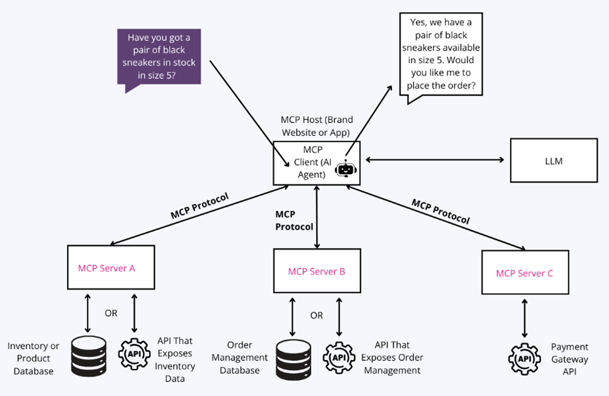
The below figure illustrates how this system operates in practice, in a scenario where a customer requests information on stock with the intention of placing an order and completing payment. It shows how an MCP client might interact with multiple servers and, therefore, how MCP - as a standardised protocol - makes it much easier for connecting with each server.
If proprietary integrations were required each time a business wanted to connect an MCP client to an MCP server, it would take far longer and be much more costly to launch. As a result, Juniper Research anticipates that the implementation of MCP will accelerate the adoption of AI agents.
Customer Interaction with Brand Leveraging AI Agents (MCP Client) & MCP Server
Source: Juniper Research
Impact on AI Agent Adoption
We believe that future growth in business messaging traffic will be attributed to the increased adoption of conversational use cases by large enterprises. With the expectation that an increasing number of customers will prefer messaging a brand rather than calling, enterprises are expected to adopt AI agents to automate a wider range of customer interactions; with conversational commerce, and customer support, being key use cases.
The cost of conversational AI solutions is decreasing for enterprises, with factors such as model compression and the creation of smaller, lightweight models being key. This is resulting in a declining cost with improving technology, which will grow adoption of these solutions; especially with AI agents that can fully automate a greater number of customer interactions.
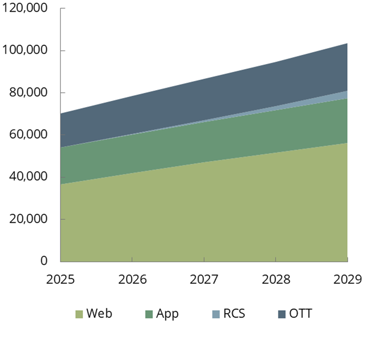
The growth in the number of chatbot interactions, as shown below, will, in part, be attributed to the increased adoption of AI agent solutions by brands. As a result, we believe that AI agents will improve customer sentiment towards chatbots. With increased adoption by brands, there is a greater chance of customers interacting with chatbots in their daily lives.
Total Chatbot Interactions (m), 2025-2029, Split by Channel
Source: Juniper Research
Juniper Research predicts that web-based and app-based chatbot interactions will continue to account for a significant proportion of all chatbot interactions over the next five years. Web-based chatbots have the benefit of being easily accessible to customers, whereas app-based chatbots are important for industries such as banking and healthcare, where a customer typically goes through multi-factor authentication to sign-in to the app, which ensures added security for app-based chatbots handling customer data.
OTT messaging chatbots are expected to experience significant growth over the next five years. One of the reasons for this will be the growth in adoption of WhatsApp for conversational business messaging use cases. This is as WhatsApp has made it free to respond to customers in certain templates; making it more attractive for enterprises to use. Also, the click-to-chat ad feature will be useful for brands to acquire new customers and engage with existing customers, through the placement of these ads in Meta apps. RCS business messaging is not as well-suited to conversational commerce interactions currently, with the entry points being less clear for customer-initiated interactions.
Communications platforms will benefit from the growing demand from enterprises for conversational use cases; as these use cases offer higher margins compared to transactional use cases such as authentication, notifications, and reminders, given the requirement for multiple SaaS components. Therefore, Juniper Research anticipates a growth in the number of communications platforms seeking to offer AI agents, with a priority to ensure these utilise MCP so that they can connect to external databases.
To conclude, MCP is a crucial open-source protocol that is expected to accelerate the adoption of AI agents; thereby expanding the number of tasks that can be automated as part of the end-to-end customer journey.
However, this is not the only factor at play; it will be essential for communications platforms to provide detailed analytics on the performance of AI agents and the number of customer requests they can automate. Doing so will be essential to demonstrating the return on investment of these solutions for brands, as it will only make sense to implement AI agents for use cases where they can save a significant amount of time for human agents, thereby decreasing costs associated with customer interaction.
Molly is a Senior Research Analyst at Juniper Research, providing insight, data, and recommendations for established and future markets within the telecommunications sector. Her recent reports have covered topics including CPaaS, Conversational AI, and RCS Business Messaging.
Related Research
-
 ReportJune 2026Conversational AI
 Peter BoylandConversational AI Market, 2026-2030
Our Conversational AI Market 2026-2030 research suite provides insightful analysis of a market that will experience significant growth in the next five years.
VIEW -
 ReportApril 2025Telecoms & Connectivity
 Sam BarkerCPaaS Market, 2025-2029
Our latest Communications Platform-as-a-Service (CPaaS) research suite comprises a comprehensive analysis of the key factors driving this evolving market over the next 12 months; emphasising how CPaaS platforms must pivot their services as demand for rich media channels and conversational messaging grows.
VIEW -
 ReportApril 2025Telecoms & Connectivity
 Georgia AllenCCaaS Market, 2025-2029
Our Contact Centre-as-a-Service (CCaaS) research suite provides detailed and insightful analysis of a market set for significant change over the next five years. It enables stakeholders from CCaaS vendors to better understand how the CCaaS market will evolve, assessing the extent to which demand for enhanced customer experience and the implementation of generative AI will impact the provision of existing contact centre services.
VIEW
Latest research, whitepapers & press releases
-
 ReportOctober 2026Fintech & Payments
 Jawad JahanCrypto-gaming Market: 2026-2035
Our Crypto-gaming Market research suite provides an insightful analysis of this rapidly growing market; enabling stakeholders - from crypto-gaming and sportsbooks operators, prediction market platforms, business-to-business (B2B) gambling platforms and software providers, to crypto payment processors and regulators - to understand future growth, key trends, and the competitive environment.
VIEW -
 ReportOctober 2026Telecoms & Connectivity
 Alex WebbRetail Roaming Market: 2026-2031
Our Retail Roaming research suite for mobile network operators (MNOs) and mobile virtual network operators (MVNOs) provides detailed analysis and strategic recommendations for the next era of retail roaming.
VIEW -
 ReportSeptember 2026Fintech & Payments
 Dr Manju ChhillarEmbedded Finance Market: 2026-2031
Embedded finance is one of the fastest-growing markets in financial services, and is about to accelerate even further. Our Embedded Finance Market research provides detailed analysis of the key drivers behind this growth, and what these mean for stakeholders in this market.
VIEW -
 ReportSeptember 2026Identity & Security
 Thomas WilsonApplication Security Market: 2026-2031
Our Application Security research suite provides detailed analysis of this emerging market; allowing application security providers to gain an understanding of key security trends and challenges, potential growth opportunities, and the competitive environment.
VIEW -
 ReportSeptember 2026Fintech & Payments
 Shane O'SullivanBanking Fraud Prevention Market: 2026-2031
Our Banking Fraud Prevention research suite provides a comprehensive and in-depth analysis of the types of fraud currently impacting the banking sector, and the evolving methods that can be used to overcome them.
VIEW -
 ReportSeptember 2026Telecoms & Connectivity
 Nick MaynardPrivate LTE & 5G Networks Market: 2026-2031
Our Private LTE & 5G Networks research suite provides detailed and insightful analysis of this evolving market; enabling stakeholders - from private LTE & 5G network platform specialists, mobile network operators, and diversified technology companies - to understand future growth, key trends, and the competitive environment.
VIEW


-
 WhitepaperOctober 2026Fintech & Payments
Jawad Jahan
WhitepaperOctober 2026Fintech & Payments
Jawad JahanCompliance or Anonymity - The Crypto-gaming Operator’s Dilemma
Our complimentary whitepaper, Compliance or Anonymity - The Crypto-gaming Operator’s Dilemma, analyses the current regulatory landscape of the crypto-gaming market.
VIEW -
 WhitepaperOctober 2026Telecoms & Connectivity
Alex Webb
WhitepaperOctober 2026Telecoms & Connectivity
Alex WebbReimagining the Future of Retail Roaming – How Mobile Network Operators Must Adapt
Our complimentary whitepaper, Reimagining the Future of Retail Roaming – How Mobile Network Operators Must Adapt, explores the emerging opportunities for MNOs within retail roaming.
VIEW -
 WhitepaperSeptember 2026Fintech & Payments
Dr Manju Chhillar
WhitepaperSeptember 2026Fintech & Payments
Dr Manju ChhillarEmerging Markets: The Next Opportunity for Embedded Finance
This free whitepaper examines how a combination of multiple factors is driving North America towards saturation for embedded finance.
VIEW -
 WhitepaperSeptember 2026Emerging Technology
Thomas Wilson
WhitepaperSeptember 2026Emerging Technology
Thomas WilsonVibe Coding: The Fastest-growing Threat to Application Security Today
Our complimentary whitepaper, Vibe Coding: The Fastest-growing Threat to Application Security Today, examines the state of the application security market; considering its impact on different verticals, and how it is being employed in these verticals to best combat malicious attackers and keep sensitive data safe.
VIEW -
 WhitepaperSeptember 2026Fintech & Payments
Shane O'Sullivan
WhitepaperSeptember 2026Fintech & Payments
Shane O'SullivanThe Fraud Frontier: Securing Banking in an AI-driven Era
Our complimentary whitepaper, The Fraud Frontier: Securing Banking in an AI-driven Era, examines the rapidly evolving state of the banking fraud prevention market.
VIEW -
 WhitepaperSeptember 2026Telecoms & Connectivity
Nick Maynard
WhitepaperSeptember 2026Telecoms & Connectivity
Nick MaynardHow Private Cellular Networks Are Unlocking Industry 4.0
Our complimentary whitepaper, How Private Cellular Networks Are Unlocking Industry 4.0, examines how private LTE & 5G networks are reshaping the way industry works.
VIEW


-
Fintech & Payments
Crypto Gaming: Wagers to Reach $1.3 Trillion by 2035, as Crypto Rails Widen Global Access Despite Regulatory Challenges
October 2026 -
Fintech & Payments
Juniper Research Unveils Identity & Security Award Winners for 2026
October 2026 -
Retail Roaming Revenue to Fall $4 Billion By 2031, as Regulatory Restrictions and Competition Bite
October 2026 -
Fintech & Payments
Soft POS to Surpass 100 Million Installations in 2030
September 2026 -
Fintech & Payments
The NextGen Payments & RegTech Forum Arrives in Dubai
September 2026 -
Fintech & Payments
The Global Trade Finance Expo Arrives in Dubai, UAE
September 2026