Circle, Fireblocks, SWIFT and the Race to Rewire Cross-border Payments

Wiring money internationally has always been met with the same frustrations, such as multi-day waits, fees that seems to multiply with every bank that touches the transaction, and no clear way to track where your money actually is. In a nutshell, this is the reality of SWIFT - the messaging network that has connected the world’s banks since 1973. The SWIFT network is still used for the vast majority of global cross-border payments, and for decades it was the only real player in town. However, this status quo is now being challenged.
Two companies in particular have made it clear they want to change how money moves across borders. Circle Internet Group - the company behind the stablecoin, USD Coin (USDC), and Fireblocks, a major institutional digital asset platform. In April 2025, Circle launched its Circle Payments Network (CPN), whilst Fireblocks unveiled its own Fireblocks Network for Payments, in September 2025. Both are effectively building what is being described as ‘SWIFT for stablecoins’.
What SWIFT Doesn’t Do
SWIFT does not move money. It moves messages about money. So, when a bank sends a SWIFT payment, it is actually sending an instruction that must pass through a chain of correspondent banks; each reconciling their own accounts before passing the message along. The result is an international wire that can take anywhere from one to five business days and cost anywhere from 1% to 6% in fees, depending on the corridor. The World Bank reported that sending remittances costs an average of 6.49% of the amount sent, as of March 2025.
Average Cost of Sending from Select G20 Countries, as of Q3 2024
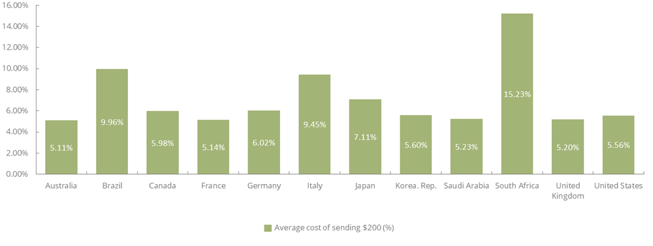
Source: World Bank
In many emerging markets, the drawdowns of traditional rails are pronounced, with correspondent banking relationships being less established and fees generally higher due to lower transaction volumes and weaker regulatory environments. Moreover, general de-risking since the post-2008 wave of anti-money laundering enforcement and bank fines has led to many Western banks cutting correspondent banking relationships in higher-risk regions.
Stablecoins, however, offer a fundamentally different approach. As a cryptocurrency pegged to the value of a traditional currency, such as the US dollar, stablecoins enable peer-to-peer settlement on a blockchain, where the transfer of value and the finality of the transaction happen simultaneously, without the need for intermediary banks. In the world of cryptocurrencies, transactions can settle in the matter of seconds, 24 hours a day, seven days a week, including bank holidays.
Two Networks, One Target
Circle’s CPN is explicitly designed to act as infrastructure for financial institutions to move money across borders using its flagship stablecoin products, such as the USDC or Euro Coin (EURC). With Banco Santander, Deutsche Bank, Société Générale, and Standard Chartered among its launch partners, the network now has 55 enrolled institutions, with a further 74 in the pipeline; generating $5.7 billion in annualised transaction volume. Similarly to SWIFT, CPN does not move funds itself. Instead, it acts as the coordination layer connecting participants and ensuring compliance and AML checks are built into every transaction flow.
On the other hand, Fireblocks is addressing the problem from a slightly different angle. Its payment network, launched in September 2025, connects over 40 providers including liquidity partners, on/off ramps, and stablecoin issuers (including Circle) across more than 100 countries and 60 currencies; handling approximately $200 billion in monthly stablecoin volume. Fireblocks is embedded directly in the movement, custody, and orchestration of assets, where its network sits at the execution layer. Whereas Circle’s CPN is designed to coordinate regulated financial institutions.
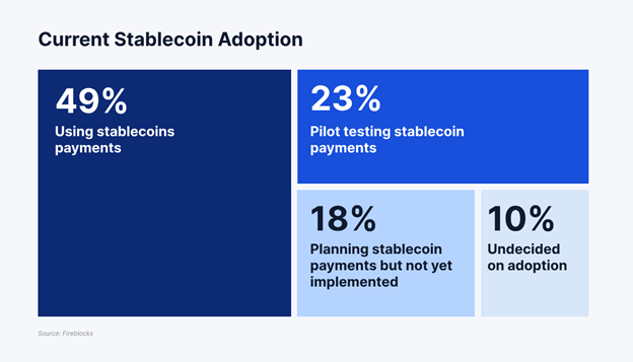
The institutional appetite for this is real. Fireblocks’ own State of Stablecoins 2025 report, based on a survey of over 300 payment providers and banks, found that 90% of financial institutions are either already using stablecoins or actively planning to. Nearly half cited cross-border payments as the primary use case, with speed the top-ranked benefit. In Latin America, this figure rises to 71%.
SWIFT Responds
Stablecoins and distributed ledgers have experienced significant growth and adoption as a tool for settlements over the years, and SWIFT has not stood still. At its annual Sibos conference, in September 2025, SWIFT announced that it was building a blockchain-based shared ledger in collaboration with over 30 global financial institutions, including Bank of America, JP Morgan Chase, HSBC, and BNP Paribas. The collaboration also involves Consensys; a leading blockchain software company focused on building infrastructure, developer tools, and decentralised applications for the Ethereum blockchain.
The ledger being built will use smart contracts to record, validate, and sequence transactions, and is designed to support stablecoins, tokenised deposits, and central bank digital currencies alongside traditional fiat. SWIFT also completed its migration to the ISO 20022 messaging standard, in November 2025, and, in December 2025, successfully completed a proof of concept with HSBC and Ant International for cross-border transfers of tokenised deposits.
Ultimately, the technology argument for stablecoins is largely won. Blockchain settlement is faster and cheaper than the correspondent banking model, and SWIFT knows it. But payments infrastructure is not just a technical problem; it is a trust and network problem. This is where SWIFT carries the competitive advantage. More than 11,000 financial institutions across 200 countries rely on SWIFT’s messaging service to securely communicate. Circle and Fireblocks, however compelling their propositions, are building those relationships from scratch.
Looking Ahead
In this landscape, there won’t be a clean winner, at least not any time soon. What is more likely, however, is a messy period where legacy rails and stablecoin networks run side by side, until the market gradually consolidates around whoever proves most reliable at scale.
SWIFT is not being replaced overnight. When a network has decades of experience and over 11,000 institutions on board, inertia alone buys some years to make up for complacency. However, as demonstrated by companies such as Circle and Fireblocks, moving fast is where SWIFT has been weak. The more interesting proposition is whether SWIFT is able to reinvent itself, or whether its blockchain efforts are ultimately a defensive play amidst the backdrop of rising competition.
Jawad is a Research Analyst at Juniper Research, specialising in financial technology and payments. He provides strategic analysis and actionable insights on the topics he covers, helping stakeholders stay ahead on emerging trends and shifting landscapes.
Latest research, whitepapers & press releases
-
 ReportMarch 2026Telecoms & Connectivity
 Alex WebbDirect Carrier Billing Market: 2026-2030
Our Direct Carrier Billing research suite for mobile network operators provides detailed analysis and strategic recommendations for the direct carrier billing market over the next four years.
VIEW -
 ReportMarch 2026Fintech & Payments
 Lorien CarterCross-border Payments Market: 2026-2030
Our Cross-border Payments research suite provides a comprehensive and in-depth analysis of the evolving cross-border payments landscape; enabling stakeholders such as businesses, financial institutions, payment service providers, card networks, regulators, and technology infrastructure providers to understand future growth, key trends, and the competitive environment.
VIEW -
 ReportFebruary 2026Telecoms & Connectivity
 Ardit BallhysaMobile Messaging Market: 2026-2030
Juniper Research’s Mobile Messaging research suite provides mobile messaging vendors, mobile network operators, and enterprises with intelligence on how to capitalise on changing market dynamics within the mobile messaging market.
VIEW -
 ReportFebruary 2026Fintech & Payments
 Shane O'SullivanKYC/KYB Systems Market: 2026-2030
Our KYC/KYB Systems research suite provides a detailed and insightful analysis of an evolving market; enabling stakeholders such as financial institutions, eCommerce platforms, regulatory agencies and technology vendors to understand future growth, key trends and the competitive environment.
VIEW -
 ReportFebruary 2026Telecoms & Connectivity
 Molly GatfordRCS for Business Market: 2026-2030
Our comprehensive RCS for Business research suite provides an in‑depth evaluation of a market poised for rapid expansion over the next five years. It equips stakeholders with clear insight into the most significant opportunities emerging over the next two years.
VIEW -
 ReportFebruary 2026Fintech & Payments
 Jawad JahanMobile Money in Emerging Markets: 2026-2030
Our Mobile Money in Emerging Markets research report provides detailed evaluation and analysis of the ways in which the mobile financial services space is evolving and developing.
VIEW


-
 WhitepaperMarch 2026Telecoms & Connectivity
Alex Webb
WhitepaperMarch 2026Telecoms & Connectivity
Alex WebbDirect Carrier Billing: Unlocking Emerging Revenue Streams for Operators
Our complimentary whitepaper, Direct Carrier Billing: Unlocking Emerging Revenue Streams for Operators, explores the emerging opportunities for mobile network operators to monetise direct carrier billing.
VIEW -
 WhitepaperMarch 2026Telecoms & Connectivity
Molly Gatford
WhitepaperMarch 2026Telecoms & Connectivity
Molly GatfordMWC 2026: What's Next for Mobile?
Our latest whitepaper distils the most important announcements from MWC Barcelona 2026 and examines what they mean for the telecoms market over the year ahead. From network APIs and 5G monetisation to AI-RAN, direct-to-cell connectivity, and 5G-Advanced, it explains where the biggest opportunities — and challenges — will emerge next.
VIEW -
 WhitepaperMarch 2026Fintech & Payments
Lorien Carter
WhitepaperMarch 2026Fintech & Payments
Lorien CarterThe Transformation of Cross-border Payment Infrastructure
Our complimentary whitepaper, The Transformation of Cross-border Payment Infrastructure, examines the state of the cross-border payments market; explaining the role of key actors in transforming the cross-border payment experience, as well as the current landscape and recent developments within the cross-border payments industry.
VIEW -
 WhitepaperFebruary 2026Telecoms & Connectivity
Ardit Ballhysa
WhitepaperFebruary 2026Telecoms & Connectivity
Ardit BallhysaHow Social Media Will Disrupt Mobile Messaging Channels in 2026
Our complimentary whitepaper, How Social Media Will Disrupt Mobile Messaging Channels in 2026, explores the challenges and opportunities for operators and enterprises as social media traffic continues to increase.
VIEW -
 WhitepaperFebruary 2026Telecoms & Connectivity
 Sam Barker
Protecting Users from Scam Ads: A Call for Social Media Platform Accountability
In this new whitepaper commissioned by Revolut, Juniper Research examines how scam advertising has become embedded across major social media platforms, quantifies the scale of user exposure and financial harm, and explains why current detection and enforcement measures are failing to keep pace.
VIEW -
 WhitepaperFebruary 2026Fintech & Payments
Shane O'Sullivan
WhitepaperFebruary 2026Fintech & Payments
Shane O'SullivanKnow Your Agents (KYA): The Next Frontier in KYC/KYB Systems
Our complimentary whitepaper, Know Your Agents (KYA): The Next Frontier in KYC/KYB Systems, examines the state of the KYC/KYB systems market; considering the impact of regulatory development, emerging risk factors such as identity enabled fraud, and how identity and business verification is evolving beyond traditional customer and merchant onboarding toward agent-level governance.
VIEW


-
Telecoms & Connectivity
Direct Carrier Billing to Grow by $35 Billion Globally Over the Next Four Years, as Anti-fraud Capabilities Are Enhanced by Network APIs
March 2026 -
Fintech & Payments
Sophisticated Microfinance Services Spend to Surpass $22 billion By 2030, as Mobile Money Services in Emerging Markets Mature
March 2026 -
Fintech & Payments
Top Three Global Leaders in Cross-border Payment Infrastructure Revealed
March 2026 -
Telecoms & Connectivity
MVNO Subscriber Revenue to Exceed $50 Billion Globally in 2030
March 2026 -
Fintech & Payments
QUBE Events is excited to bring back the 24th NextGen Payments & RegTech Forum - Switzerland
February 2026 -
Telecoms & Connectivity
OTT Messaging Apps to Exceed 5 Billion Users Globally by 2028; Driving Shift in Enterprise Communication Strategies
February 2026