What Is Driving the Rapid Growth of Financial Services Markets?

As the wider embedded finance market continues to mature, profitable segments are becoming increasingly popular, and relatively younger segments are becoming accepted in the mainstream.
Embedded finance can be split into several different areas, all of which use APIs to enable the integration of financial services into a third-party platform. In this report, five key segments will be explored, which are defined as follows:
- Embedded Payments: This is where payment processing functionalities are embedded into the checkout process, including one-click checkout buttons via digital wallets or account funding via Open Banking for investments.
- Embedded Lending: Here, lending products and/or services are offered through a non-financial institution at the point of sale. This is often referred to as ‘Digital Buy Now, Pay Later.’
- Embedded Investment: This occurs when platforms are enabled to integrate investment products and services into their existing product offering. This is often performed through ‘round-up’ options, where users are given the choice to automatically round up their purchases to build an investment portfolio.
- Embedded Insurance: This is when consumers are offered insurance bundles; bought as part of the purchase process of an item.
- Embedded Banking: This is where banking functions are integrated into the platforms of non-financial organisations. This includes services such as current accounts, savings accounts, and credit and debit cards. This can enable a wide range of non-banking players to offer some banking services via Banking-as-a-Service (BaaS).
About the Infographic
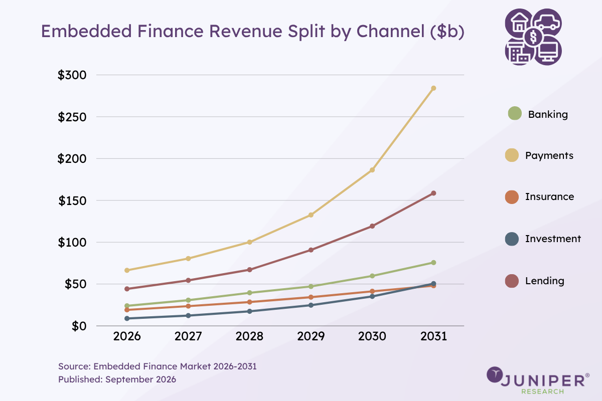
The infographic highlights the projected growth of five embedded financial services sectors - Banking, Payments, Insurance, Investment, and Lending - between 2026 and 2031.
Across every sector, the figures increase year-on-year; indicating sustained growth throughout the five-year period. Payments is consistently the largest segment; increasing from $66.4bn in 2026 to $284.2bn in 2031. Lending is the second-largest category; rising from $44.2bn to $158.6bn over the same period.
Banking also demonstrates strong and steady growth; increasing from $24bn in 2026 to $75.7bn in 2031. Meanwhile, Insurance grows from $19.1bn to $48bn; showing a more gradual upward trajectory.
Although Investment starts as the smallest segment at $8.8bn in 2026, it experiences substantial growth; reaching $50.5bn by 2031. Overall, the figures suggest that Payments and Lending are expected to remain the dominant areas of growth, with Payments showing particularly significant expansion after 2028. The total value across all five sectors rises from approximately $162.5bn in 2026 to $617bn in 2031; representing an increase of around $454.5bn.
The data therefore points towards considerable expansion across the financial services landscape, with Payments accounting for the largest share of the projected growth, while Investment shows the most notable relative increase from its smaller starting base.
Source: Embedded Finance Market: 2026-2031
Read the Press Release: Embedded Finance Revenue to Reach $617 Billion Globally by 2031, as B2B Revenue Surges 390%
Download the Whitepaper: Emerging Markets: The Next Opportunity for Embedded Finance
Get the related whitepaper

Latest research, whitepapers & press releases
-
 ReportOctober 2026Fintech & Payments
 Jawad JahanCrypto-gaming Market: 2026-2035
Our Crypto-gaming Market research suite provides an insightful analysis of this rapidly growing market; enabling stakeholders - from crypto-gaming and sportsbooks operators, prediction market platforms, business-to-business (B2B) gambling platforms and software providers, to crypto payment processors and regulators - to understand future growth, key trends, and the competitive environment.
VIEW -
 ReportOctober 2026Telecoms & Connectivity
 Alex WebbRetail Roaming Market: 2026-2031
Our Retail Roaming research suite for mobile network operators (MNOs) and mobile virtual network operators (MVNOs) provides detailed analysis and strategic recommendations for the next era of retail roaming.
VIEW -
 ReportSeptember 2026Fintech & Payments
 Dr Manju ChhillarEmbedded Finance Market: 2026-2031
Embedded finance is one of the fastest-growing markets in financial services, and is about to accelerate even further. Our Embedded Finance Market research provides detailed analysis of the key drivers behind this growth, and what these mean for stakeholders in this market.
VIEW -
 ReportSeptember 2026IoT & Emerging Technology
 Thomas WilsonApplication Security Market: 2026-2031
Our Application Security research suite provides detailed analysis of this emerging market; allowing application security providers to gain an understanding of key security trends and challenges, potential growth opportunities, and the competitive environment.
VIEW -
 ReportSeptember 2026Fintech & Payments
 Shane O'SullivanBanking Fraud Prevention Market: 2026-2031
Our Banking Fraud Prevention research suite provides a comprehensive and in-depth analysis of the types of fraud currently impacting the banking sector, and the evolving methods that can be used to overcome them.
VIEW -
 ReportSeptember 2026Telecoms & Connectivity
 Nick MaynardPrivate LTE & 5G Networks Market: 2026-2031
Our Private LTE & 5G Networks research suite provides detailed and insightful analysis of this evolving market; enabling stakeholders - from private LTE & 5G network platform specialists, mobile network operators, and diversified technology companies - to understand future growth, key trends, and the competitive environment.
VIEW


-
 WhitepaperOctober 2026Telecoms & Connectivity
Alex Webb
WhitepaperOctober 2026Telecoms & Connectivity
Alex WebbReimagining the Future of Retail Roaming – How Mobile Network Operators Must Adapt
Our complimentary whitepaper, Reimagining the Future of Retail Roaming – How Mobile Network Operators Must Adapt, explores the emerging opportunities for MNOs within retail roaming.
VIEW -
 WhitepaperSeptember 2026Fintech & Payments
Dr Manju Chhillar
WhitepaperSeptember 2026Fintech & Payments
Dr Manju ChhillarEmerging Markets: The Next Opportunity for Embedded Finance
This free whitepaper examines how a combination of multiple factors is driving North America towards saturation for embedded finance.
VIEW -
 WhitepaperSeptember 2026IoT & Emerging Technology
Thomas Wilson
WhitepaperSeptember 2026IoT & Emerging Technology
Thomas WilsonVibe Coding: The Fastest-growing Threat to Application Security Today
Our complimentary whitepaper, Vibe Coding: The Fastest-growing Threat to Application Security Today, examines the state of the application security market; considering its impact on different verticals, and how it is being employed in these verticals to best combat malicious attackers and keep sensitive data safe.
VIEW -
 WhitepaperSeptember 2026Fintech & Payments
Shane O'Sullivan
WhitepaperSeptember 2026Fintech & Payments
Shane O'SullivanThe Fraud Frontier: Securing Banking in an AI-driven Era
Our complimentary whitepaper, The Fraud Frontier: Securing Banking in an AI-driven Era, examines the rapidly evolving state of the banking fraud prevention market.
VIEW -
 WhitepaperSeptember 2026Telecoms & Connectivity
Nick Maynard
WhitepaperSeptember 2026Telecoms & Connectivity
Nick MaynardHow Private Cellular Networks Are Unlocking Industry 4.0
Our complimentary whitepaper, How Private Cellular Networks Are Unlocking Industry 4.0, examines how private LTE & 5G networks are reshaping the way industry works.
VIEW -
 WhitepaperSeptember 2026Fintech & Payments
 Michael Greenwood
How Omnichannel Payment Platforms Are Streamlining Merchant Operations
Our complimentary whitepaper, How Omnichannel Payment Platforms Are Streamlining Merchant Operations, examines how merchants are utilising omnichannel payment platforms to capitalise on customer data and integration with other business management software in order to minimise inefficiency.
VIEW


-
Retail Roaming Revenue to Fall $4 Billion By 2031, as Regulatory Restrictions and Competition Bite
October 2026 -
Fintech & Payments
Soft POS to Surpass 100 Million Installations in 2030
September 2026 -
Fintech & Payments
The NextGen Payments & RegTech Forum Arrives in Dubai
September 2026 -
Fintech & Payments
The Global Trade Finance Expo Arrives in Dubai, UAE
September 2026 -
Fintech & Payments
The Vision Forex Forum Arrives in Dubai, UAE
September 2026 -
Fintech & Payments
Embedded Finance Revenue to Reach $617 Billion Globally by 2031, as B2B Revenue Surges 390%
September 2026